On this page
Key takeaways
A pricing review checks whether your prices still reflect your costs, the value customers get and what alternatives cost. Many small firms go years without one because it is never urgent. A few protected days a year, funded by freed hours, can lift margin faster than winning new customers. Review at least annually and after big cost changes.
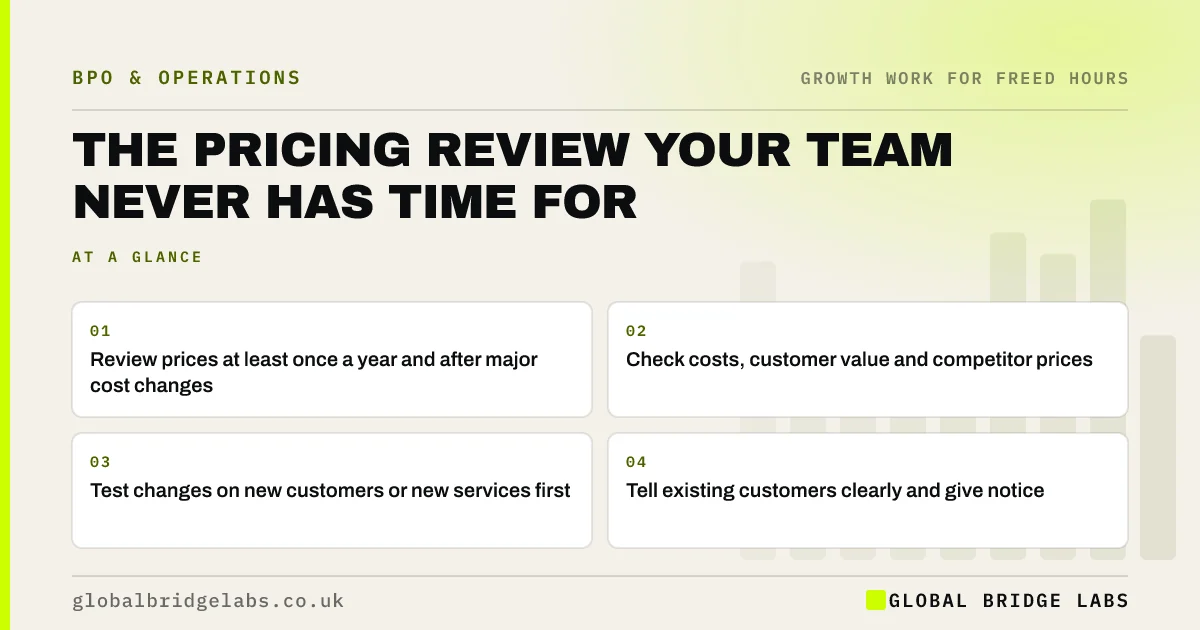
- Review prices at least once a year and after major cost changes.
- Check costs, customer value and competitor prices.
- Test changes on new customers or new services first.
- Tell existing customers clearly and give notice.
Want help planning a pricing review? Message us on WhatsApp.
Chat on WhatsApp →Why do pricing reviews get postponed?
Pricing reviews get postponed because they feel risky and are never urgent. Nobody is waiting for them, and raising prices invites awkward conversations. Meanwhile costs rise: the Office for National Statistics publishes inflation figures that show how quickly input costs can drift away from prices set a few years ago.
How do you run a pricing review?
- Costs: what does each product or service cost to deliver now?
- Value: what results do customers get, and what would they pay elsewhere?
- Market: what do comparable providers charge?
- Mix: which services are underpriced, and which customers are unprofitable?
- Decide: changes, timing and how to communicate them.
What rules apply to price changes?
Check your contracts for notice periods and price change terms. For consumers, prices must be clear and not misleading, and the Competition and Markets Authority's guidance on unfair commercial practices applies. Give customers clear notice and explain changes plainly.
When should you not raise prices?
When service quality is slipping, when a key competitor has just cut prices, or when your customers are under severe pressure. In those cases, fix delivery or adjust packaging rather than headline price.
What does this look like in practice?
A pattern we see: a trades business has not reviewed prices in three years. The director uses two freed days to cost every job type and finds two services priced below cost. Adjusting those, with notice, lifts margin without losing regular customers.
Pricing review checklist
- Cost every product or service.
- Compare against customer value and competitor prices.
- Identify underpriced services and unprofitable customers.
- Check contract notice terms.
- Communicate changes clearly and on time.
Next step
Book two protected half-days this month for a pricing review, and start by costing your five highest-volume services.
Message us on WhatsApp for the pricing review sheet, or book a 30-minute consultation.
Chat on WhatsApp →Sources and further reading
- Inflation and price indices · Office for National Statistics
- Consumer Rights Act 2015 · legislation.gov.uk
- Unfair commercial practices guidance (CMA207) · Competition and Markets Authority
Frequently asked questions
How often should a small business review its prices?
At least once a year, and whenever costs change significantly, such as wage rises, supplier increases or energy costs. Many firms go much longer because the review is never urgent. Putting it in the diary with protected time is the simplest way to make sure it happens.
How do I tell customers about a price increase?
Give clear notice in line with your contracts, explain briefly why prices are changing and what customers continue to get, and keep the message short. Tell your largest customers personally. Most customers accept reasonable, well-explained increases, especially when service has been good.
What should a pricing review include?
Current cost to deliver each product or service, the value customers receive, comparable market prices, which services and customers are profitable, and the contract terms for changing prices. The output is a short list of changes, their timing and how each will be communicated.
Written by

Global Bridge Labs (GBL) is a UK–Sri Lanka partner for social media, websites and BPO. Everything here comes from client delivery, not theory.