On this page
- 01Key takeaways
- 02How did account managers use freed time?
- 03How did operations leads use freed time?
- 04How did owners use freed time?
- 05How did office teams use freed time?
- 06When did freed time not produce growth?
- 07What do these examples show in practice?
- 08Lessons checklist
- 09Next step
- 10Sources and further reading
- 11Frequently asked questions
Key takeaways
These anonymised patterns show how different roles in UK SMEs used hours freed by outsourcing routine work. The common thread is that each person had a named growth goal before the handover. The results varied by business, but the pattern of plan, protect and review was the same.
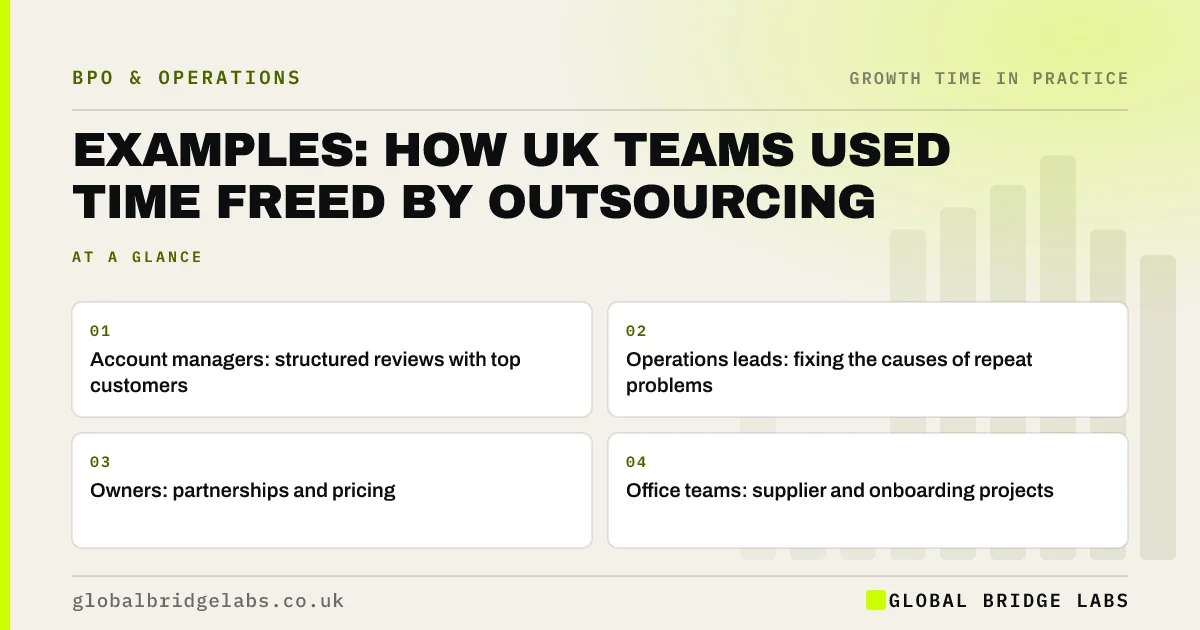
- Account managers: structured reviews with top customers.
- Operations leads: fixing the causes of repeat problems.
- Owners: partnerships and pricing.
- Office teams: supplier and onboarding projects.
Want to find the right use for your team's freed hours? Message us on WhatsApp.
Chat on WhatsApp →How did account managers use freed time?
In a B2B supplier, two account managers each gained about 8 hours a week when order admin moved out. They started quarterly reviews with the top 25 customers, which uncovered at-risk accounts and cross-sell opportunities the business had not seen.
How did operations leads use freed time?
In a logistics office, planners gained half a day a week each when booking updates moved out. They logged delivery exceptions for a month and fixed the main cause at order entry, which reduced repeat problems.
How did owners use freed time?
An IT support owner gained 5 hours a week and built two referral partnerships with accountancy practices. A trades business owner used two freed days for a pricing review that found services priced below cost.
How did office teams use freed time?
In a facilities company, two administrators moved from job sheet processing to reviewing subcontractor performance and renegotiating terms.
When did freed time not produce growth?
Where no goal was set, freed hours went to longer meetings and checking the provider. These firms recovered by setting goals and running a two-week check of where hours went.
What do these examples show in practice?
The examples above are anonymised patterns from client work rather than case studies. Across engagements we have seen 31 hours a week returned to owners and managers; results depend on the goals set and protected.
Lessons checklist
- Set a growth goal before the handover.
- Choose work from growth roles.
- Protect growth blocks from week one.
- Check where hours went.
- Review outcomes at 90 days.
Next step
Pick the example closest to your business and write the equivalent goal for your own team.
Message us on WhatsApp to discuss examples for your sector, or book a 30-minute consultation.
Chat on WhatsApp →Sources and further reading
- Employee earnings in the UK (Annual Survey of Hours and Earnings) · Office for National Statistics
- Business population estimates for the UK and regions 2025 · Department for Business and Trade
Frequently asked questions
What do teams do with time freed by outsourcing?
Common uses are account reviews with top customers, faster lead follow-up, fixing causes of repeat problems, pricing reviews, partnerships and new services. The most successful teams choose a specific goal for the freed hours before the routine work moves out.
How quickly do teams see results from freed time?
Activity changes within the first two months; outcomes such as retained accounts or new partnerships typically show within one or two quarters. Timing depends on the goal and the sales cycle. Revisit the answer each quarter, because team capacity and priorities change as the business grows.
Why do some teams not benefit from freed time?
Usually because no goal was set, so hours filled with meetings and admin, or because work moved from roles that were never going to do growth work. Planning the hours and checking where they go fixes most cases. Over-checking the provider is another common cause; move to sample checks once quality is stable.
Written by

Global Bridge Labs (GBL) is a UK–Sri Lanka partner for social media, websites and BPO. Everything here comes from client delivery, not theory.