On this page
Key takeaways
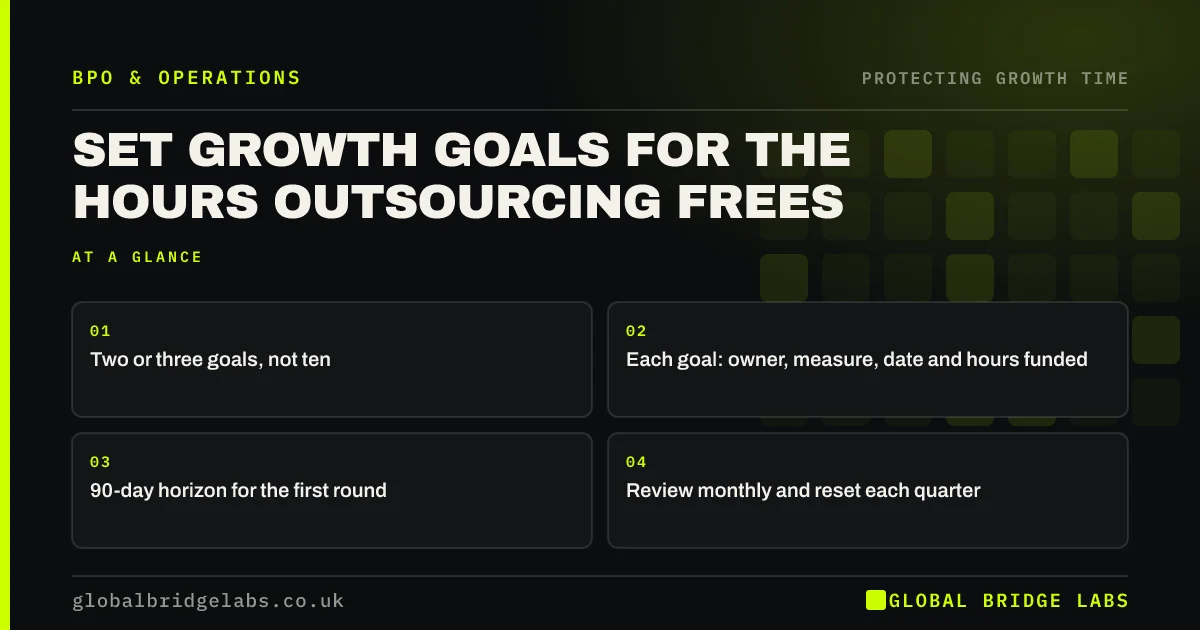
Freed hours need goals, or they disappear. Set two or three growth goals before the outsourcing handover finishes, each with an owner, a measurable result and a 90-day date. Link each goal to the hours that fund it. This gives the team a reason to use the time and gives you a way to judge whether outsourcing paid off.
- Two or three goals, not ten.
- Each goal: owner, measure, date and hours funded.
- 90-day horizon for the first round.
- Review monthly and reset each quarter.
Want help setting growth goals for your freed hours? Message us on WhatsApp.
Chat on WhatsApp →Why do freed hours need goals?
Freed hours need goals because time without a purpose is absorbed by whatever is nearest. A named goal gives people a reason to protect the time, a way to prioritise within it and a result to report. It also turns outsourcing into a decision you can evaluate, not just a cost.
What makes a good growth goal?
For example: complete reviews with our top 20 customers by the end of March, owned by Priya, funded by 6 hours a week.
- Specific: one outcome, such as reviewing the top 20 accounts.
- Measurable: a number or a clear finish line.
- Owned: one named person.
- Timed: a 90-day date for the first round.
- Funded: the weekly hours it receives.
Which goals suit freed hours?
Goals close to revenue work best first: account reviews, faster lead follow-up, a pricing review, a new service pilot or two partnerships. Larger strategic goals can follow once the habit of using growth time is established.
When are goals counterproductive?
When there are too many, when they are imposed without the people doing the work, or when they are measured only by activity. Agree goals with the owners and measure results.
What does this look like in practice?
A pattern we see: a firm frees 24 hours a week and sets three goals: top 20 account reviews, a pricing review and one referral partnership. At 90 days two are complete and the third is reset with a clearer measure.
Growth goal checklist
- Choose two or three goals.
- Name an owner for each.
- Write the measure and date.
- Link each to the hours that fund it.
- Review monthly, reset quarterly.
Next step
Write your three growth goals on one page before the next outsourcing conversation. If a goal has no owner, it is not ready.
Message us on WhatsApp for the growth goal template, or book a 30-minute consultation.
Chat on WhatsApp →Sources and further reading
- Write a business plan · GOV.UK
- Employee earnings in the UK (Annual Survey of Hours and Earnings) · Office for National Statistics
Frequently asked questions
How do you set goals for freed-up time?
Choose two or three outcomes close to revenue, give each a named owner, a measurable result, a 90-day date and the weekly hours that fund it. Agree them with the people doing the work and review progress monthly. Reset them each quarter based on what was achieved.
How many growth goals should a small team have?
Two or three at a time. More than that spreads the freed hours too thinly to finish anything. Once the first goals are achieved, set the next round. Concentrated effort produces results that justify the outsourcing and build confidence in the approach.
Should growth goals be linked to pay?
Usually not at first. Linking new, uncertain goals to pay can encourage safe targets and gaming. Recognise progress publicly and include growth contributions in reviews. Once goals and measures are well understood, some firms add them to bonus schemes. Whatever you choose, explain it clearly so people know how growth work is recognised.
Written by

Global Bridge Labs (GBL) is a UK–Sri Lanka partner for social media, websites and BPO. Everything here comes from client delivery, not theory.