On this page
Key takeaways
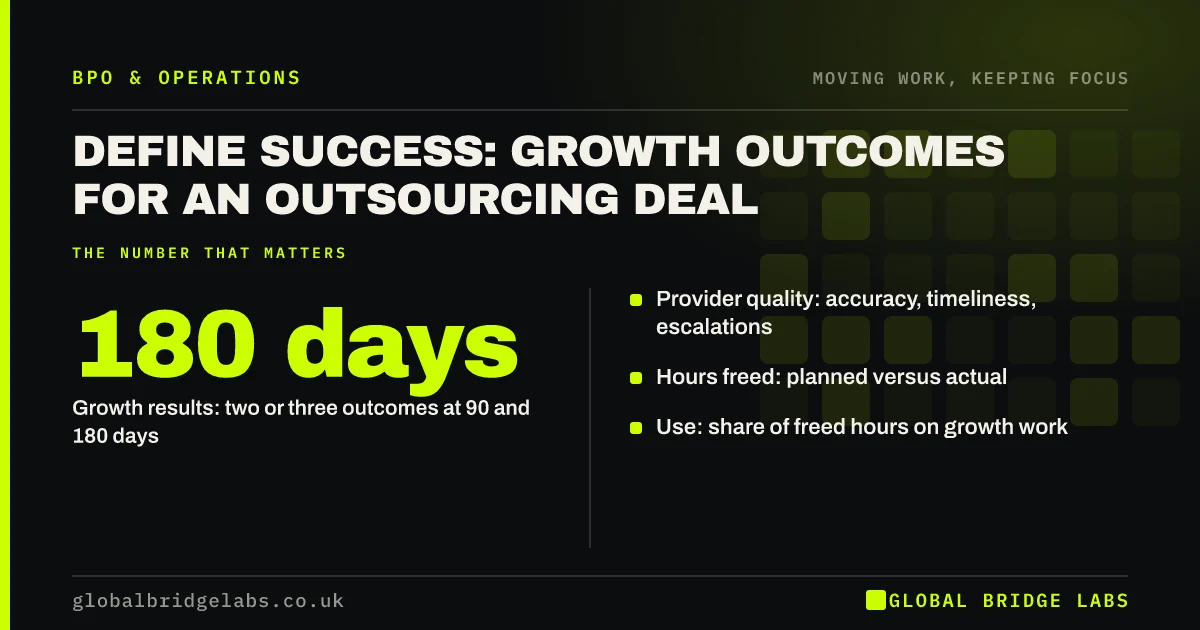
Define success for an outsourcing arrangement before you sign, and include growth outcomes, not only service levels. Good success criteria cover the provider's quality, the hours freed for your team, the share of those hours reaching growth work and two or three growth results by day 90 and day 180. Agree them internally and share the relevant parts with the provider.
- Provider quality: accuracy, timeliness, escalations.
- Hours freed: planned versus actual.
- Use: share of freed hours on growth work.
- Growth results: two or three outcomes at 90 and 180 days.
Want help defining success criteria? Message us on WhatsApp.
Chat on WhatsApp →Why define success before signing?
Because without agreed criteria, outsourcing is judged on feelings: the team feels busy, so it must not be working, or the invoice feels high, so it must be too expensive. Written criteria let you judge fairly at 90 days and make clear decisions about expanding, fixing or stopping. The UK government's Sourcing Playbook makes a similar point about defining outcomes before sourcing.
What should the criteria include?
- Quality: error rate, turnaround and escalations.
- Capacity: hours freed for named people.
- Conversion: share of those hours spent on growth work.
- Outcomes: growth results tied to goals.
- Cost: spend within budget.
Which criteria does the provider own?
The provider owns quality, turnaround and its own capacity. Your team owns how freed hours are used and the growth results. Sharing the growth goals with the provider helps them understand priorities, but the growth outcome is yours.
When are criteria too rigid?
When they ignore learning. If a growth goal turns out to be the wrong one, change it rather than judging the outsourcing as failed. Keep criteria stable for the provider's service, flexible for your growth goals.
What does this look like in practice?
A pattern we see: a firm's only success measure is cost. At six months the invoice is debated monthly. Adding criteria for hours freed and two growth outcomes reframes the review: both outcomes are on track and the debate stops.
Success criteria checklist
- Write quality measures for the provider.
- Record planned hours freed per person.
- Set a conversion target for growth work.
- Choose two or three growth outcomes.
- Review at 90 and 180 days.
Next step
Write your success criteria on one page before your next provider conversation.
Message us on WhatsApp for the success criteria template, or book a 30-minute consultation.
Chat on WhatsApp →Sources and further reading
- The Sourcing and Consultancy Playbooks · Cabinet Office
- Employee earnings in the UK (Annual Survey of Hours and Earnings) · Office for National Statistics
Frequently asked questions
How do you measure outsourcing success?
Measure the provider's quality and timeliness, the hours freed for your team, the share of those hours reaching growth work, growth outcomes against goals and cost against budget. Agree these before signing and review at 90 and 180 days. Agree written instructions, access controls and a data processing contract before any work moves.
What are good outsourcing objectives?
Clear, measurable objectives such as freeing 20 hours a week for named roles, reaching 70% of those hours on growth work by day 90 and completing specific growth goals such as top account reviews. Service quality objectives for the provider sit alongside them.
Should the provider share growth targets?
The provider should know your growth goals so it understands why the work matters, but it cannot be held responsible for how your team uses freed time. Keep provider targets to quality, timeliness and capacity, and own the growth results internally.
Written by

Global Bridge Labs (GBL) is a UK–Sri Lanka partner for social media, websites and BPO. Everything here comes from client delivery, not theory.