On this page
Key takeaways
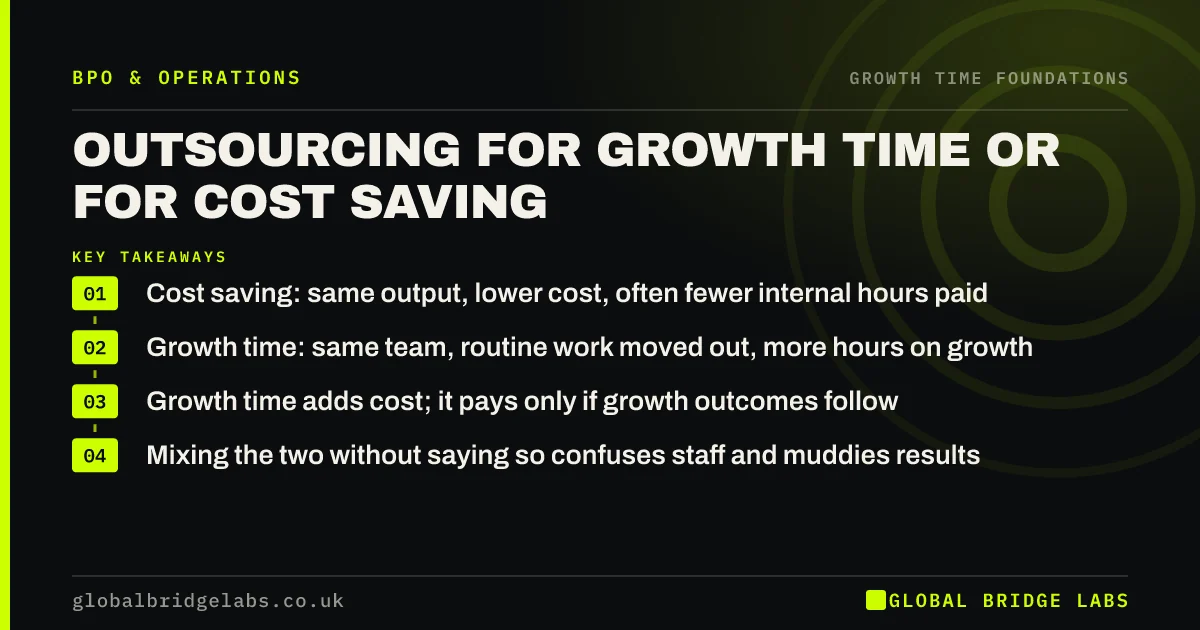
Outsourcing for cost saving reduces what you spend on work that already gets done. Outsourcing for growth time keeps your team and redirects their hours to growth, so total spend often rises. The two goals need different business cases, measures and conversations with staff. Decide which one you are buying before you start.
- Cost saving: same output, lower cost, often fewer internal hours paid for.
- Growth time: same team, routine work moved out, more hours on growth.
- Growth time adds cost; it pays only if growth outcomes follow.
- Mixing the two without saying so confuses staff and muddies results.
Want to work out which goal fits your business? Message us on WhatsApp.
Chat on WhatsApp →What is the difference?
Outsourcing for cost saving aims to do the same work for less money, usually by moving it to a lower-cost provider and reducing internal hours. Outsourcing for growth time aims to keep your people and change what they do, moving routine work out so they can spend more hours on growth. One shrinks a cost; the other buys capacity.
How do the business cases differ?
A cost-saving case compares today's cost of the work with the provider's cost. A growth-time case compares the added cost of outsourcing with the growth those freed hours are expected to produce.
- Cost saving measure: cost per task, total spend.
- Growth time measure: share of hours on growth, growth outcomes.
- Cost saving risk: quality dips while costs fall.
- Growth time risk: hours freed but no growth produced.
Why does the difference matter to staff?
Staff hear outsourcing and assume cost cutting. If your goal is growth time, say so plainly and show them what their new focus will be. If roles are genuinely at risk, that is a cost-saving project and UK redundancy rules apply, including consultation. Acas advises consulting employees early on changes that affect them.
When can one project do both?
When volume is growing. A business adding customers can move routine work out, avoid the next administrative hire and redirect existing staff to growth. Costs grow more slowly than revenue, which is a saving in practice, and the team gains growth time at the same time.
What does this look like in practice?
A pattern we see: an owner presents outsourcing as a cost saving, and the team expects cuts. Reframed as a growth-time project, with each person's new growth goal named in the same meeting, the conversation changes from worry to planning.
Goal clarity checklist
- Write down whether the goal is cost, growth time or both.
- Choose measures that fit the goal.
- Build the business case around those measures.
- Tell staff the goal in plain language.
- Review against the right measures at 90 days.
Next step
Write one sentence: we are outsourcing this work so that our team can... If the sentence ends with a growth goal, this cluster is for you.
Message us on WhatsApp to test your outsourcing goal, or book a 30-minute consultation.
Chat on WhatsApp →Sources and further reading
- Employee earnings in the UK (Annual Survey of Hours and Earnings) · Office for National Statistics
- Redundancy: your rights · GOV.UK
- Consulting employees and their representatives · Acas
Frequently asked questions
Is outsourcing always about saving money?
No. Many firms outsource to buy capacity rather than cut cost: they keep their team, move routine work out and redirect people to growth work. In that case total spend often rises, and the case rests on the growth the freed hours produce rather than on a lower cost per task.
Can outsourcing grow revenue?
Indirectly, yes. Outsourcing itself does not sell anything, but it frees internal hours that can go to account development, new business, new services and partnerships. Revenue grows when those hours are assigned to specific growth goals with owners and protected from new admin.
How do I explain growth-focused outsourcing to staff?
Say what is moving, why, and what each person will do instead, in the same conversation. Be specific: name the growth goal and how their role changes. Make clear whether any roles are at risk; if none are, say so. Vague reassurance tends to increase worry.
Written by

Global Bridge Labs (GBL) is a UK–Sri Lanka partner for social media, websites and BPO. Everything here comes from client delivery, not theory.