On this page
- 01Key takeaways
- 02Why talk to customers for growth?
- 03How do you run a customer conversation?
- 04What do you do with the findings?
- 05When are customer conversations misleading?
- 06What does this look like in practice?
- 07Customer conversation checklist
- 08Next step
- 09Sources and further reading
- 10Frequently asked questions
Key takeaways
Talking to customers is the cheapest growth research a small business can do, and the first thing dropped when the team is busy. Ten structured conversations a quarter show what customers need next, why they chose you and what nearly made them leave. Freed hours from outsourcing are well spent here, because the insight shapes every other growth decision.
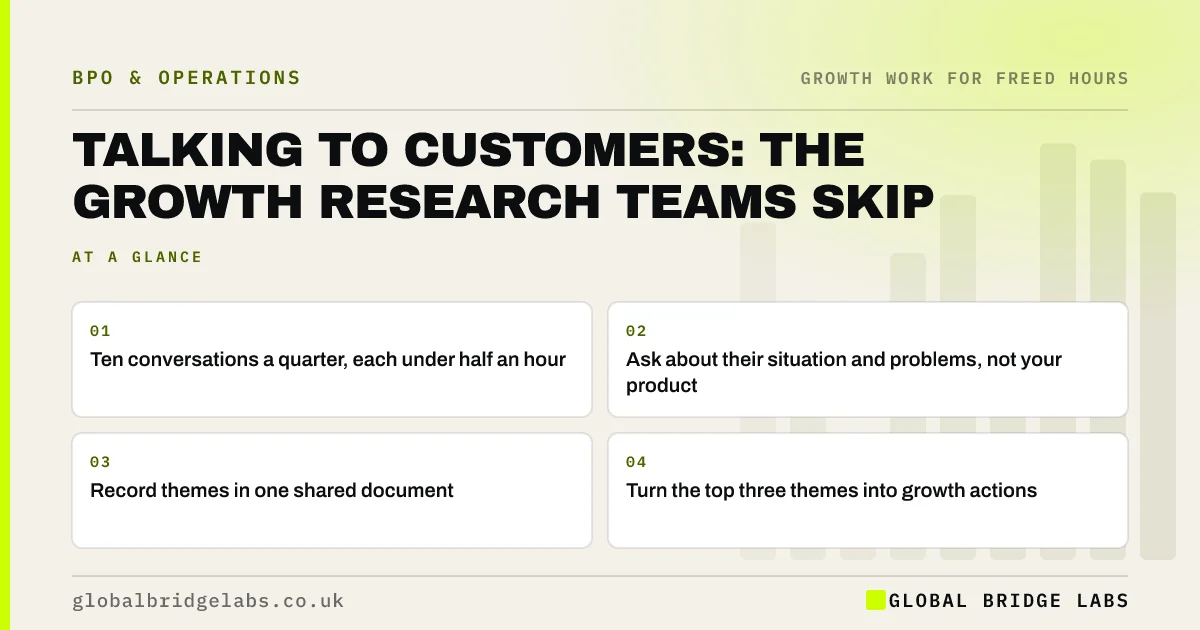
- Ten conversations a quarter, each under half an hour.
- Ask about their situation and problems, not your product.
- Record themes in one shared document.
- Turn the top three themes into growth actions.
Want a customer conversation guide for your team? Message us on WhatsApp.
Chat on WhatsApp →Why talk to customers for growth?
Customer conversations reveal what customers are trying to achieve, what frustrates them and what they would buy next, which no report or survey shows as clearly. Harvard Business Review's work on customers' jobs to be done explains why understanding the job a customer hires you for leads to better offers.
Busy teams speak to customers constantly, but about orders and problems. Growth conversations are different: they are about the customer's situation, not today's transaction.
How do you run a customer conversation?
Store notes securely and only use them for the purpose you explained; UK GDPR requires a lawful basis for processing personal data.
- Invite a mix: loyal, new and recently lapsed customers.
- Keep it to 20 to 30 minutes, by phone or video.
- Ask what they were trying to achieve when they first came to you.
- Ask what else they struggle with and how they handle it now.
- Ask what nearly made them choose someone else.
What do you do with the findings?
Group notes into themes after every five conversations. Pick the top three themes and turn each into an action: a new service, a fix, a change in message or price. Share the themes with the whole team.
When are customer conversations misleading?
When you only speak to happy customers, or when you lead the conversation towards the answer you want. Include lapsed customers, ask open questions and listen more than you talk.
What does this look like in practice?
A pattern we see: a training provider frees its operations lead 4 hours a week. She runs ten customer conversations and discovers that clients struggle to track staff certification renewals. That becomes a new reminder service sold to existing clients.
Customer conversation checklist
- Choose ten customers across loyal, new and lapsed.
- Use a short, open question guide.
- Record notes in one shared place.
- Group themes after every five conversations.
- Turn the top three into actions.
Next step
Invite five customers this week for a 20-minute conversation about their business, not yours.
Message us on WhatsApp for the customer conversation guide, or book a 30-minute consultation.
Chat on WhatsApp →Sources and further reading
- Know your customers' jobs to be done (Christensen and others, 2016) · Harvard Business Review
- Lawful basis for processing personal data · Information Commissioner's Office
Frequently asked questions
How many customers should I interview?
For a small business, ten conversations a quarter is a practical target. Themes usually start repeating after five to eight interviews. Include a mix of loyal, new and recently lapsed customers so you hear more than one view. Revisit the answer each quarter, because team capacity and priorities change as the business grows.
What questions should I ask customers?
Ask what they were trying to achieve when they first came to you, what else they struggle with, how they deal with it now, what nearly made them choose someone else and what would make them recommend you. Avoid leading questions about specific products.
Can customer research be outsourced?
Survey administration, scheduling and transcription can be. The conversations themselves usually produce better insight when run by people who know the business and can follow up on surprising answers. Moving routine work out is usually how teams make time for them.
Written by

Global Bridge Labs (GBL) is a UK–Sri Lanka partner for social media, websites and BPO. Everything here comes from client delivery, not theory.