On this page
Key takeaways
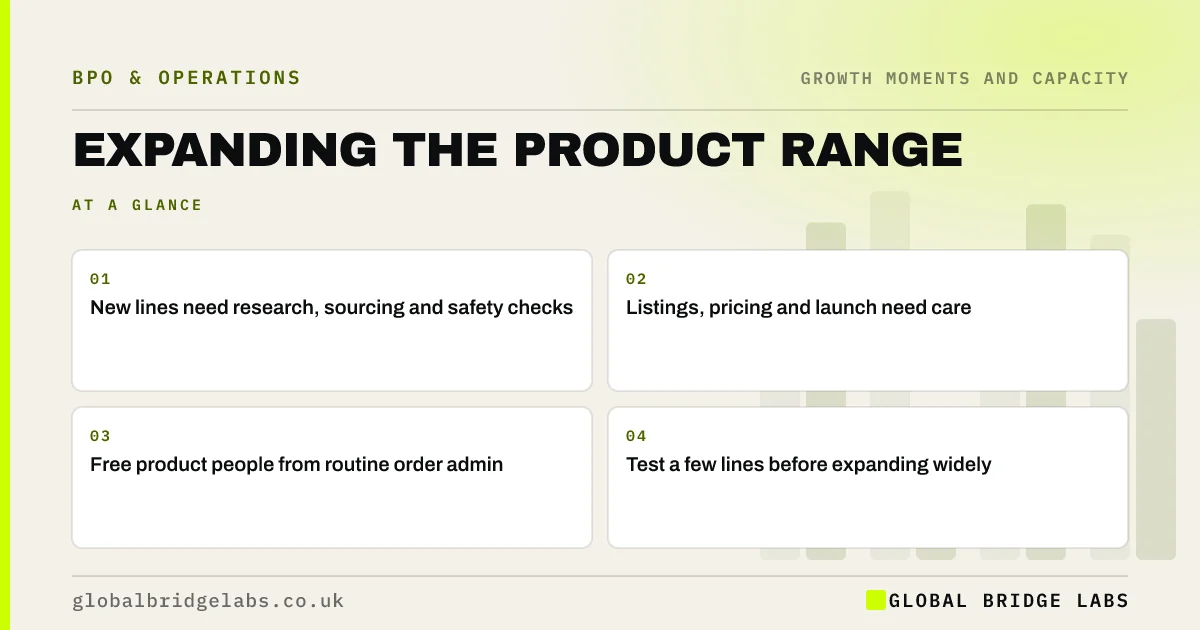
Adding new products is a common growth step, but it takes team time for research, sourcing, safety checks, listings, pricing and launch. Without that time, new lines go live with weak descriptions, poor stock planning and little promotion. Free the people who know your customers from routine order admin first, then expand in small, tested steps.
- New lines need research, sourcing and safety checks.
- Listings, pricing and launch need care.
- Free product people from routine order admin.
- Test a few lines before expanding widely.
Want to plan team time for range expansion? Message us on WhatsApp.
Chat on WhatsApp →Why does range expansion need team time?
Range expansion needs team time because each new product needs customer research, supplier checks, safety and compliance checks, good listings, pricing and a launch plan. The people best placed to do this know your customers, and in small retailers they are usually processing orders and answering queries all day.
What work does a new line need?
The Office for Product Safety and Standards publishes advice for businesses on product safety duties.
- Customer research: what customers ask for.
- Supplier sourcing and samples.
- Product safety and labelling checks.
- Listings, images and pricing.
- Launch promotion and stock planning.
What can move out?
Routine order processing, customer queries, returns admin and listing data entry can move out, freeing product people. Listing creation support can also be outsourced, with your team checking accuracy and claims.
When is expansion a mistake?
When current products have stock or quality problems, when cash cannot cover new stock, or when new lines dilute a clear brand. Test a small number of lines first.
What does this look like in practice?
A pattern we see: a homeware retailer adds new lines every month but most sell poorly. Freeing its buyer from order queries gives her time to research what customers ask for, and the next five lines sell through in half the time.
Range expansion checklist
- Free product people from routine order admin.
- Research what customers ask for.
- Check safety and labelling duties.
- Test a few lines first.
- Review sell-through before expanding.
Next step
List the products customers asked for last quarter that you do not sell. That is your research starting point.
Message us on WhatsApp to plan range expansion time, or book a 30-minute consultation.
Chat on WhatsApp →Sources and further reading
- Product safety advice for businesses · Office for Product Safety and Standards
- Consumer Rights Act 2015 · legislation.gov.uk
Frequently asked questions
How do you expand a product range successfully?
Start from what customers ask for, source and check products carefully, meet safety and labelling duties, create strong listings, price deliberately and launch a few lines at a time. Review sell-through before expanding further. Each step needs time from people who know your customers.
How many new products should a small business add at once?
Fewer than most expect. A handful of well-researched, well-launched lines usually outperform many rushed ones. Test, review sell-through and margin, then expand the lines that work. This also limits stock risk. Stock tied up in slow lines also limits what you can try next.
Can product listing work be outsourced?
Yes. Listing creation, data entry, image formatting and updates can be outsourced with clear templates. Your team should check product claims, safety information and pricing, because responsibility for accuracy stays with your business. A short style guide keeps listings consistent across channels.
Written by

Global Bridge Labs (GBL) is a UK–Sri Lanka partner for social media, websites and BPO. Everything here comes from client delivery, not theory.