On this page
- 01Key takeaways
- 02Why do leadership teams get stuck in operations?
- 03How does outsourcing help?
- 04How do you protect strategy time?
- 05When is more strategy time not the answer?
- 06What does this look like in practice?
- 07Leadership strategy checklist
- 08Next step
- 09Sources and further reading
- 10Frequently asked questions
Key takeaways
Leadership teams in growing SMEs often spend their meetings and weeks on operational detail: who is covering what, why an order was late, which report is wrong. Strategy gets squeezed into an annual away day. Outsourcing routine work below them reduces escalations, and a protected monthly strategy session keeps growth decisions moving.
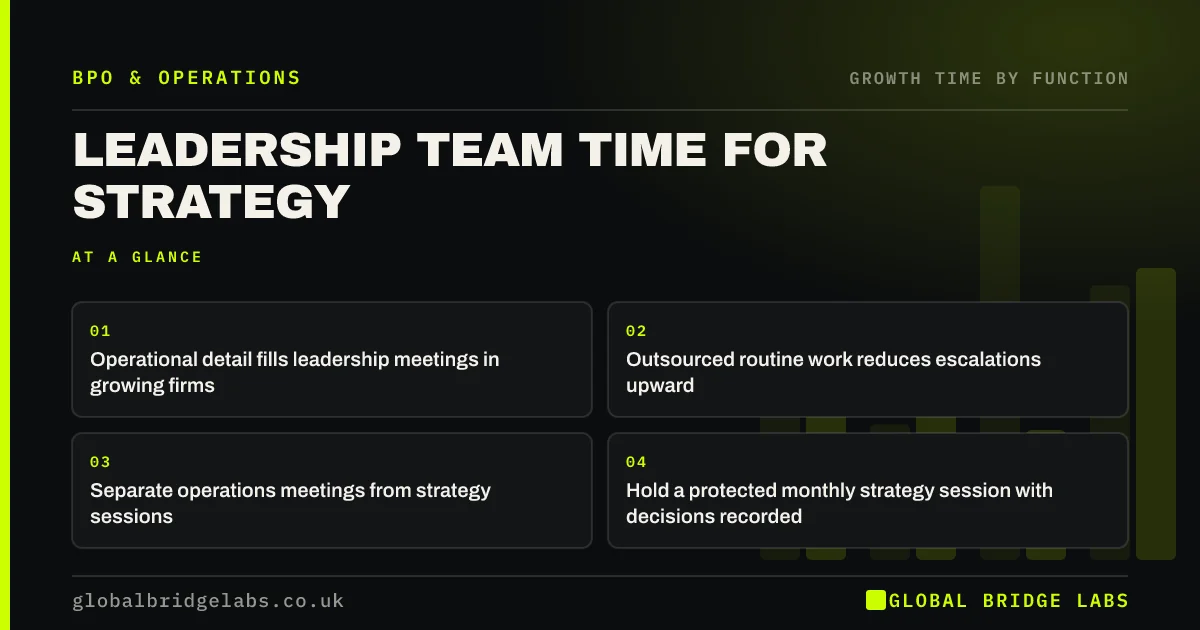
- Operational detail fills leadership meetings in growing firms.
- Outsourced routine work reduces escalations upward.
- Separate operations meetings from strategy sessions.
- Hold a protected monthly strategy session with decisions recorded.
Want to free leadership time for strategy? Message us on WhatsApp.
Chat on WhatsApp →Why do leadership teams get stuck in operations?
Leadership teams get stuck in operations because problems escalate to them when teams below are stretched. If the team has no capacity, every exception becomes a leadership issue. Meetings fill with operational updates, and strategic decisions wait. Directors also keep statutory duties that need attention.
How does outsourcing help?
When routine work moves to a managed team with clear processes, fewer problems escalate. Team leaders have more capacity to handle exceptions themselves. That frees leadership attention for growth decisions.
- Fewer escalations from stretched teams.
- More capable team leaders with time to decide.
- Cleaner reporting from consistent processes.
How do you protect strategy time?
- Separate weekly operations meetings from monthly strategy sessions.
- Set a strategy agenda in advance with two or three decisions.
- Keep operational updates to a written report.
- Record decisions and owners.
- Review the growth backlog quarterly.
When is more strategy time not the answer?
When the leadership team is not aligned on direction, more meetings will not help. Agree the direction first, sometimes with outside facilitation.
What does this look like in practice?
A pattern we see: a five-person leadership team spends its whole weekly meeting on order issues. After outsourcing order processing and moving updates to a written report, it starts a monthly strategy session and makes three overdue growth decisions in the first quarter.
Leadership strategy checklist
- Measure meeting time spent on operations.
- Move routine work below leadership out.
- Separate operations and strategy meetings.
- Set strategy agendas with decisions.
- Record decisions and owners.
Next step
Look at your last three leadership meeting agendas and count items that were operational. If it is most of them, separate the meetings.
Message us on WhatsApp for a leadership strategy session outline, or book a 30-minute consultation.
Chat on WhatsApp →Sources and further reading
- Being a company director · GOV.UK
- Write a business plan · GOV.UK
Frequently asked questions
How do leadership teams make time for strategy?
Reduce escalations by giving teams more capacity, often by outsourcing routine work, separate operational meetings from strategy sessions, use written reports for updates and hold a protected monthly session focused on two or three decisions. Record decisions and owners. Start with one decision per session that has been postponed for too long.
How often should a leadership team discuss strategy?
A monthly session with a clear agenda suits most SMEs, with a deeper review once or twice a year. Weekly meetings are better kept for operations. Mixing the two usually means operational issues crowd strategy out. Keep a running list of strategic questions so each session starts with the most pressing one.
Why does operational work escalate to directors?
Usually because teams below are stretched, processes are unclear or team leaders lack authority to decide. Adding capacity, often by outsourcing routine work, clarifying processes and delegating decisions reduces escalations and frees leadership attention. It also helps to agree which decisions team leaders can take alone.
Written by

Global Bridge Labs (GBL) is a UK–Sri Lanka partner for social media, websites and BPO. Everything here comes from client delivery, not theory.