On this page
Key takeaways
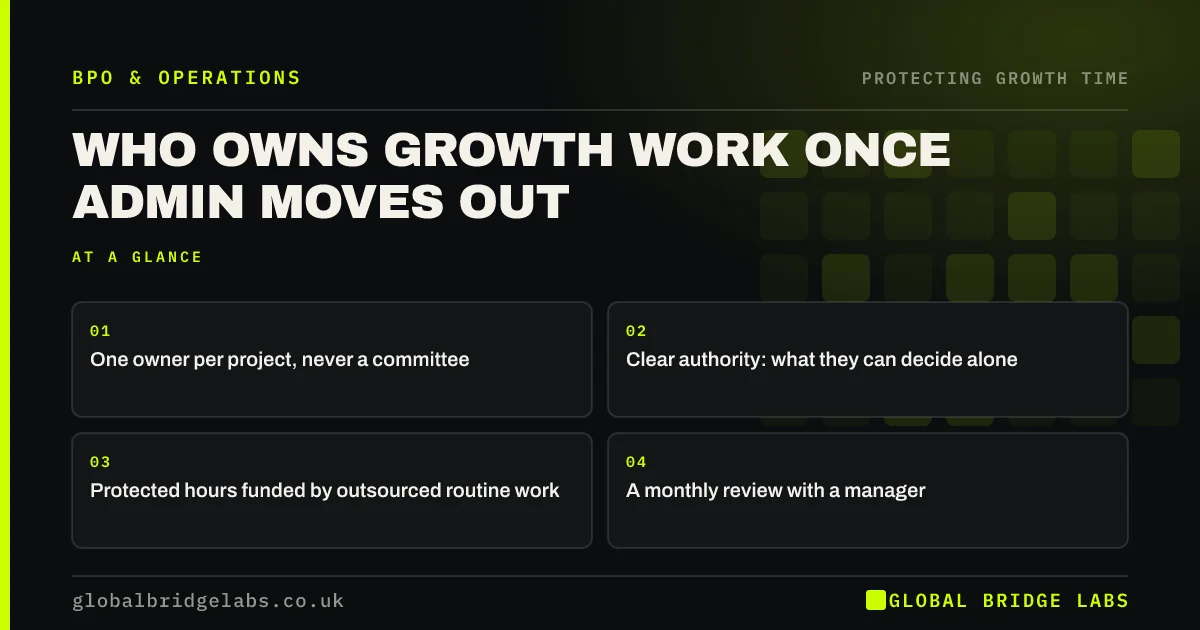
Growth work only happens when someone owns it. Give every growth project one named owner with protected hours, the authority to make day-to-day decisions and a monthly review with a manager. Shared ownership means nobody feels responsible when the week gets busy, and the project quietly stalls.
- One owner per project, never a committee.
- Clear authority: what they can decide alone.
- Protected hours funded by outsourced routine work.
- A monthly review with a manager.
Want help assigning growth work owners? Message us on WhatsApp.
Chat on WhatsApp →Why does growth work need a single owner?
Growth work needs a single owner because it competes with urgent work every day, and only someone who feels personally responsible will protect it. When three people share a project, each assumes another is moving it on. A single owner can still involve others, but there is no doubt about who answers for progress.
What should an owner have?
The Health and Safety Executive's Management Standards include role clarity among factors affecting stress at work; a clear owner and clear authority help.
- Protected weekly hours, written into their diary.
- Authority to make routine decisions without approval.
- A budget, even a small one, if spending is needed.
- Access to the information and people they need.
- A monthly review with a manager.
Who makes a good owner?
Someone close to customers, with some commercial judgement, and with hours freed by outsourcing. It need not be the most senior person; often it is a capable team member who has been stuck on routine work.
When should ownership change?
When the owner leaves, when the project moves to a stage needing different skills, or when progress has stalled for two months despite support. Change it openly and record what has been learnt.
What does this look like in practice?
A pattern we see: a partnership project shared between three directors stalls for a year. Given to one operations manager with 4 protected hours a week, it produces two active referral partners in a quarter.
Ownership checklist
- Name one owner per growth project.
- Write down their authority.
- Protect their hours in the diary.
- Set a monthly review.
- Record progress and blockers.
Next step
List your current growth projects and write one name next to each. Any project with two names, or none, needs a decision this week.
Message us on WhatsApp to assign growth owners, or book a 30-minute consultation.
Chat on WhatsApp →Sources and further reading
- What are the Management Standards for work-related stress? · Health and Safety Executive
- Write a business plan · GOV.UK
Frequently asked questions
Who should be responsible for business growth?
Overall growth direction belongs to the owner or leadership team. Individual growth projects should each have one named owner with protected time, clear authority and a regular review. Spreading responsibility across many people usually means growth work stalls when everyone is busy.
Can a junior person own a growth project?
Yes, if the project fits their skills and they have support. Many capable junior staff have been stuck on routine work. Giving them a well-defined growth project, protected hours and a monthly review is a good development opportunity and often brings fresh energy.
How do you hold someone accountable for growth work?
Agree a clear outcome, measure and date at the start, review progress monthly, and focus on blockers rather than blame. Accountability works best when the owner has real authority and protected time; holding someone accountable without those is unfair and usually fails.
Written by

Global Bridge Labs (GBL) is a UK–Sri Lanka partner for social media, websites and BPO. Everything here comes from client delivery, not theory.