On this page
- 01Key takeaways
- 02Is 10% innovation time realistic for a small team?
- 03How do you make innovation time productive?
- 04Can innovation qualify for tax relief?
- 05When is innovation time a mistake?
- 06What does this look like in practice?
- 07Innovation time checklist
- 08Next step
- 09Sources and further reading
- 10Frequently asked questions
Key takeaways
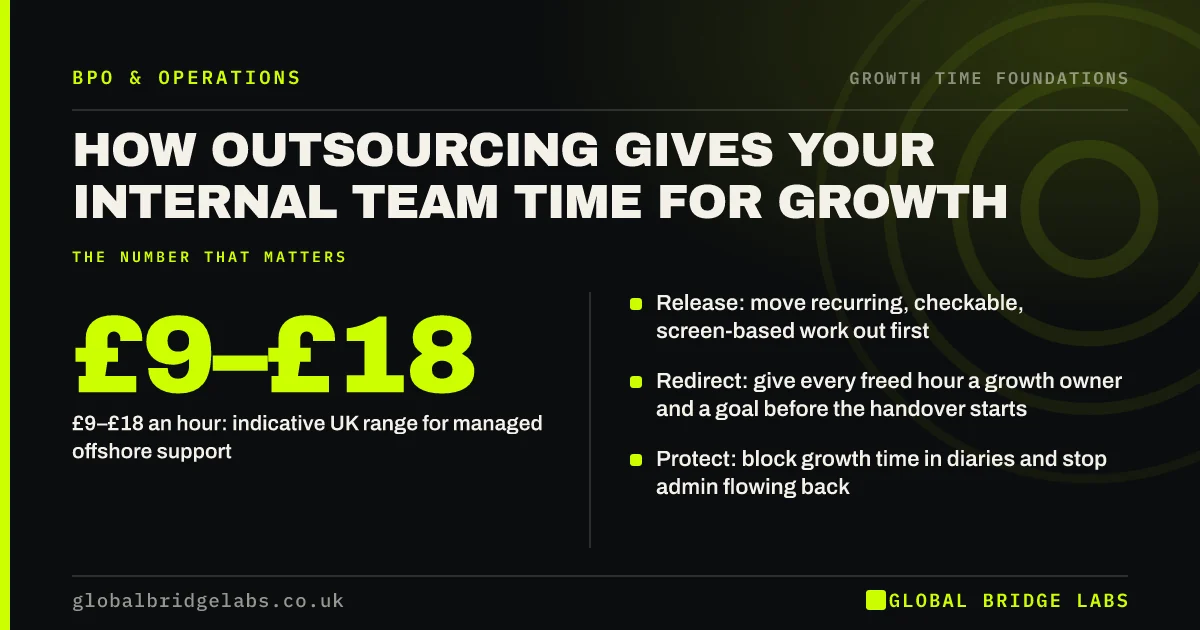
Protected innovation time, often set at about 10% of the week, works in small teams only when it is focused on a specific business problem and reviewed regularly. Without focus it becomes free time; without protection it disappears. Outsourcing routine work is a practical way to fund it without extending working hours.
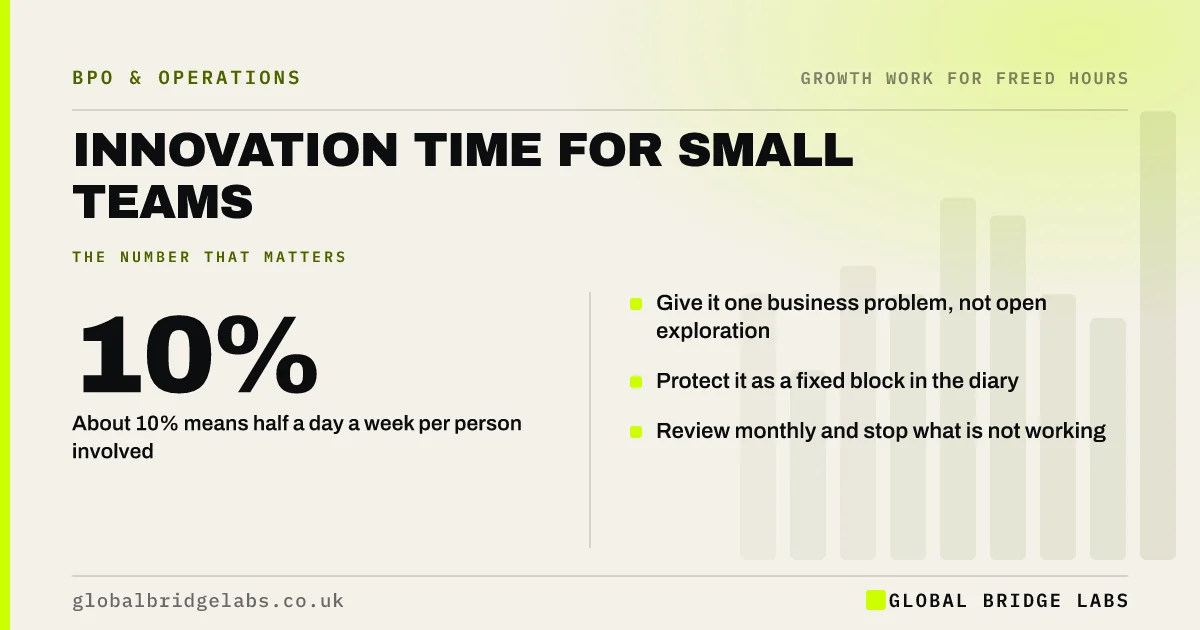
- About 10% means half a day a week per person involved.
- Give it one business problem, not open exploration.
- Protect it as a fixed block in the diary.
- Review monthly and stop what is not working.
Want to plan innovation time for your team? Message us on WhatsApp.
Chat on WhatsApp →Is 10% innovation time realistic for a small team?
It is realistic for the people whose ideas matter most, not for everyone at once. Half a day a week for two or three key people is achievable if routine work moves out to make room. Spreading 10% across the whole team often produces scattered effort with nothing finished.
Innovation time here means protected hours to improve how the business serves customers: new services, better processes or new ways to reach customers.
How do you make innovation time productive?
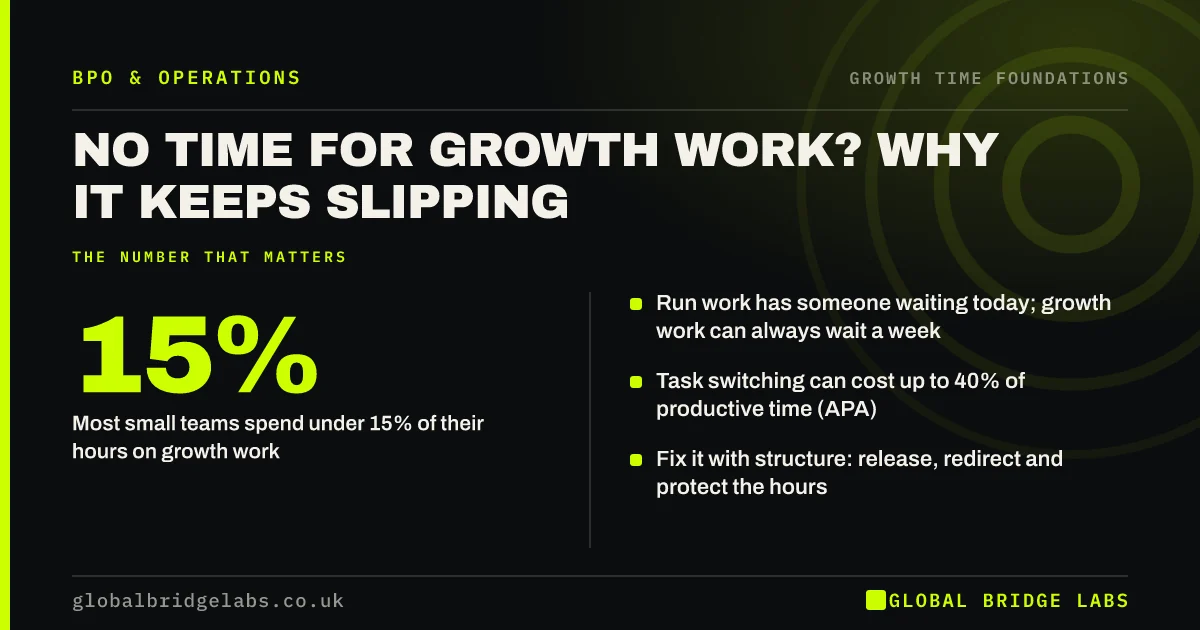
Batching matters: the American Psychological Association notes that switching between tasks can cost as much as 40% of productive time, so a single half-day block beats scattered hours.
- Choose one business problem per quarter.
- Book the time as a fixed weekly block.
- Work in short cycles: test an idea in two to four weeks.
- Share what you learnt monthly, including failures.
- Stop ideas that do not show promise after one cycle.
Can innovation qualify for tax relief?
Some can. HMRC's research and development relief guidance explains when work to resolve scientific or technological uncertainty qualifies. Most service and process improvement in small firms will not, but software or technical development sometimes does. Take advice before claiming.
When is innovation time a mistake?
When the core business is struggling with delivery or cash, innovation time distracts. Fix the basics first. It is also a mistake when nobody reviews the output; unreviewed time drifts.
What does this look like in practice?
A pattern we see: a small logistics firm frees two planners half a day a week by outsourcing booking admin. They spend one quarter on a single problem, failed first-time deliveries, and test a new pre-delivery text routine that cuts repeat visits.
Innovation time checklist
- Pick two or three people and one problem.
- Book a fixed half-day block weekly.
- Test ideas in two to four week cycles.
- Share learning monthly.
- Stop ideas that do not show promise.
Next step
Choose the one problem that costs your customers or your team the most, and give it half a day a week for one quarter.
Message us on WhatsApp to plan protected innovation time, or book a 30-minute consultation.
Chat on WhatsApp →Sources and further reading
- Corporation Tax: research and development (R&D) relief · HM Revenue & Customs
- Multitasking: switching costs · American Psychological Association
Frequently asked questions
What is 10 percent innovation time?
It is the practice of giving people about a tenth of their working week, roughly half a day, to work on improvements or new ideas outside their routine tasks. In small firms it works best when focused on one business problem, protected in the diary and reviewed monthly.
How do small businesses make time for innovation?
By moving routine work out of the diaries of the people with the best ideas, booking fixed innovation blocks, focusing on one problem at a time and reviewing results regularly. Without protected time, innovation work is always the first thing pushed aside by urgent tasks.
Should innovation be outsourced?
Specialist pieces such as design, prototyping or technical development can be bought in. Understanding customers and choosing what to build usually works best inside the business. Many firms outsource the routine work instead, so their own people have time for the innovation.
Written by

Global Bridge Labs (GBL) is a UK–Sri Lanka partner for social media, websites and BPO. Everything here comes from client delivery, not theory.