On this page
Key takeaways
A team growth time audit measures how many hours each person spends on growth work versus routine run work over a normal week. It shows who carries the routine load, which growth roles are being diluted, and where outsourcing would release the most valuable capacity. One week of rough tagging is usually enough.
- Tag one normal week in half-hour blocks: run, grow or manage.
- Total by person and by role, not just for the team.
- Look for growth roles spending over half their week on run work.
- Repeat after outsourcing to see whether growth hours actually rose.
Want a growth time audit run with your team? Message us on WhatsApp.
Chat on WhatsApp →What is a team growth time audit?
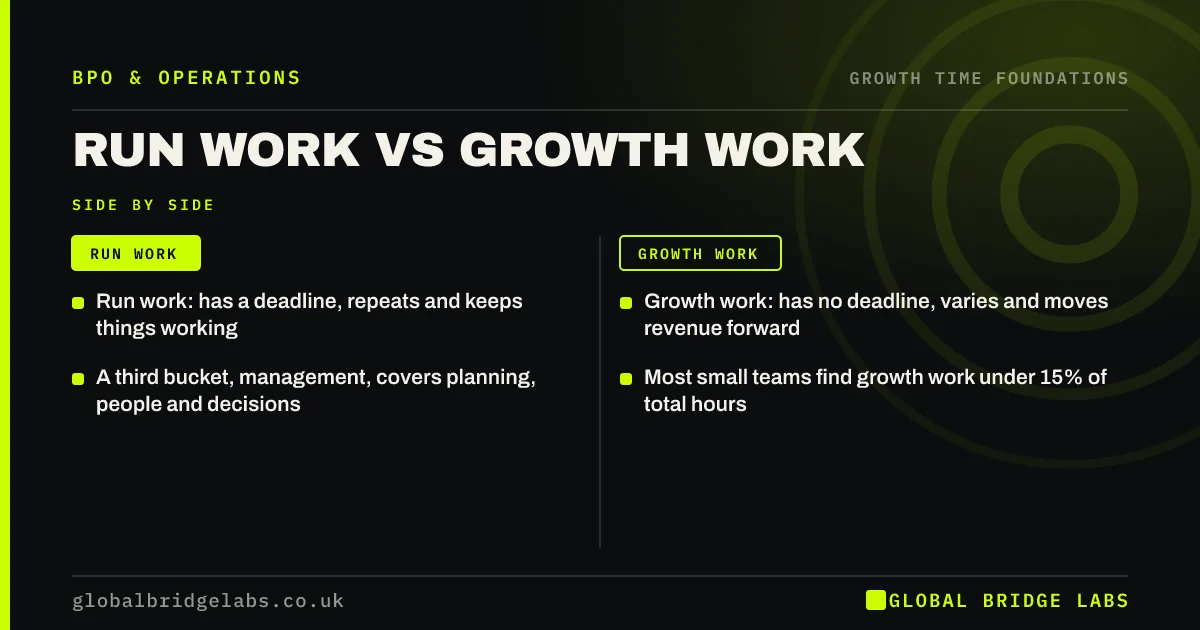
A team growth time audit is a one-week exercise in which every team member tags their working hours as run work, growth work or management. It produces a baseline: the share of paid hours going on growth, broken down by person and role. That baseline shows where capacity is trapped and lets you measure the effect of outsourcing later.
It differs from a general time audit, which looks for wasted time. This audit has one question: how much of the week moves the business forward?
How do you run the audit?
Keep it light so people do it honestly.
Most people overestimate their growth time. Daily tagging from records is more accurate than a memory exercise at the end of the week.
- Pick a normal week, not month-end or a holiday week.
- Use a simple sheet with half-hour rows and three tags.
- Ask people to fill it daily from their diary and inbox.
- Total hours per person by tag on Friday.
- Discuss the results as a team, without blame.
What should you look for in the results?
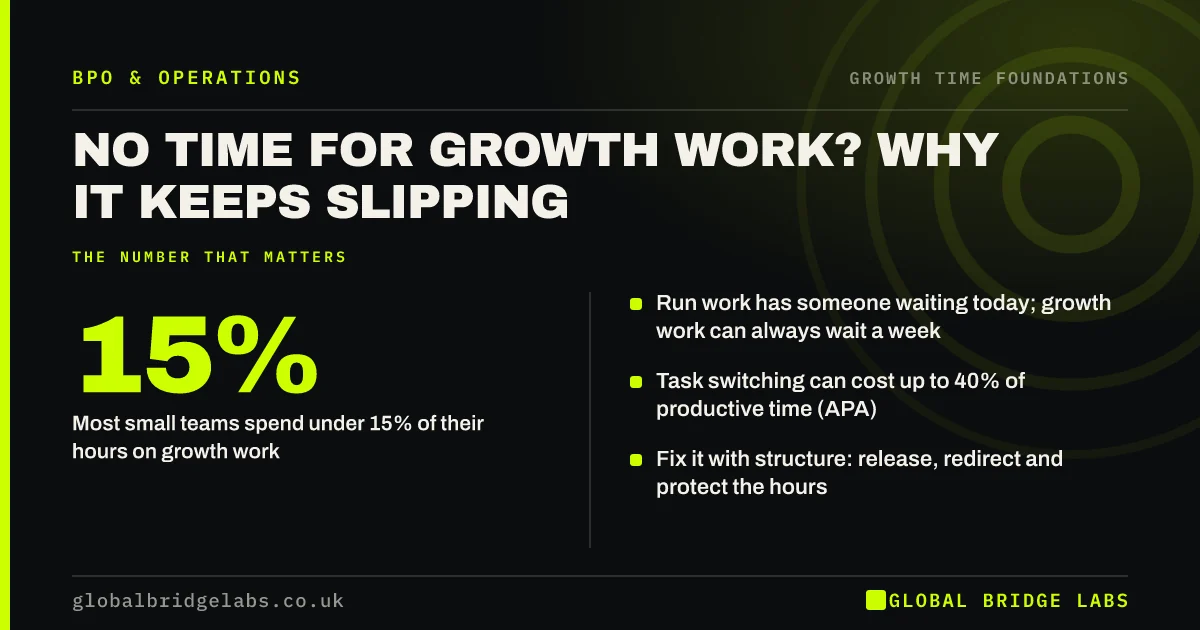
Look for growth roles drowning in run work. A salesperson, account manager or service lead spending more than half the week on routine processing is the clearest sign of trapped growth capacity. Also look at the team total: if growth work is under 15% of all hours, routine work is crowding it out.
For context, UK rules cap the average working week at 48 hours, so you cannot fix the gap by asking for longer days. The hours have to come from somewhere else.
When is an audit not worth doing?
In a team of two or three, you probably already know where the time goes; skip the sheet and talk it through. And if you are about to restructure, wait until the new roles are settled, or you will audit a week that no longer exists.
What does this look like in practice?
A pattern we see: a 15-person agency audits a week and finds its three account leads spend 58% of their time on reporting, scheduling and invoice queries. Those tasks move out first, because they free the most valuable hours, even though other roles carry more routine work in total.
Growth time audit checklist
- Choose a normal week.
- Share a simple three-tag sheet.
- Fill it daily from diaries and inboxes.
- Total hours by person, role and team.
- Flag growth roles over 50% run work.
- Repeat the audit 90 days after outsourcing.
Next step
Run the audit next week with your two most commercially important roles first. Their numbers alone will tell you whether growth time is being lost.
Message us on WhatsApp for the growth time audit sheet, or book a 30-minute consultation.
Chat on WhatsApp →Sources and further reading
- Employee earnings in the UK (Annual Survey of Hours and Earnings) · Office for National Statistics
- Maximum weekly working hours · GOV.UK
Frequently asked questions
How do I measure how much time my team spends on growth?
Ask each person to tag a normal week in half-hour blocks as run work, growth work or management, using their diary and inbox as a guide. Total the hours by person and role. The share of hours tagged as growth work is your baseline, and you can repeat the exercise later to see whether it rose.
How accurate does a time audit need to be?
Rough is fine. You are looking for the shape of the week: whether growth work is 5%, 15% or 30% of time, and which roles carry the routine load. Daily tagging from diaries and inboxes is accurate enough. Minute-by-minute tracking is unnecessary and tends to make people defensive.
How often should we repeat the audit?
Run it once as a baseline, again about 90 days after outsourcing to check that growth hours actually rose, and then once or twice a year. Repeat it sooner if the team feels stretched again, because that usually means routine work has crept back in.
Written by

Global Bridge Labs (GBL) is a UK–Sri Lanka partner for social media, websites and BPO. Everything here comes from client delivery, not theory.