On this page
Key takeaways
Freed-up time disappears because work expands to fill the hours available unless something else claims them first. After outsourcing, the gap fills with longer meetings, extra polishing and small requests that used to be refused. Keep the time by naming a growth goal for it before the handover, blocking it in diaries and checking where it went.
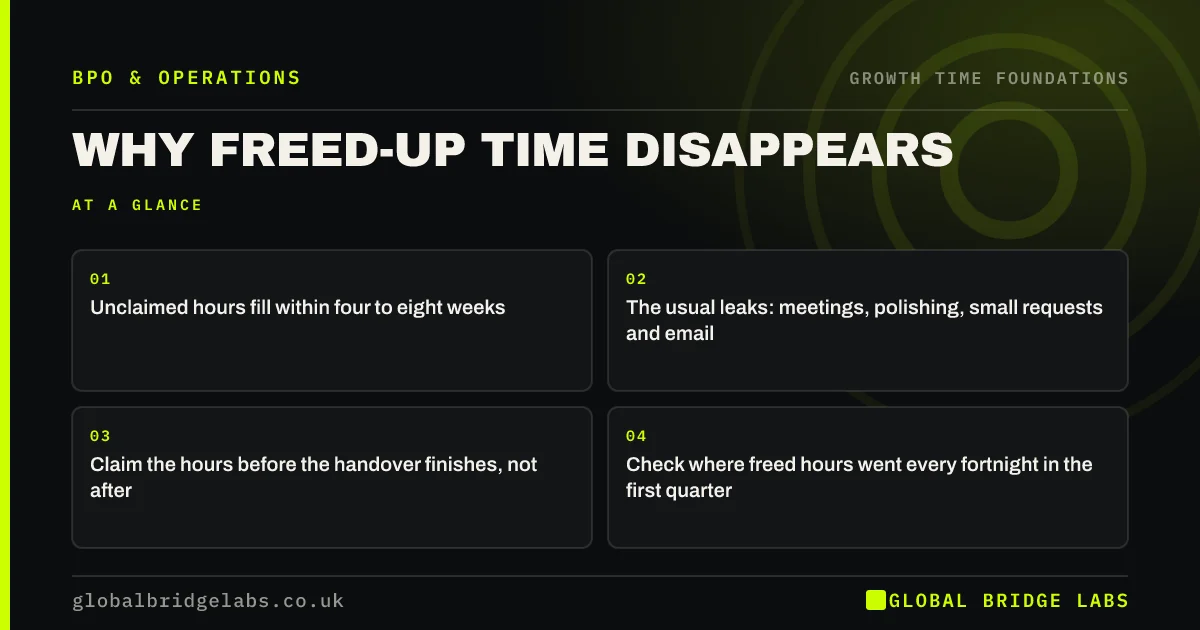
- Unclaimed hours fill within four to eight weeks.
- The usual leaks: meetings, polishing, small requests and email.
- Claim the hours before the handover finishes, not after.
- Check where freed hours went every fortnight in the first quarter.
Want help claiming your freed hours before they vanish? Message us on WhatsApp.
Chat on WhatsApp →Why does freed-up time disappear?
Freed-up time disappears because nobody decided what it was for. When routine work moves out, the hours do not stay empty; they absorb whatever is nearest. People reply to email faster, meetings run longer, reports get one more revision and colleagues ask for small favours. Each feels reasonable, and together they take the whole gap.
This is not laziness. It is how busy teams behave when there is no clear priority waiting for the time.
Where does the time usually go?
The leaks are predictable.
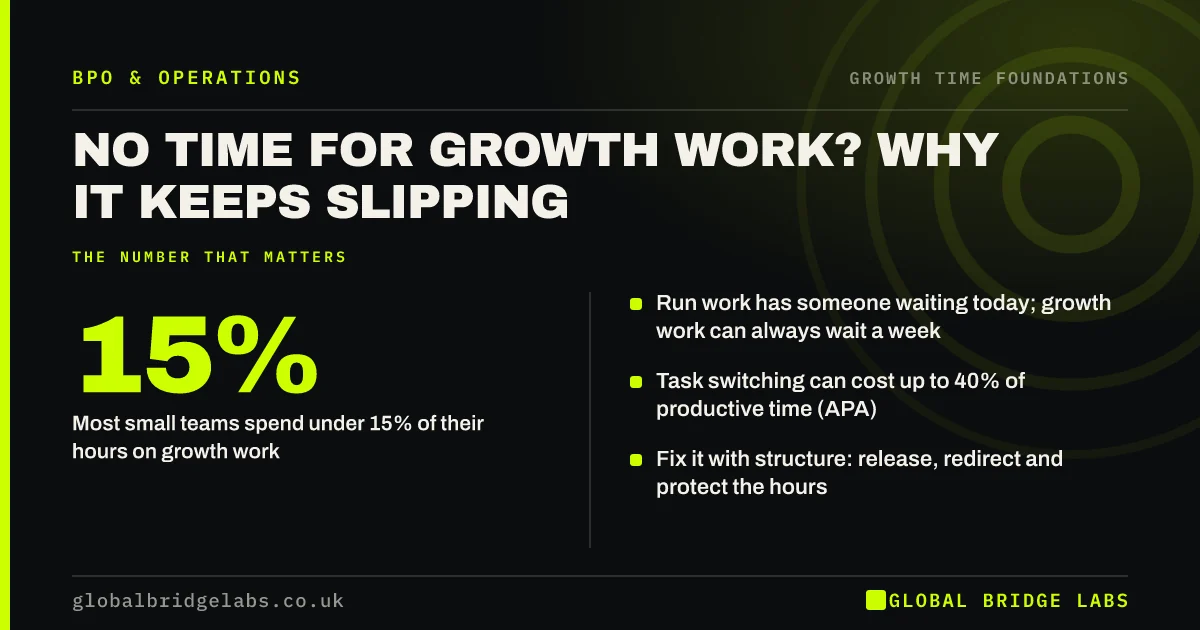
Fragmented time is also less useful. The American Psychological Association notes that switching between tasks can cost as much as 40% of productive time, so ten scattered half-hours are worth far less than one five-hour block.
- Meetings: more attendees, longer agendas, extra check-ins.
- Polishing: more revisions of work that was good enough.
- Small requests: favours that were refused when everyone was busy.
- Email and chat: faster replies and more threads.
- Supervising the provider beyond what is needed.
How do you keep the freed hours?
Claim them before they are free. Before the handover starts, name the growth goal each person's freed hours will go to, put recurring growth blocks in diaries, and agree what new admin goes to the provider. Then check every fortnight whether the blocks were used.
When is some leakage acceptable?
Some of the freed time should go to rest. If the team was working long hours before, part of the gain is simply a normal working week, and the Health and Safety Executive treats unmanageable workload as a stress risk. Decide that share deliberately rather than letting it happen by accident.
What does this look like in practice?
A pattern we see: a firm outsources 20 hours a week of order admin. Six weeks later the team still feels busy. A two-week check shows most of the hours went to an extra weekly meeting, faster replies to internal chat and redoing reports. Naming a growth goal and moving the meeting to fortnightly recovers most of the time.
Keep the hours checklist
- Name the growth goal for each person's freed hours.
- Block growth time in diaries before the handover.
- Agree which new admin goes to the provider.
- Review meetings added since the handover.
- Check where freed hours went every fortnight.
Next step
Before your next handover, write one line per person: freed hours per week and the growth goal they go to. If you cannot write that line, the hours will disappear.
Message us on WhatsApp to plan where your freed hours go, or book a 30-minute consultation.
Chat on WhatsApp →Sources and further reading
- Multitasking: switching costs · American Psychological Association
- Work-related stress and how to manage it · Health and Safety Executive
Frequently asked questions
Why are we still busy after outsourcing?
Usually because the freed hours were never claimed. Without a named goal, the time fills with longer meetings, extra polishing, faster email and small requests. It can also mean the handover is still in its learning phase, when briefing and checking take time. Check where the hours actually go for two weeks to find out which.
What is Parkinson's law in business?
Parkinson's law is the observation that work expands to fill the time available for its completion. In practice it means freed-up time is absorbed by existing tasks unless a new priority claims it. That is why freed hours need a named goal and a diary slot before the routine work moves out.
How long does it take for freed time to disappear?
Typically four to eight weeks. In the first few weeks the gap is noticeable and people use it deliberately. By the second month, new meetings, small requests and habits have filled it. That is why the first fortnightly check on where hours went should happen within a month of the handover.
Written by

Global Bridge Labs (GBL) is a UK–Sri Lanka partner for social media, websites and BPO. Everything here comes from client delivery, not theory.