On this page
Key takeaways
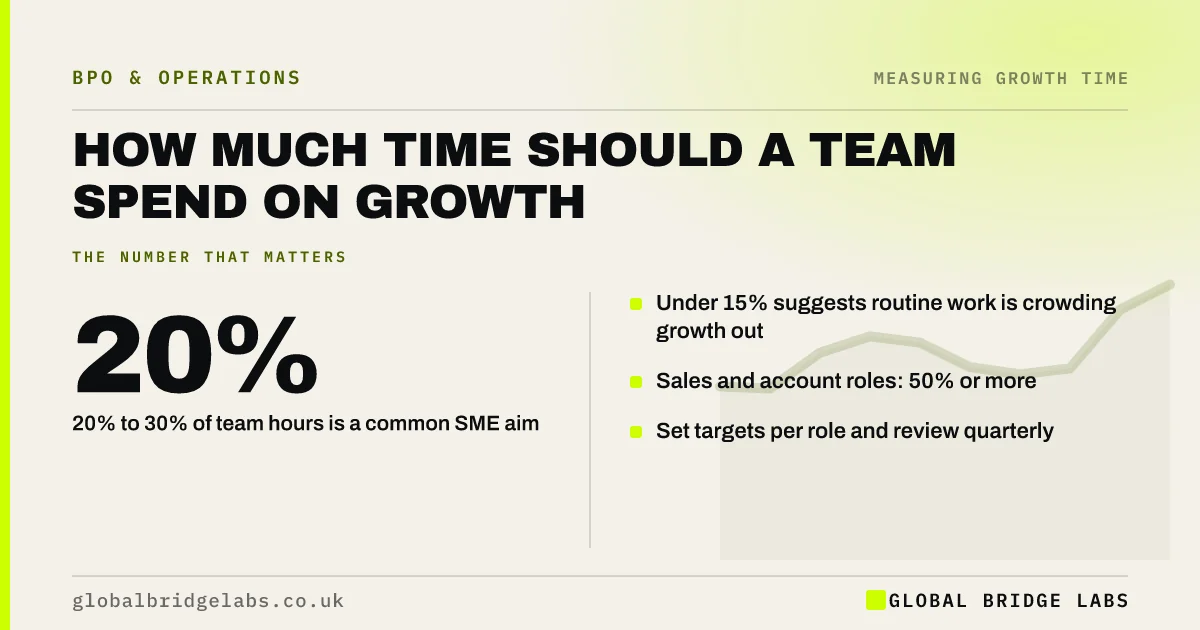
There is no official benchmark, but many growth-minded SMEs aim for 20% to 30% of total team hours on growth work, with sales and account roles much higher and routine operational roles lower. If your team is below 15%, routine work is probably crowding growth out. Set a target per role, not one figure for everyone.
- 20% to 30% of team hours is a common SME aim.
- Under 15% suggests routine work is crowding growth out.
- Sales and account roles: 50% or more.
- Set targets per role and review quarterly.
Want to benchmark your team's growth time? Message us on WhatsApp.
Chat on WhatsApp →How much time should go on growth work?
Many SMEs that grow steadily spend roughly a fifth to a third of total team hours on growth work, meaning selling, account development, new services, partnerships and pricing. The right figure depends on your business model and stage: a young business needs more, a mature service business with long contracts may need less.
How should targets differ by role?
These are working ranges, not standards; adjust to your business.
- Owner or MD: 30% to 50% on growth and strategy.
- Sales and account roles: 50% or more on growth work.
- Service leads: 15% to 25%, mainly account growth.
- Operations and finance: 10% to 20%, mainly improvement and analysis.
- Admin roles: low, unless moving into growth projects.
What if you are far below target?
Find out where the hours go first. Then move routine work from the roles furthest below target. UK rules cap average working time at 48 hours a week, so closing the gap by working longer is neither sustainable nor always lawful.
When is a benchmark unhelpful?
When it becomes a target to hit regardless of results. A team that logs 30% growth time with no outcomes is not doing better than one at 20% with strong results. Use the benchmark to find gaps, then judge by outcomes.
What does this look like in practice?
A pattern we see: a 20-person firm measures 9% growth time. Its two sales leads are at 35% because of quoting admin. Moving quoting support out lifts them above 55% and the team total to about 18% within a quarter.
Growth time benchmark checklist
- Measure current growth time by role.
- Set a target range for each role.
- Find roles furthest below target.
- Move routine work from those roles.
- Review against outcomes quarterly.
Next step
Measure your team's growth time for one week, then compare each role with the ranges above.
Message us on WhatsApp for the growth time benchmark sheet, or book a 30-minute consultation.
Chat on WhatsApp →Sources and further reading
- Employee earnings in the UK (Annual Survey of Hours and Earnings) · Office for National Statistics
- Maximum weekly working hours · GOV.UK
Frequently asked questions
What percentage of time should be spent on business growth?
Many growth-focused SMEs aim for roughly 20% to 30% of total team hours on growth work, with sales and account roles much higher. There is no official benchmark. Measure your own figure and set targets by role, then judge progress by results rather than hours.
How much time should a business owner spend on growth?
Many owners aim for 30% to 50% of their week on growth and strategy once the business has a team. In practice, owners of busy small firms often spend far less. Moving routine work off the owner's desk is usually the first step.
Is more growth time always better?
No. Growth time without clear goals or skills produces little. And some roles need to focus on delivery, because good delivery drives repeat business. The aim is enough protected growth time in the right roles, used on the right goals.
Written by

Global Bridge Labs (GBL) is a UK–Sri Lanka partner for social media, websites and BPO. Everything here comes from client delivery, not theory.