On this page
Key takeaways
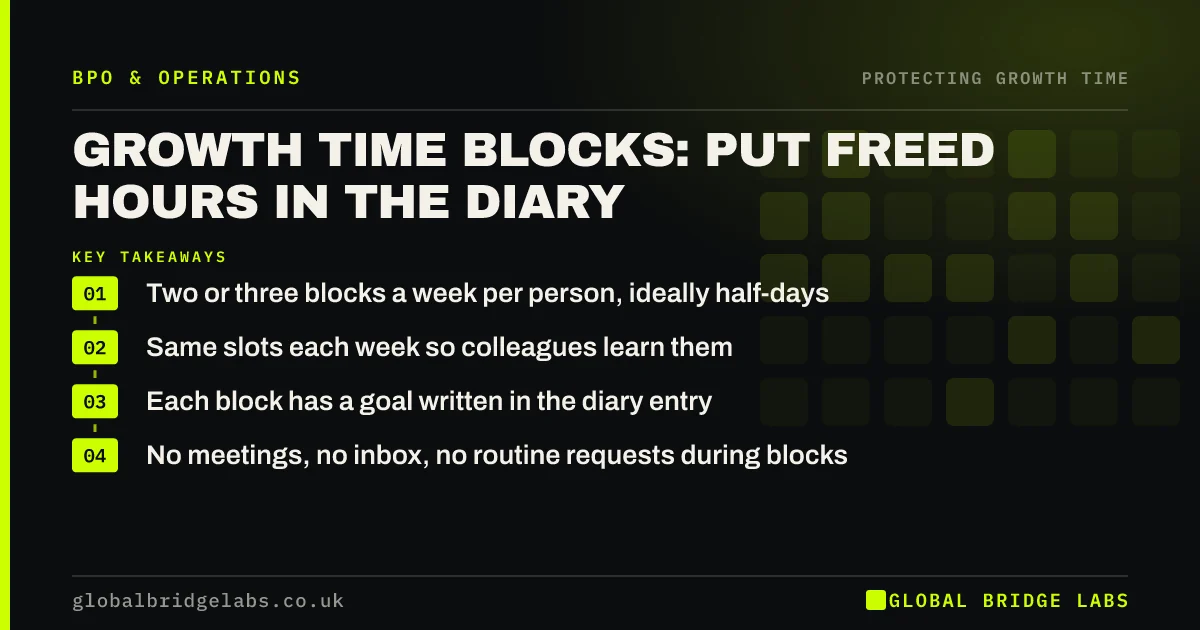
Growth time blocks are recurring diary slots, ideally half-days, reserved for growth work and kept free of meetings and routine tasks. They turn freed hours into real progress because growth work needs uninterrupted time. Book them before the handover finishes, give each block a goal and protect them as firmly as a customer meeting.
- Two or three blocks a week per person, ideally half-days.
- Same slots each week so colleagues learn them.
- Each block has a goal written in the diary entry.
- No meetings, no inbox, no routine requests during blocks.
Want help designing growth time blocks? Message us on WhatsApp.
Chat on WhatsApp →What is a growth time block?
A growth time block is a recurring, protected period in someone's diary set aside for growth work such as account reviews, proposals, partnerships or new service development. It is treated like an external appointment. Blocks work because growth work needs sustained concentration, and scattered spare minutes rarely add up to progress.
How long should blocks be?
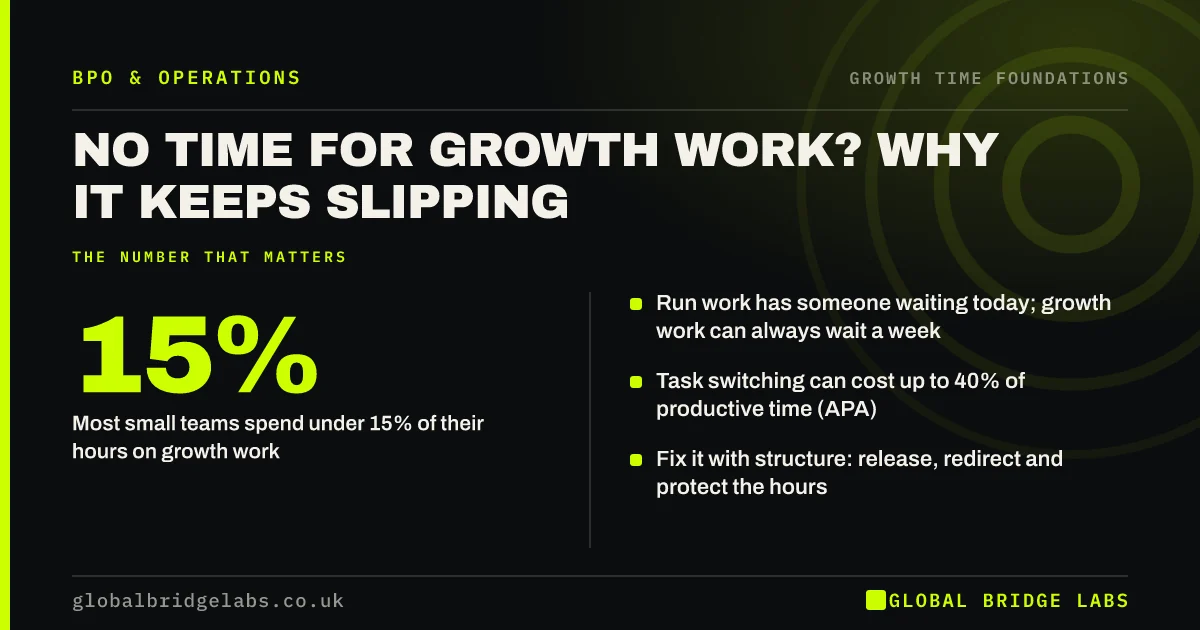
Half-days work best for most growth work; two hours is a sensible minimum. Shorter slots are eaten by the time it takes to get going again. The American Psychological Association notes that task switching can cost as much as 40% of productive time, so fewer, longer blocks beat many short ones.
How do you set them up?
- Pick slots with fewest customer demands, often mornings.
- Make them recurring for at least a quarter.
- Write the goal for each block in the entry.
- Set status to busy and turn off notifications.
- Agree cover for urgent customer issues.
When do blocks not suit a role?
Customer-facing roles with unpredictable demand, such as reception or on-call support, may not hold half-days. Use shorter blocks with cover from a colleague or the outside team, or rotate blocks between people.
What does this look like in practice?
A pattern we see: an agency gives each account lead two half-day growth blocks a week after moving reporting out. Tuesday mornings are for account reviews and Thursday afternoons for new business. Within a quarter, both slots are respected by the rest of the team.
Growth block checklist
- Choose two or three slots per person.
- Make them recurring for a quarter.
- Write a goal in each entry.
- Arrange cover for urgent issues.
- Review attendance monthly.
Next step
Book your own first growth block for next week and write its goal in the entry. Then ask your team to do the same.
Message us on WhatsApp for a growth block template, or book a 30-minute consultation.
Chat on WhatsApp →Sources and further reading
- Multitasking: switching costs · American Psychological Association
- Maximum weekly working hours · GOV.UK
Frequently asked questions
How long should a focus time block be?
Half a day is ideal for growth work such as proposals or planning; two hours is a practical minimum. Shorter slots are often lost to restarting and interruptions. Most people manage two or three long blocks a week alongside their other work.
How do I stop meetings being booked over growth blocks?
Make blocks recurring and marked busy, explain the purpose to the team, and give a manager authority to refuse clashes. Over a few weeks colleagues learn the pattern. Hold meetings in fixed windows outside the blocks so there is an obvious alternative.
Should everyone have the same growth time blocks?
Not necessarily. Shared blocks reduce interruptions because the whole team is quiet at once, but customer-facing roles may need staggered blocks to keep cover. A mix often works: one shared block a week and individual blocks the rest. Revisit the answer each quarter, because team capacity and priorities change as the business grows.
Written by

Global Bridge Labs (GBL) is a UK–Sri Lanka partner for social media, websites and BPO. Everything here comes from client delivery, not theory.