On this page
- 01Key takeaways
- 02What makes a task suitable for outsourcing?
- 03Why does picking the wrong tasks cost so much?
- 04How do you identify tasks suitable for outsourcing?
- 05Where do outsourceable tasks hide?
- 06What are the six signals that a task can be outsourced?
- 07Which tasks should come off the list straight away?
- 08How do you rank the tasks that pass?
- 09What does it cost to outsource the tasks you find?
- 10When is hunting for tasks the wrong approach?
- 11What does this look like in practice?
- 12Task finder checklist
- 13Guides on the task finder foundations
- 14Guides on finding tasks in your records
- 15Guides on quick tests for a task
- 16Guides on tasks hidden in roles
- 17Guides on task types that travel
- 18Guides on ranking the candidates
- 19Guides on ways to surface tasks
- 20Guides on finding tasks by sector
- 21Guides on more sectors and their tasks
- 22Guides on moving from task list to handover
- 23Next step
- 24Sources and further reading
- 25Frequently asked questions
Key takeaways
To identify tasks suitable for outsourcing, list every recurring task in the business first, then flag each one against six signals: teachable, checkable, remote, recurring, recoverable and worthwhile. Tasks with five or six flags go on a shortlist, ranked by hours a week and risk. Test the top five properly before anything moves.
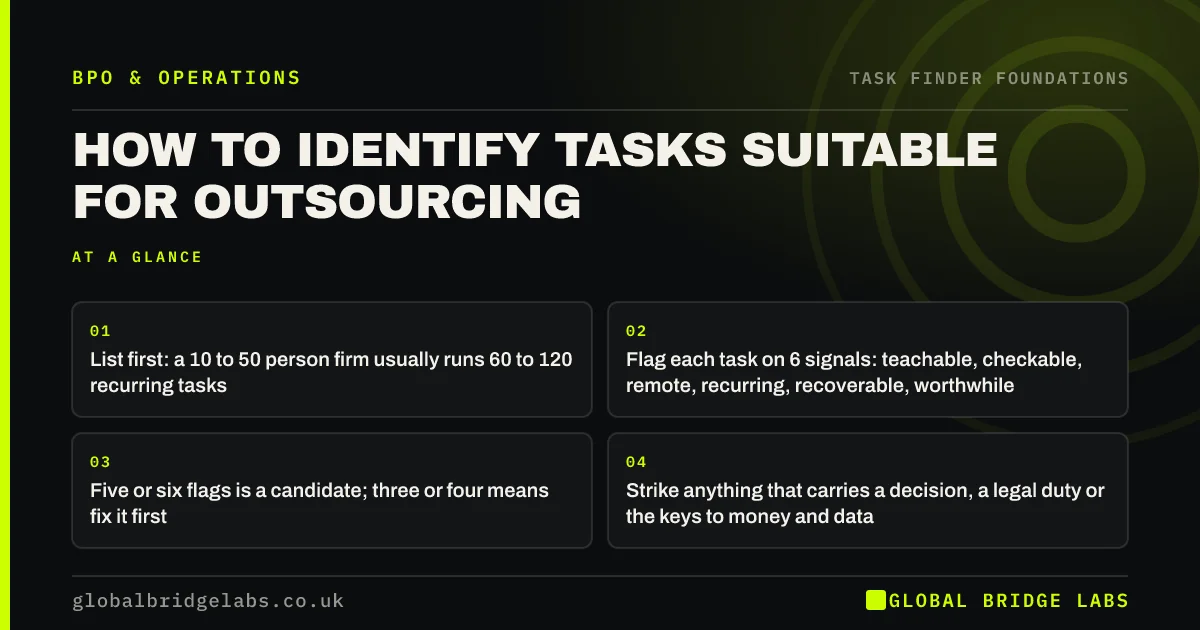
- List first: a 10 to 50 person firm usually runs 60 to 120 recurring tasks.
- Flag each task on 6 signals: teachable, checkable, remote, recurring, recoverable, worthwhile.
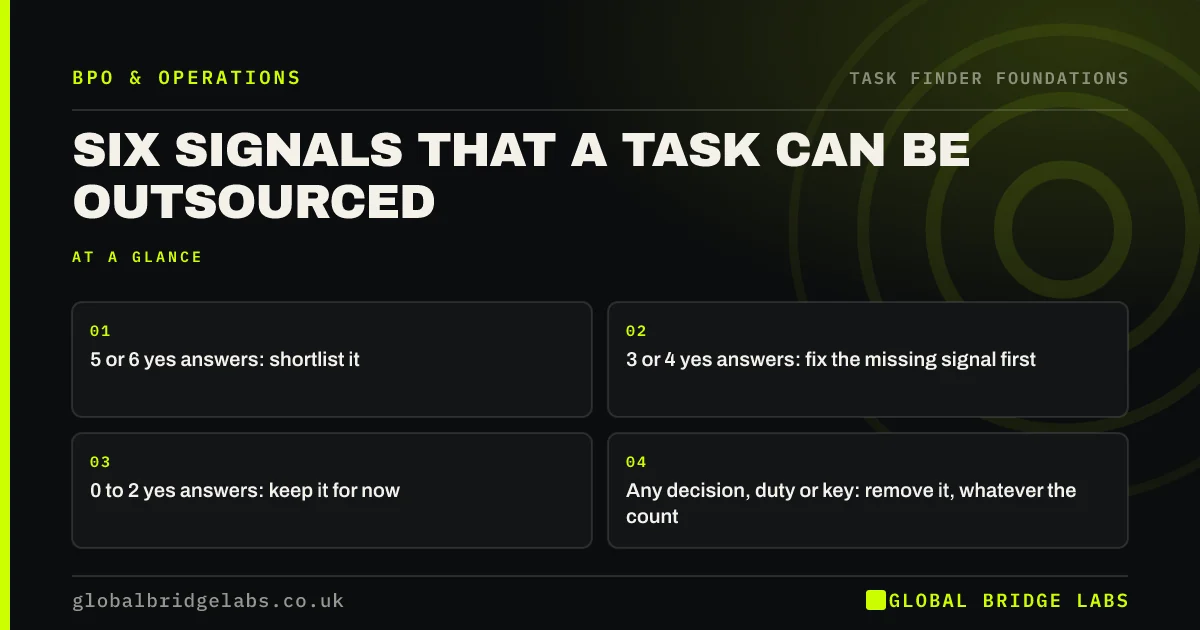
- Five or six flags is a candidate; three or four means fix it first.
- Strike anything that carries a decision, a legal duty or the keys to money and data.
- Rank the candidates by hours a week and risk, then test your top 5.
Want your task list screened with you in 30 minutes? Message us on WhatsApp.
Chat on WhatsApp →What makes a task suitable for outsourcing?
A task suitable for outsourcing is a piece of recurring work that someone outside the business can learn from written instructions, do from a screen, and hand back in a form you can check, where an occasional mistake can be caught before it harms a customer. Suitability is about the task's shape, not its importance or how much you dislike it.
That definition rules out more than people expect. A task can be dull and still unsuitable, because it needs a decision only the owner can make. A task can feel important and still be suitable, because it is really a set of rules applied the same way every time.
This guide is about finding those tasks across the whole business. For the list of tasks small firms commonly hand over, see what tasks a small business can outsource. To score one task in depth once you have found it, use the repetitive task fit score. To judge a whole end-to-end process, see which business processes you should outsource.
Why does picking the wrong tasks cost so much?
Picking the wrong tasks is the most common reason a first outsourcing arrangement disappoints. Hand over work that needs constant judgement and the provider asks questions all day, so you save no time. Hand over a task that only takes an hour a week and the management effort outweighs the hours saved.
Picking too few tasks costs as well. A £30,000 administrator costs about £19.81 per worked hour once employer costs and holidays are included, and an owner's time is usually worth far more. Every hour of suitable work left with the wrong person is capacity you are paying for twice. The aim is a short, well-chosen list, not the longest possible one.
How do you identify tasks suitable for outsourcing?
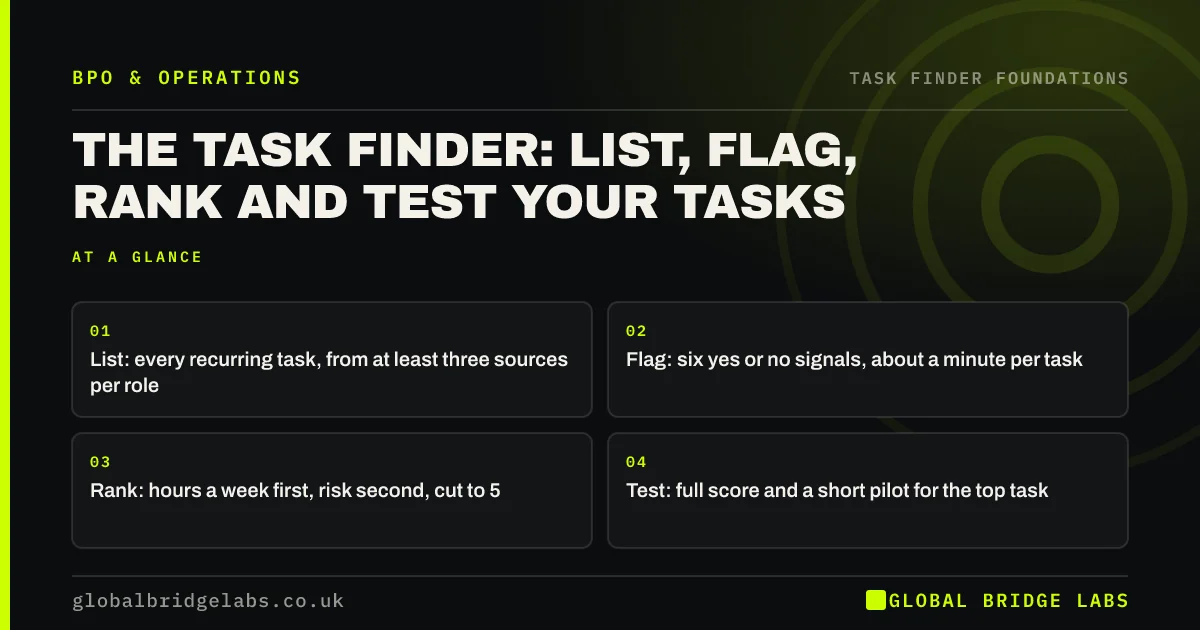
Use the Global Bridge Labs (GBL) Task Finder, four steps run in order: List, Flag, Rank and Test. List captures every recurring task from the places work actually hides. Flag screens each task against six yes or no signals. Rank orders the survivors by hours and risk. Test puts the top five through a full score and a short pilot before anything is handed over.
Running the steps in order matters. Most owners start by guessing a favourite task and testing it, which skips the work that would have found a better one. Listing first takes a few hours and usually surfaces two or three tasks nobody had thought of.
- List: capture every recurring task, with who does it and roughly how often.
- Flag: mark each task yes or no against the six signals.
- Rank: order tasks with five or six flags by hours a week and risk.
- Test: score the top five in depth and pilot the best one.
Where do outsourceable tasks hide?
Outsourceable tasks hide in records, not in memory. Ask people what they do and they describe their job; look at their diary, inbox and software and you see the tasks. The best sources are calendars, inboxes, job descriptions, system exports, call logs, support tickets, spreadsheets and the list of work that piles up when someone is on leave.
Use at least three sources for each role. One source always misses something: a diary shows meetings but not email admin, and an inbox shows requests but not the spreadsheet someone updates every Friday afternoon.
- Diaries and calendars: recurring slots, prep time and booking work.
- Inboxes: the same request arriving again and again.
- System data: exports, logs and manual edits in your software.
- Phone logs and tickets: the reasons customers contact you.
- Spreadsheets and leave cover: the work only one person keeps going.
What are the six signals that a task can be outsourced?
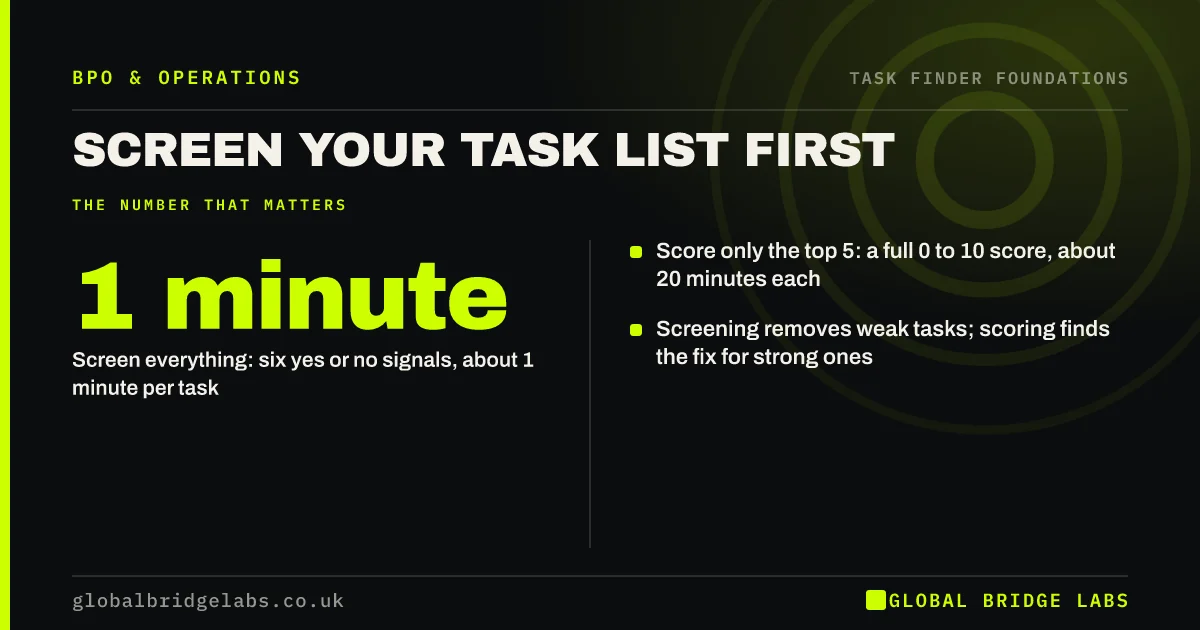
The six signals are quick yes or no questions you can ask of every task on a long list in under a minute each. They screen, they do not score: their job is to separate the tasks worth a closer look from the ones that are not.
- Teachable: could you write the steps on one page?
- Checkable: could someone tell, from the output, that it was done right?
- Remote: can it be done entirely from a screen, away from your premises?
- Recurring: does it happen weekly or more often, or in predictable batches?
- Recoverable: would a mistake be caught and fixed before it hurt anyone?
- Worthwhile: does it add up to about 2 hours a week, alone or bundled with similar tasks?
Which tasks should come off the list straight away?
Strike any task that is really a decision, a legal duty or a key, whatever its flags. Approving payments, changing supplier bank details, setting prices, hiring and firing, signing off a regulated filing and holding admin passwords all belong inside the business. The preparation around them, such as matching invoices or drafting the shortlist, can still move.
Also strike tasks that are about to change. A task attached to software you are replacing next quarter, or a process you are redesigning, will need to be learnt twice. Fix or replace it first, then come back to it.
How do you rank the tasks that pass?
Rank the tasks that pass by two numbers: hours a week and risk. Estimate hours roughly, to the nearest half hour, and rate risk low, medium or high. Put high-hours, low-risk tasks at the top. A task taking 6 hours a week at low risk beats one taking 10 hours at high risk for a first handover, because it can be learnt and checked quickly.
Then cut to five. A shortlist of five is enough to choose a strong first task and keep two or three in reserve. Longer lists turn into projects that never start.
What does it cost to outsource the tasks you find?
Indicative UK market ranges for managed offshore support run from about £9 to £18 an hour, against £20 to £35 for comparable onshore support. GBL does not publish prices; these ranges are market figures to help you size the opportunity, and your own costs depend on volume, complexity and hours of cover.
An illustrative example: five shortlisted tasks totalling 18 hours a week, currently done by staff costing about £20 an hour, is roughly £18,700 a year of time. Bought at £9 to £18 an hour, the same hours cost roughly £8,400 to £16,800, before you count what the freed staff do instead. The bigger gain is usually the second number: the work those people move on to.
- BPO cost UK: what SMEs actually pay per hour
- Work out your cost per task before you outsource
- Senior people doing junior tasks: the costliest mismatch
Want your shortlist sized against real market ranges? Message us on WhatsApp.
Chat on WhatsApp →When is hunting for tasks the wrong approach?
Hunting task by task is the wrong approach when one whole process is the problem. If invoicing, chasing and reconciling are all late, outsourcing one task in the middle just moves the bottleneck. Judge the whole process instead. It is also wrong when the task should not exist at all: stop it, or automate it if software can do it reliably.
Be honest about the management time too. Each new task needs a brief, a few weeks of questions and a regular check. As a GBL rule of thumb, expect 3 to 4 hours of owner or manager time a week in the first month of a new task, falling to 1 to 2 hours by the third month.
What does this look like in practice?
A pattern we see often: an owner arrives sure that bookkeeping is the task to outsource. The long list, built from diaries, inboxes and the shared drive, shows something different. The biggest suitable block is order updates, delivery chasing and stock spreadsheet edits spread across three people, none of whom thought of it as one job.
Across our client work, moving the right tasks is where results come from: back-office cost per task down 42% and 31 hours a week returned to owners and managers. Those are results across engagements, not a promise for any one task.
Task finder checklist
- Build the long list from at least three sources per role.
- Record who does each task, how often and roughly how long it takes.
- Flag each task against the six signals.
- Strike decisions, duties and keys, whatever their flags.
- Rank tasks with five or six flags by hours and risk.
- Cut to a shortlist of five and test the top one.
- Plan what the freed hours will be used for.
- Review the list every quarter.
Guides on the task finder foundations
- The task finder: list, flag, rank and test your tasks
- Six signals that a task can be outsourced
- Screen your task list first, score the shortlist second
- Build a long list of tasks before you choose any
- Where to look for tasks you could outsource
- Tasks that look easy to outsource but are not
- Invisible work: the tasks nobody lists but someone does
- Break a job into tasks before deciding what moves
- Mistakes people make when picking tasks to outsource
Guides on finding tasks in your records
- A calendar audit: find the tasks hiding in your diary
- Your inbox as a task list: find the repeat requests
- Read job descriptions for tasks that could move
- Use your software data to find manual work
- Call logs: what your phone data says about tasks
- Support tickets by type: which ones could move?
- Work done after hours: a clue to what to outsource
- What stops when someone is on leave?
- Find the manual tasks living in your spreadsheets
- Review completed tasks to find what keeps coming back
Guides on quick tests for a task
- The write-it-down test: can you explain the task on a page?
- The new starter test: could someone new do this task?
- Can you check the result? Tasks with a checkable output
- Can this task be done from anywhere?
- What does a mistake cost? Rate the risk of each task
- Tasks that suit overnight work in another time zone
- Tasks done entirely in software are the easiest to move
- Tasks with fixed deadlines: outsource with a clock
- Tasks that need someone on site, and the parts that do not
- The tasks owners hate: a useful but unreliable signal
Guides on tasks hidden in roles
- Review a founder's week for tasks someone else could do
- Office manager tasks you could outsource
- Non-selling time: find the admin in a salesperson's week
- Field technicians doing paperwork: what can move?
- Marketing manager tasks you could outsource
- Finance manager tasks you could outsource
- Practice manager tasks you could outsource
- Receptionist duties: which ones could move?
- Operations manager tasks you could outsource
- Executive assistant tasks you could outsource
Guides on task types that travel
- Processing form submissions: a task type that travels well
- Chasing people for information: an ideal task to hand over
- Checking and verifying: tasks that need care, not seniority
- Manual reports: weekly numbers someone builds by hand
- Scheduling and booking tasks: easy to spot, easy to move
- Document preparation: drafts, packs and templates
- Watching and alerting: monitoring tasks to outsource
- Keeping records up to date: the task nobody owns
- Filing and archiving: digital housekeeping tasks
- Follow-up tasks: the work that slips when everyone is busy
Guides on ranking the candidates
- How to prioritise tasks to outsource
- Estimate the hours a task takes without a full study
- A value and effort matrix for outsourcing candidates
- Quick wins: the tasks to hand over in the first month
- How much effort does it take to hand over a task?
- Senior people doing junior tasks: the costliest mismatch
- Rate the risk of each candidate task: low, medium or high
- Turn your long list into a shortlist of five
- Eliminate before you outsource: tasks that should stop
- Baseline a task before you move it
Guides on ways to surface tasks
- Job shadowing: sit with someone to map their tasks
- A day-in-the-life review of one role
- A gemba walk for office work
- A 30-minute interview that finds tasks to hand over
- A sticky-note task mapping exercise for a team
- Swimlane diagrams: see who does each task
- Process mining: can small firms use it to find tasks?
- The admin behind each order: trace one sale end to end
- Run a task identification workshop with your team
- Trace customer requests to find repeat tasks
Guides on finding tasks by sector
- Architect practices: tasks to outsource and keep
- Vet practices: tasks you could outsource
- Gyms and studios: admin tasks to outsource
- Nurseries: admin tasks you could hand over
- Marketing agencies: tasks to outsource behind the work
- IT support firms: tasks to outsource without losing clients
- Wholesalers: order and account tasks to outsource
- Events companies: tasks to outsource around each event
- Cleaning companies: admin tasks to outsource
- Surveyors: tasks to outsource between site visits
Guides on more sectors and their tasks
- Removals companies: tasks to outsource off the van
- Pharmacies: admin tasks that can move
- Opticians: admin tasks to outsource
- Engineering consultancies: tasks to outsource
- Schools: admin tasks that can be outsourced
- Builders merchants: tasks to outsource behind the counter
- Funeral directors: admin that can move, care that stays
- Print companies: tasks to outsource around production
- Travel agencies: tasks to outsource behind the bookings
- Landscaping companies: admin to outsource in the busy season
Guides on moving from task list to handover
- Task finder checklist: 20 checks before you choose a task
- An outsourcing candidate register: one row per task
- Review your task list every quarter, not once
- Tasks that fail the screen: fix, automate, stop or keep
- Examples of tasks UK firms identified to outsource
- A 30-day plan to find the right tasks to outsource
- Manual work left over after new software
- An employee is leaving: decide which tasks move out
- Before you hire, list the tasks: some may not need a hire
- An outsourcing discovery session: what to bring
Next step
Pick one role, ideally your own, and build its task list from your diary and inbox this week. Flag each task against the six signals. You will usually find two or three strong candidates in the first hour.
Message us on WhatsApp for the GBL Task Finder Checklist, or book a 30-minute consultation to screen your list together.
Chat on WhatsApp →Sources and further reading
- The probability of automation in England: 2011 and 2017 · Office for National Statistics
- Employee earnings in the UK (Annual Survey of Hours and Earnings) · Office for National Statistics
- Business population estimates for the UK and regions 2025 · Department for Business and Trade
- Controllers and processors · Information Commissioner's Office
- The Sourcing and Consultancy Playbooks · Cabinet Office
Frequently asked questions
How do I know which tasks to outsource?
List every recurring task first, then ask six questions of each: can it be written down, can the result be checked, can it be done remotely, does it recur, can a mistake be caught in time, and does it add up to about two hours a week? Tasks that pass five or six are your candidates.
What kind of tasks are best for outsourcing?
Recurring, rule-based tasks done on a screen with an output you can check: data updates, form processing, chasing, scheduling, reporting, document preparation and first-line customer queries. Tasks that carry decisions, legal duties or access to money and passwords are poor candidates, even when they look simple.
How long does it take to identify tasks to outsource?
For a business of 10 to 50 people, building a long list takes about a week of part-time effort, flagging and ranking takes an afternoon, and testing the top candidate takes two to four weeks. A 30-day plan is realistic for finding and starting your first well-chosen task.
Should I outsource tasks or whole processes?
Start with tasks when the work is scattered across roles and each piece is small. Move to whole processes when one end-to-end flow, such as invoicing to cash collection, is the real problem. Outsourcing one task in the middle of a broken process usually just moves the bottleneck.
Which tasks should never be outsourced?
Decisions, legal duties and keys: approving payments, setting prices, hiring and firing, signing regulated filings, and holding admin passwords or bank mandates. The admin around them, such as preparing a payment run or drafting a shortlist, can usually move while the decision stays with a named person.
Written by

Global Bridge Labs (GBL) is a UK–Sri Lanka partner for social media, websites and BPO. Everything here comes from client delivery, not theory.