On this page
- 01Key takeaways
- 02What makes a partnership strategic?
- 03Why do partnerships fail in small firms?
- 04How do you build one with freed hours?
- 05When is a partnership not worth the time?
- 06What does this look like in practice?
- 07Partnership checklist
- 08Next step
- 09Sources and further reading
- 10Frequently asked questions
Key takeaways
Strategic partnerships, such as a complementary firm that refers clients or a supplier you co-sell with, can bring steady growth, but they need regular attention that busy teams cannot give. Choose two or three partners, agree a simple shared offer and meet monthly. Freed hours from outsourcing are a good way to fund this work.
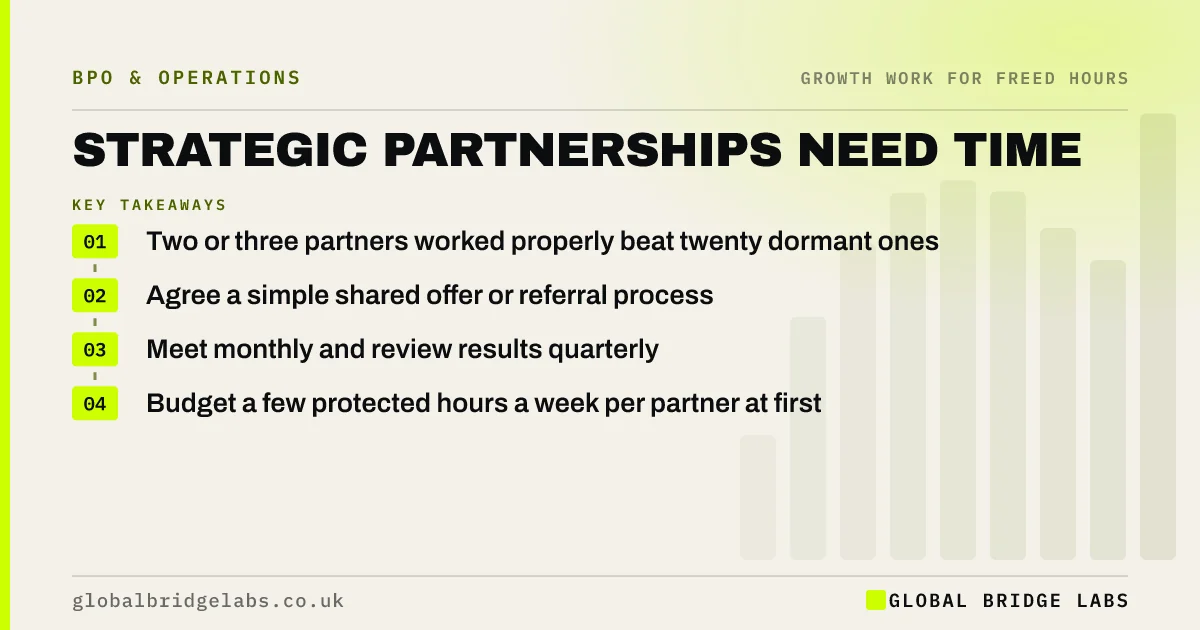
- Two or three partners worked properly beat twenty dormant ones.
- Agree a simple shared offer or referral process.
- Meet monthly and review results quarterly.
- Budget a few protected hours a week per partner at first.
Want a partnership plan for your freed hours? Message us on WhatsApp.
Chat on WhatsApp →What makes a partnership strategic?
A strategic partnership is an ongoing arrangement with another business that serves the same customers with something different, where both sides gain from working together. Examples include an accountant and a payroll firm, or a builder and an architect. It is strategic when it is chosen deliberately and worked regularly, not just a name on a referral list.
Why do partnerships fail in small firms?
Most fail from neglect rather than conflict. After an enthusiastic first meeting, both sides get busy and the partnership goes quiet. Partnerships need regular contact, shared materials and someone to chase the referrals, which is exactly the time that routine work consumes.
How do you build one with freed hours?
Avoid agreeing prices or dividing customers with partners who compete with you; UK competition law prohibits anti-competitive agreements.
- Choose partners who serve your customers with a complementary offer.
- Agree how referrals work and what each side does.
- Create one shared piece: a joint offer, guide or event.
- Meet monthly and review referrals quarterly.
- Keep commercial terms simple and in writing.
When is a partnership not worth the time?
When the partner's customers are not yours, when they want referrals but do not send any, or when the relationship takes more time than it returns after six months. Review honestly and step back if it is not working.
What does this look like in practice?
A pattern we see: an IT support firm frees its director 5 hours a week. He builds partnerships with two accountancy practices, runs a joint cyber security session for their clients and receives a steady flow of referrals within two quarters.
Partnership checklist
- List complementary businesses serving your customers.
- Choose two or three to approach.
- Agree a referral process and one shared offer.
- Meet monthly with each partner.
- Review referrals and revenue quarterly.
Next step
List five businesses whose customers are your customers, and contact the two best fits this month.
Message us on WhatsApp for a partnership planning sheet, or book a 30-minute consultation.
Chat on WhatsApp →Sources and further reading
- Employee earnings in the UK (Annual Survey of Hours and Earnings) · Office for National Statistics
- Avoid and report anti-competitive activity · GOV.UK
Frequently asked questions
How do small businesses find strategic partners?
Look for businesses serving the same customers with a complementary, non-competing offer. Ask your best customers who else they use and trust. Start with two or three conversations, agree a simple referral process and one joint activity, and review after a quarter.
How much time do business partnerships take?
In the first six months, 1 to 3 hours a week per active partner is typical: monthly meetings, shared materials and following up referrals. Once established, less. Partnerships often fail because this regular time is not protected, not because the idea was wrong.
Do I need a contract for a referral partnership?
For informal referrals, a short written note of how referrals work is often enough. If money changes hands, such as referral fees, put the terms in writing and check any regulatory rules in your sector. Avoid agreements with competitors on prices or customers.
Written by

Global Bridge Labs (GBL) is a UK–Sri Lanka partner for social media, websites and BPO. Everything here comes from client delivery, not theory.