On this page
Key takeaways
Run work keeps today's business going: processing, answering, updating and reporting. Growth work wins, keeps or expands revenue: selling, account development, new services, partnerships and pricing. Sorting your team's hours into the two shows how much capacity you really have for growth, and which run work could move out.
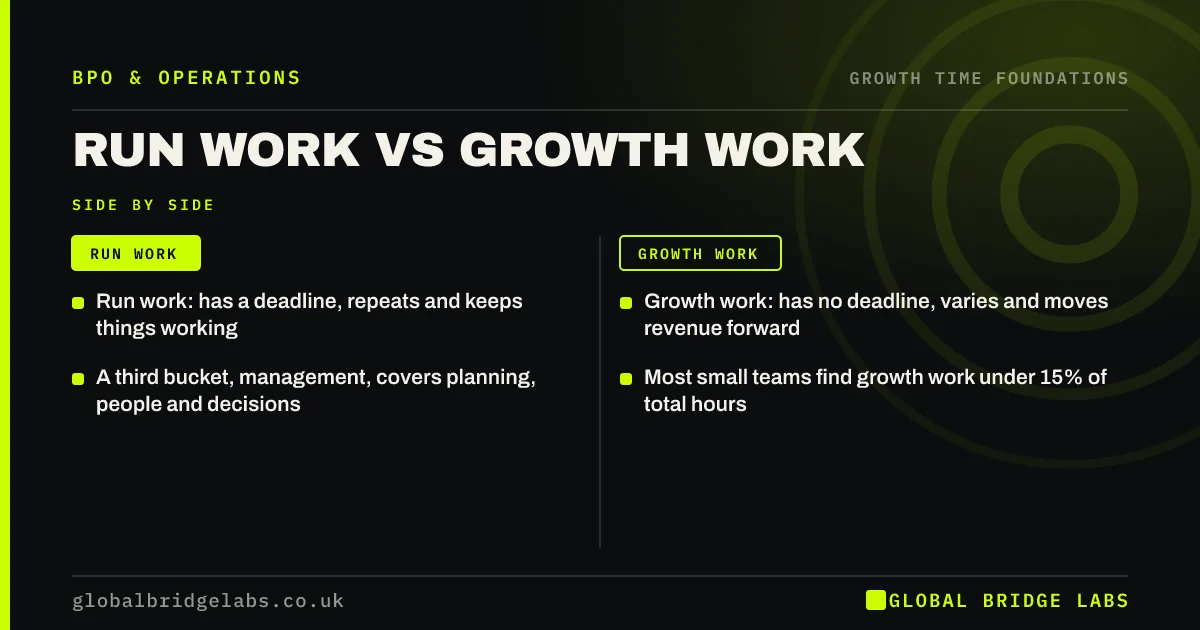
- Run work: has a deadline, repeats and keeps things working.
- Growth work: has no deadline, varies and moves revenue forward.
- A third bucket, management, covers planning, people and decisions.
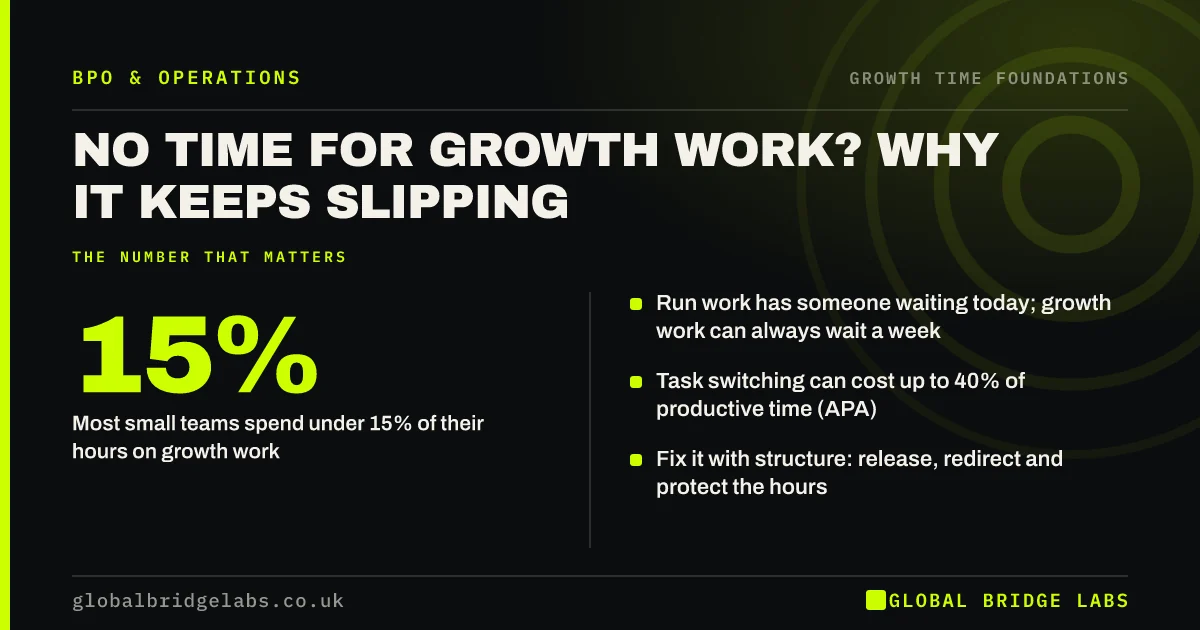
- Most small teams find growth work under 15% of total hours.
Want help sorting your team's hours into run and growth work? Message us on WhatsApp.
Chat on WhatsApp →What is the difference between run work and growth work?
Run work is the recurring activity that keeps the business operating today, such as processing orders, answering routine queries, updating records and building regular reports. Growth work is activity aimed at future revenue, such as winning new customers, expanding accounts, developing services and building partnerships. Both matter; the problem is when run work takes every hour.
A useful test is to ask what happens if the work stops for a month. Stop run work and something breaks within days. Stop growth work and nothing breaks at all, which is exactly why it gets dropped.
How do you sort the hours?
Use three buckets, not two, so management work does not get mislabelled.
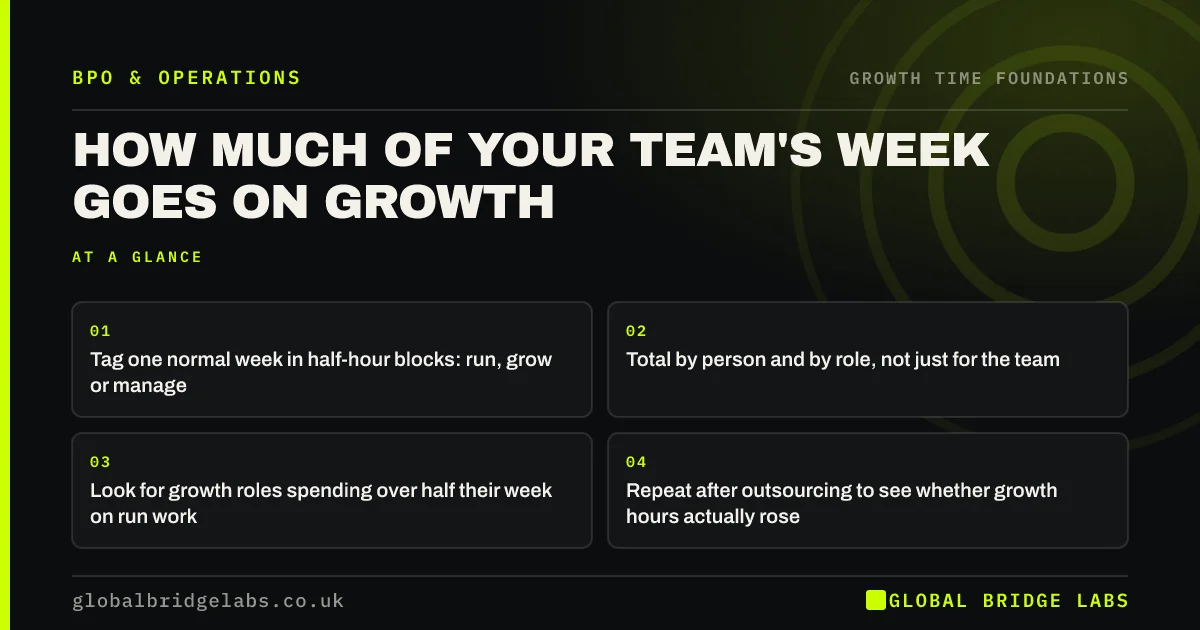
Ask each person to tag a normal week in half-hour blocks. Calendars, inboxes and task lists help people remember. The result is rough, and that is fine; you are looking for the shape, not a timesheet.
- Run: recurring work that keeps operations going.
- Grow: work aimed at winning, keeping or expanding revenue.
- Manage: planning, people, decisions and supervision.
Which run work can move out?
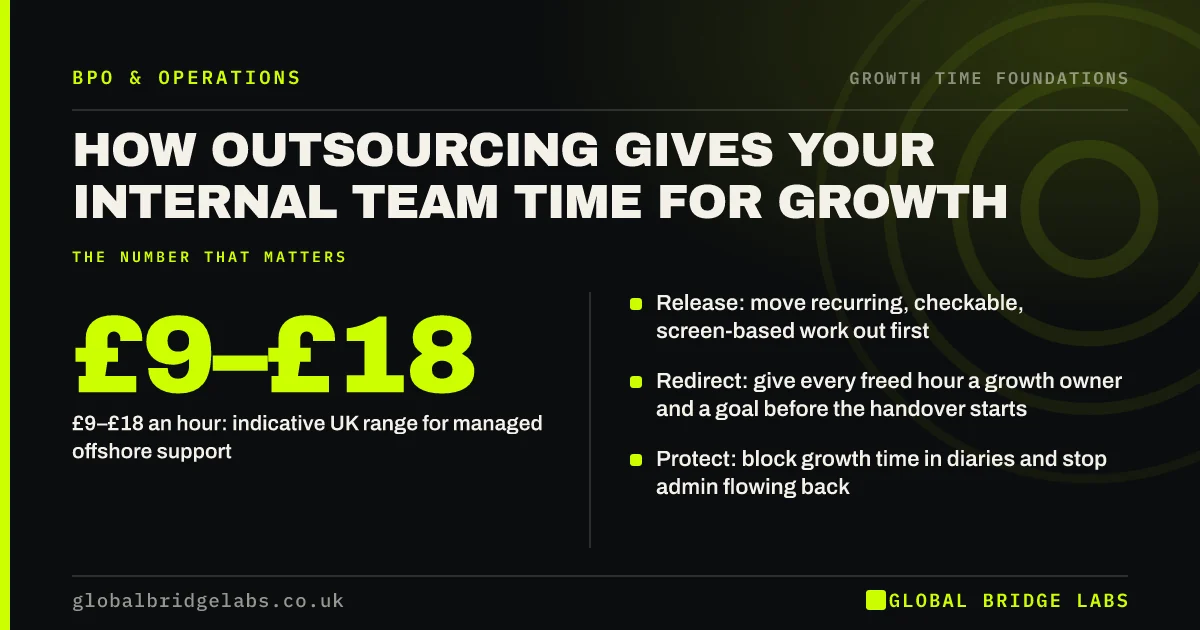
Run work that is recurring, rule-based, screen-based and easy to check can usually move to an outside team. Run work that needs judgement, physical presence or a close client relationship usually stays. The aim is to shrink the run bucket for the people whose growth hours are most valuable.
When does the split mislead?
Some run work is growth work in disguise. A fast, friendly reply to a customer query can protect an account, and a good onboarding call can lead to an upsell. Tag those carefully: the routine part may move out while the relationship part stays with your team.
What does this look like in practice?
A pattern we see: a 12-person logistics office tags a week and finds 71% run work, 18% management and 11% growth. Most of the run work is booking updates and proof-of-delivery chasing. Moving those out lifts growth work to about a quarter of team time within a quarter.
Run and grow checklist
- Agree the three buckets: run, grow and manage.
- Ask everyone to tag one normal week.
- Total the hours by person and by bucket.
- Highlight run work sitting with growth roles.
- Mark which run work could move out.
Next step
Run the tagging exercise for one week with your team. It takes about 20 minutes per person and gives you the baseline every other growth decision depends on.
Message us on WhatsApp for the run and grow tagging sheet, or book a 30-minute consultation.
Chat on WhatsApp →Sources and further reading
- Employee earnings in the UK (Annual Survey of Hours and Earnings) · Office for National Statistics
- Multitasking: switching costs · American Psychological Association
Frequently asked questions
What is run work in a business?
Run work is the recurring activity that keeps a business operating day to day: processing orders and invoices, answering routine queries, updating records, scheduling and building regular reports. It usually has a deadline and something breaks if it stops, which is why it tends to crowd out longer-term growth work.
What counts as growth work?
Growth work is activity aimed at future revenue: winning new customers, developing existing accounts, building partnerships, developing new services, reviewing prices and researching what customers need next. It rarely has a fixed deadline, so it is easy to postpone even though it determines where the business will be in a year.
Is management time run work or growth work?
Treat it as a third bucket. Planning, supervising, hiring and decision-making are neither routine processing nor direct revenue work. Keeping them separate stops management time inflating either figure and shows whether managers are spending too much time on supervision and too little on growth.
Written by

Global Bridge Labs (GBL) is a UK–Sri Lanka partner for social media, websites and BPO. Everything here comes from client delivery, not theory.