On this page
Key takeaways
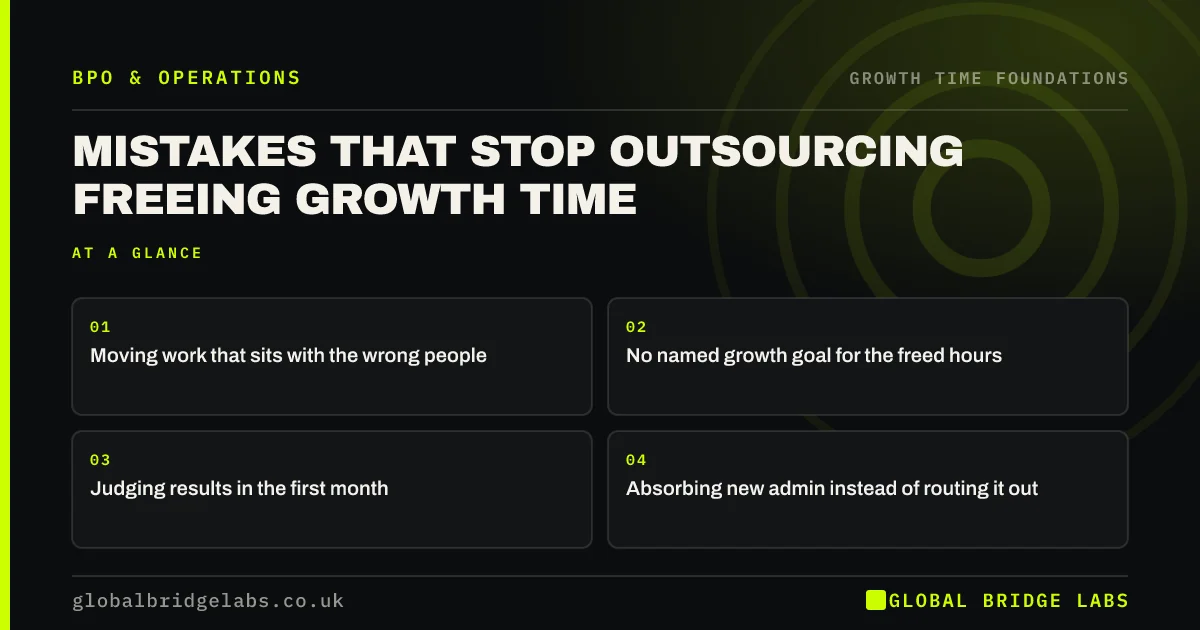
Outsourcing fails to free growth time for predictable reasons: the wrong work moves, nobody names what the hours are for, the handover is judged too early, admin creeps back and nobody checks where time went. Each mistake is avoidable with a little planning before the handover and a fortnightly check after it.
- Moving work that sits with the wrong people.
- No named growth goal for the freed hours.
- Judging results in the first month.
- Absorbing new admin instead of routing it out.
- Measuring hours saved but not growth outcomes.
Want your outsourcing plan checked for these mistakes? Message us on WhatsApp.
Chat on WhatsApp →Why does outsourcing often fail to free growth time?
Outsourcing often fails to free growth time because firms plan the handover but not the hours. The work moves, the team gets lighter for a few weeks, and then meetings, small requests and new admin fill the gap. Growth time needs its own plan: goals, owners, diary blocks and checks.
What are the most common mistakes?
- Wrong work: moving tasks from roles that were never going to do growth work.
- No goal: freed hours with no named purpose.
- Too early: judging the handover before the learning period ends.
- Admin creep: new routine work absorbed by the team instead of routed out.
- Over-supervising: checking the provider far more than needed.
- Wrong measure: counting hours saved instead of growth produced.
How do you avoid them?
Pick work from growth roles first. Write the allocation before the handover. Expect a dip for four to six weeks. Agree a route for new admin. Set a light checking routine that tapers over three months. Report growth outcomes alongside hours.
When is the mistake on the provider's side?
When quality is poor and your team spends hours fixing output, the problem is the brief or the provider. Tighten instructions and acceptance criteria first; if errors persist after six to eight weeks, review the provider.
What does this look like in practice?
A pattern we see: a firm outsources data entry from its administrator, whose role was already admin. Growth time does not change. Moving instead the reporting and quote preparation done by its two sales leads frees fewer hours in total but doubles their selling time.
Mistake check
- Is the work coming from growth roles?
- Is every freed hour named?
- Have you allowed for the handover dip?
- Is there a route for new admin?
- Are you measuring growth outcomes?
Next step
Run the five questions against your current or planned handover. Any no is a gap to close this week.
Message us on WhatsApp to review your outsourcing plan, or book a 30-minute consultation.
Chat on WhatsApp →Sources and further reading
- Multitasking: switching costs · American Psychological Association
- Controllers and processors · Information Commissioner's Office
Frequently asked questions
Why didn't outsourcing free up any time?
Common causes are moving work from the wrong roles, leaving freed hours without a named goal, judging too early in the handover, and letting new admin flow back to the team. Check where the hours went for two weeks; the answer is usually obvious once you look.
How long before outsourcing frees time?
Expect four to six weeks of learning, during which your team briefs, answers questions and checks output. Freed time usually becomes noticeable in the second month. If after three months your team is no less busy, review the work moved and where the hours are going.
What is the biggest mistake when outsourcing to free time?
Not deciding what the freed time is for. Without a named growth goal and an owner, the hours fill with meetings, polishing and small requests within weeks. Writing a one-line allocation for each person before the handover prevents most of the problem.
Written by

Global Bridge Labs (GBL) is a UK–Sri Lanka partner for social media, websites and BPO. Everything here comes from client delivery, not theory.