On this page
Key takeaways
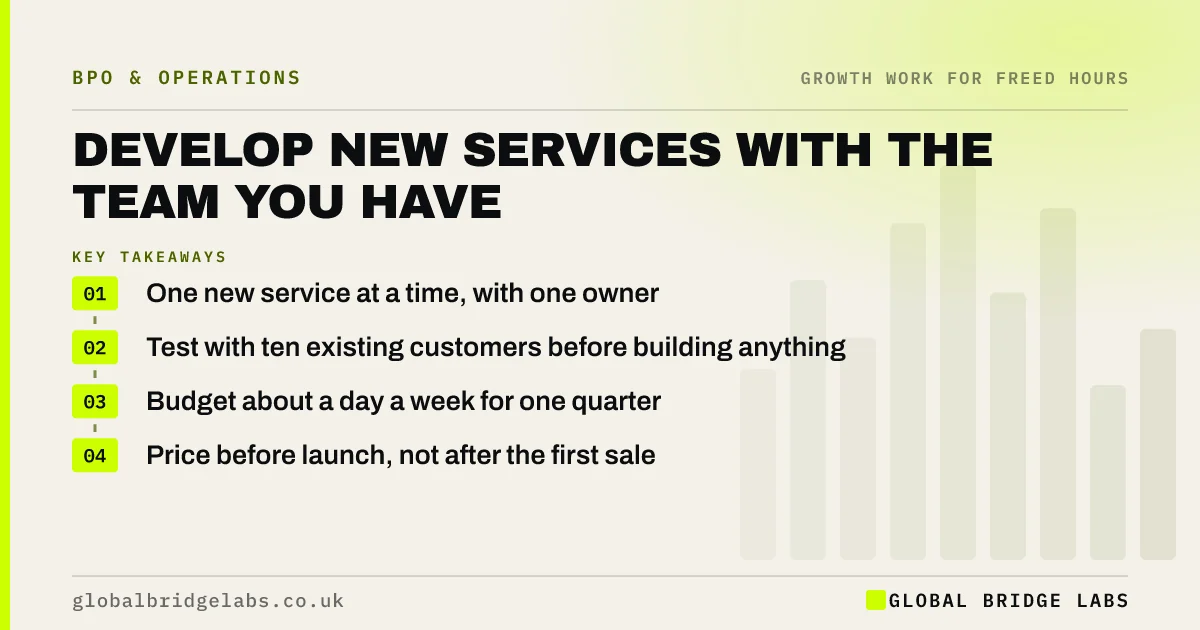
Most small firms have a new service idea that never gets developed because the team is busy delivering the current ones. Freed hours from outsourcing can fund it: scope one service, test it with ten existing customers, price it and launch a pilot. Give it a single owner and a 90-day deadline so it does not drift.
- One new service at a time, with one owner.
- Test with ten existing customers before building anything.
- Budget about a day a week for one quarter.
- Price before launch, not after the first sale.
Want to plan a new service with your freed hours? Message us on WhatsApp.
Chat on WhatsApp →Why do new services never get developed?
New services never get developed because development work has no customer waiting for it. The people who understand the business best are the people delivering today's services, and delivery always wins. Freeing their routine hours is often the only way to give a new service the attention it needs.
How do you develop a new service in 90 days?
If the work involves resolving genuine scientific or technological uncertainty, HMRC's research and development relief guidance explains what may qualify. Most service development will not, but it is worth checking.
- Weeks 1 to 2: write a one-page description of the problem, customer and offer.
- Weeks 3 to 5: test the idea in conversations with ten existing customers.
- Weeks 6 to 8: define scope, delivery steps and price.
- Weeks 9 to 12: run a paid pilot with two or three customers.
Who should own it?
One person, with protected hours and a manager who reviews progress fortnightly. Shared ownership usually means no ownership. Choose someone who knows the customers and has some commercial judgement.
When should you not launch a new service?
When the current services have quality problems, when the new service needs skills nobody has, or when customer testing shows weak interest. Stopping after the testing stage is a good outcome; it saves months.
What does this look like in practice?
A pattern we see: an accountancy practice frees a manager 8 hours a week by moving bookkeeping data entry out. She develops a cash flow forecasting service for existing clients, tests it with ten, and launches with four paying clients in the first quarter.
New service checklist
- Write the one-page service description.
- Name one owner with protected hours.
- Test with ten existing customers.
- Set scope, delivery steps and price.
- Run a paid pilot and review after 90 days.
Next step
Write the one-page description for the service idea that has waited longest. If you cannot fill the page, the idea needs more customer conversations first.
Message us on WhatsApp for the new service one-pager, or book a 30-minute consultation.
Chat on WhatsApp →Sources and further reading
- Corporation Tax: research and development (R&D) relief · HM Revenue & Customs
- Write a business plan · GOV.UK
Frequently asked questions
How do you develop a new service for a small business?
Describe the problem, customer and offer on one page, test the idea with around ten existing customers, define the scope and price, then run a paid pilot with two or three customers. Give one person ownership and protected hours, and set a 90-day deadline to decide whether to launch.
How long does it take to launch a new service?
For a small firm, about 90 days from idea to paid pilot is realistic if one person has 6 to 10 protected hours a week. It takes much longer when development is squeezed between delivery work, which is why freeing routine hours often matters more than the idea itself.
Should you test a new service before launching it?
Yes. Ask existing customers whether the problem matters to them, what they do about it now and what they would pay. Then run a small paid pilot. Testing first avoids building a service nobody buys, and paid pilots show real demand far better than survey answers.
Written by

Global Bridge Labs (GBL) is a UK–Sri Lanka partner for social media, websites and BPO. Everything here comes from client delivery, not theory.