On this page
Key takeaways
UK productivity, output per hour worked, has grown slowly for years, and the Office for National Statistics tracks it closely. For an individual small firm, one practical lever is making sure skilled people spend their hours on high-value work rather than routine admin. Moving routine work out and redirecting freed hours to growth raises output per person without longer hours.
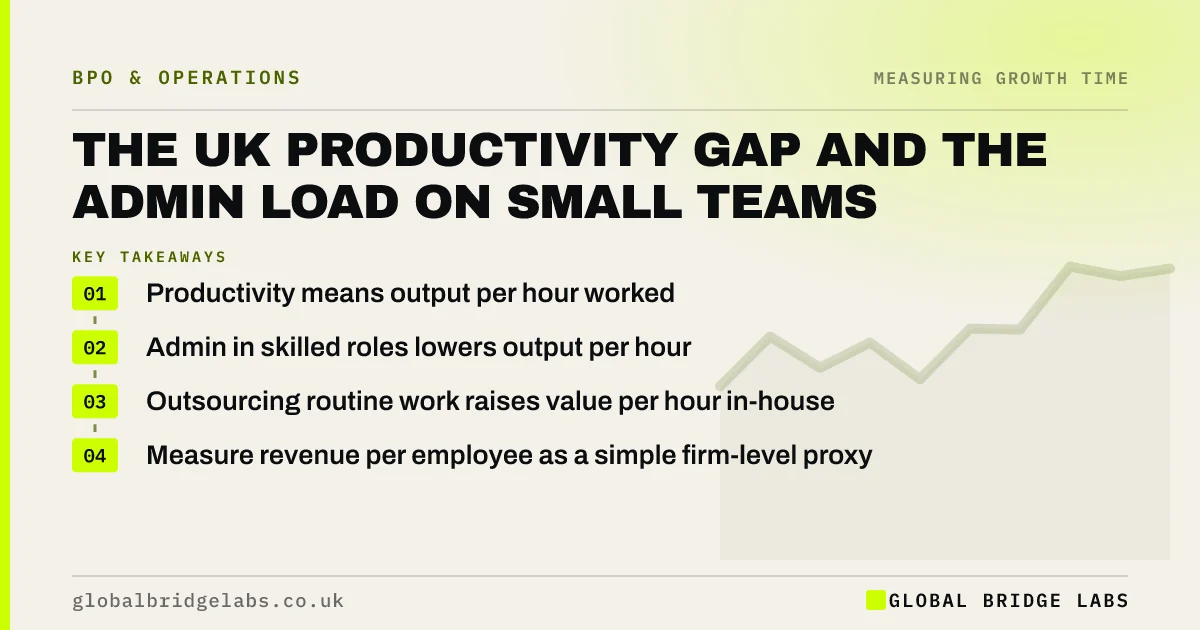
- Productivity means output per hour worked.
- Admin in skilled roles lowers output per hour.
- Outsourcing routine work raises value per hour in-house.
- Measure revenue per employee as a simple firm-level proxy.
Want to talk through productivity in your team? Message us on WhatsApp.
Chat on WhatsApp →What is the UK productivity gap?
Labour productivity measures output per hour worked. The Office for National Statistics publishes UK productivity statistics, and growth has been weak for over a decade compared with earlier periods. Small firms make up most UK businesses, with 5.7 million private sector businesses counted at the start of 2025, so their productivity matters to the national picture.
How does admin affect small firm productivity?
When skilled, well-paid people spend hours on routine admin, the business pays high rates for low-value output. Output per hour falls even if everyone is busy. In small firms, there is often no one else to do the admin, so it spreads across every role.
What can a small firm do?
- Measure where time goes by role.
- Remove unnecessary admin first.
- Automate where software is reliable.
- Move routine admin to an outside team.
- Redirect freed hours to growth goals.
When does this not raise productivity?
When freed hours fill with low-value work, or when the outsourced work creates more coordination than it saves. Measure revenue per employee before and after to check.
What does this look like in practice?
A pattern we see: a 15-person firm's revenue per employee has been flat for three years. Moving 35 hours a week of routine work out and redirecting it to account growth lifts revenue per employee by the second year without adding headcount.
Productivity checklist
- Measure time by role.
- Remove, automate, then outsource admin.
- Redirect freed hours to growth.
- Track revenue per employee.
- Review annually.
Next step
Calculate your revenue per employee for the last three years. If it is flat, look at where your skilled people's hours go.
Message us on WhatsApp to discuss productivity in your team, or book a 30-minute consultation.
Chat on WhatsApp →Sources and further reading
- Labour productivity · Office for National Statistics
- Business population estimates for the UK and regions 2025 · Department for Business and Trade
- Small Business Survey reports · Department for Business and Trade
Frequently asked questions
Why is UK productivity low?
Economists point to several factors, including investment levels, management practices, skills and the spread of new technology. The ONS publishes the official productivity statistics. For an individual small firm, the practical question is narrower: are skilled people spending their hours on the highest-value work?
How can a small business improve productivity?
Measure where time goes, remove unnecessary work, automate reliable tasks, move routine admin out and redirect skilled people's hours to higher-value work. Track revenue per employee over time as a simple measure of whether the changes are working. The key is to decide in advance, write it down and check it at regular reviews.
Does outsourcing improve productivity?
It can raise output per hour inside the business by moving routine work away from skilled people, provided the freed hours go to higher-value work. If freed time fills with low-value tasks, productivity does not change, so redirecting the hours is essential.
Written by

Global Bridge Labs (GBL) is a UK–Sri Lanka partner for social media, websites and BPO. Everything here comes from client delivery, not theory.