On this page
Key takeaways
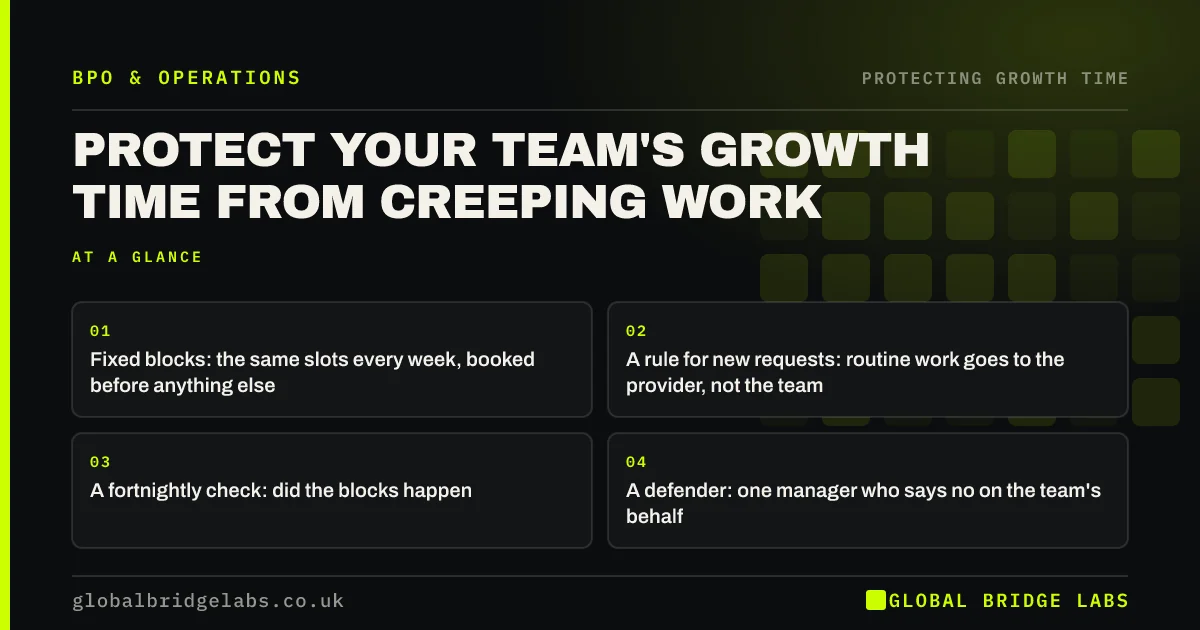
Protecting your team's growth time takes four habits: fixed growth blocks in diaries, a clear rule for where new routine requests go, a fortnightly check of where hours went, and a manager who defends the time when pressure rises. Without them, freed hours from outsourcing are reabsorbed within two months.
- Fixed blocks: the same slots every week, booked before anything else.
- A rule for new requests: routine work goes to the provider, not the team.
- A fortnightly check: did the blocks happen?
- A defender: one manager who says no on the team's behalf.
Want help setting up growth time habits? Message us on WhatsApp.
Chat on WhatsApp →Why does growth time need protecting?
Growth time needs protecting because every other kind of work arrives with someone asking for it. Customers, colleagues and suppliers all have a claim on the team's day; growth work has none. Unless growth time is fixed in advance and defended, it is the first thing given up whenever the week gets busy.
What are the four habits?
Fixed blocks put growth work in diaries as recurring appointments, ideally half-days. A request rule says that new routine work goes to the outside team or waits for a weekly triage. A fortnightly check compares planned and actual growth hours. A defender, usually the line manager, protects the blocks when someone tries to book over them.
- Blocks: two or three per week per person.
- Rule: written down and shared with the whole team.
- Check: ten minutes every other Friday.
- Defender: named, with authority to say no.
What does protection cost?
Very little time, but some discipline. The fortnightly check takes ten minutes; the request rule needs a few weeks to become habit. The Health and Safety Executive's Management Standards highlight control over work as a factor in stress, and protected blocks give people more of it.
When should protection give way?
In a genuine crisis, such as a system failure or a major customer issue, growth time should flex. The test is frequency: once a quarter is a crisis, once a week is a habit. If blocks are cancelled weekly, the request rule is not working.
What does this look like in practice?
A pattern we see: a firm frees 20 hours a week but growth blocks are cancelled half the time. Naming the operations manager as defender and routing new admin to the provider through one shared inbox brings attendance at growth blocks to over 80% within a month.
Protection checklist
- Book recurring growth blocks for each person.
- Write the request rule and share it.
- Name the defender.
- Run the fortnightly check.
- Review cancelled blocks monthly.
Next step
Book next month's growth blocks today, before the diary fills. Then write the request rule in one sentence.
Message us on WhatsApp for the growth time protection checklist, or book a 30-minute consultation.
Chat on WhatsApp →Sources and further reading
- Multitasking: switching costs · American Psychological Association
- What are the Management Standards for work-related stress? · Health and Safety Executive
Frequently asked questions
How do you protect time for strategic work?
Book recurring blocks for it before other work is scheduled, set a rule for where new routine requests go, check every fortnight whether the blocks happened, and give a manager authority to defend them. Moving routine work out to an outside team removes the main source of interruptions.
What should happen when urgent work clashes with growth time?
Ask whether it is genuinely urgent or just arrived. Genuine crises can take the slot, and the growth block is rebooked the same week. Routine requests should go to the outside team or wait for triage. If clashes happen every week, the routing rule needs fixing.
How long does it take for growth time habits to stick?
Usually four to eight weeks of consistent practice. The first month needs active defending by a manager. After that, colleagues learn that growth blocks are not available for meetings and requests drop. Fortnightly checks help catch slippage early. Expect some slippage in busy weeks; what matters is that blocks are rebooked rather than dropped.
Written by

Global Bridge Labs (GBL) is a UK–Sri Lanka partner for social media, websites and BPO. Everything here comes from client delivery, not theory.