On this page
- 01Key takeaways
- 02Why do service levels affect team time?
- 03Which service levels protect time?
- 04How do you measure them?
- 05When can these service levels be too strict?
- 06What does this look like in practice?
- 07Team time service level checklist
- 08Next step
- 09Sources and further reading
- 10Frequently asked questions
Key takeaways
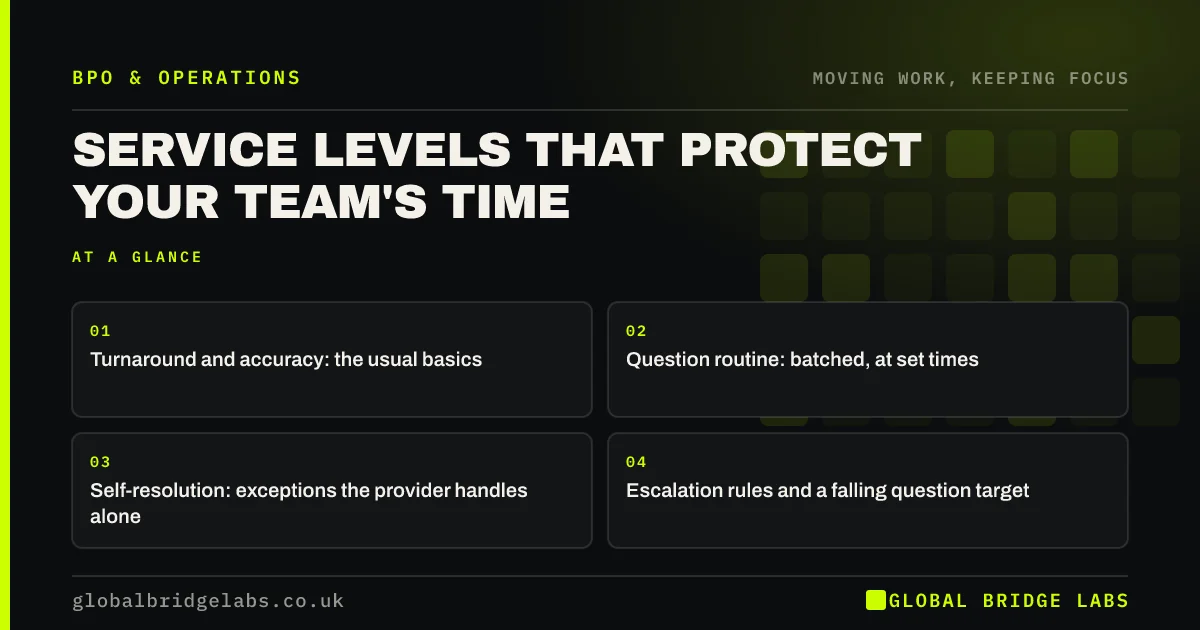
Standard service levels cover accuracy and turnaround. To protect your team's growth time, add a few more: how questions are batched, what the provider resolves itself, what counts as an escalation and how fast the question volume should fall. These turn the service agreement into a tool for keeping freed hours free.
- Turnaround and accuracy: the usual basics.
- Question routine: batched, at set times.
- Self-resolution: exceptions the provider handles alone.
- Escalation rules and a falling question target.
Want help adding team time to your service levels? Message us on WhatsApp.
Chat on WhatsApp →Why do service levels affect team time?
Because a provider that meets turnaround and accuracy targets can still consume your team's time with constant questions and escalations. If every exception comes back to your team, the freed hours shrink. Service levels that cover how the provider interacts with your team protect those hours.
Which service levels protect time?
- Questions batched into one or two daily slots.
- A list of exceptions the provider resolves without asking.
- Escalations only for defined categories, to a named person.
- Question volume falling month on month for the first quarter.
- New routine work proposed for scope, not returned to your team.
How do you measure them?
Log questions and escalations by category each month. Review the log with the provider and add answers to the instructions. A falling count shows the provider is learning and your team's time is being protected.
When can these service levels be too strict?
In the first weeks, when the provider genuinely needs to ask more. Phase them in over the first month and keep safety-critical or compliance escalations unrestricted.
What does this look like in practice?
A pattern we see: a provider meets all turnaround targets but escalates around 40 items a week. A self-resolution list and a batched question routine bring that down sharply within two months.
Team time service level checklist
- Keep accuracy and turnaround measures.
- Add a batched question routine.
- List exceptions the provider resolves.
- Define escalation categories.
- Track question volume monthly.
Next step
Count last month's questions and escalations from your provider. That number is the baseline for your new service levels.
Message us on WhatsApp for team time service level examples, or book a 30-minute consultation.
Chat on WhatsApp →Sources and further reading
- Contracts and liabilities between controllers and processors · Information Commissioner's Office
- The Sourcing and Consultancy Playbooks · Cabinet Office
Frequently asked questions
What should a service level agreement include?
Accuracy, turnaround and availability, plus how questions are handled, which exceptions the provider resolves itself, what counts as an escalation and how scope changes are managed. Adding these interaction measures protects your team's time as well as the quality of the work.
How do you reduce questions from an outsourcing provider?
Batch questions into set times, give the provider a list of exceptions it can resolve, add every answer to the instructions and review the question log monthly. A falling question count is a good sign that the handover is maturing.
Should escalations be limited in an SLA?
Routine escalations should be limited to defined categories and routed to a named person, with the categories reviewed as the provider learns. Safety, compliance and data protection issues should never be restricted; the provider must raise those immediately. Revisit the answer each quarter, because team capacity and priorities change as the business grows.
Written by

Global Bridge Labs (GBL) is a UK–Sri Lanka partner for social media, websites and BPO. Everything here comes from client delivery, not theory.