On this page
Key takeaways
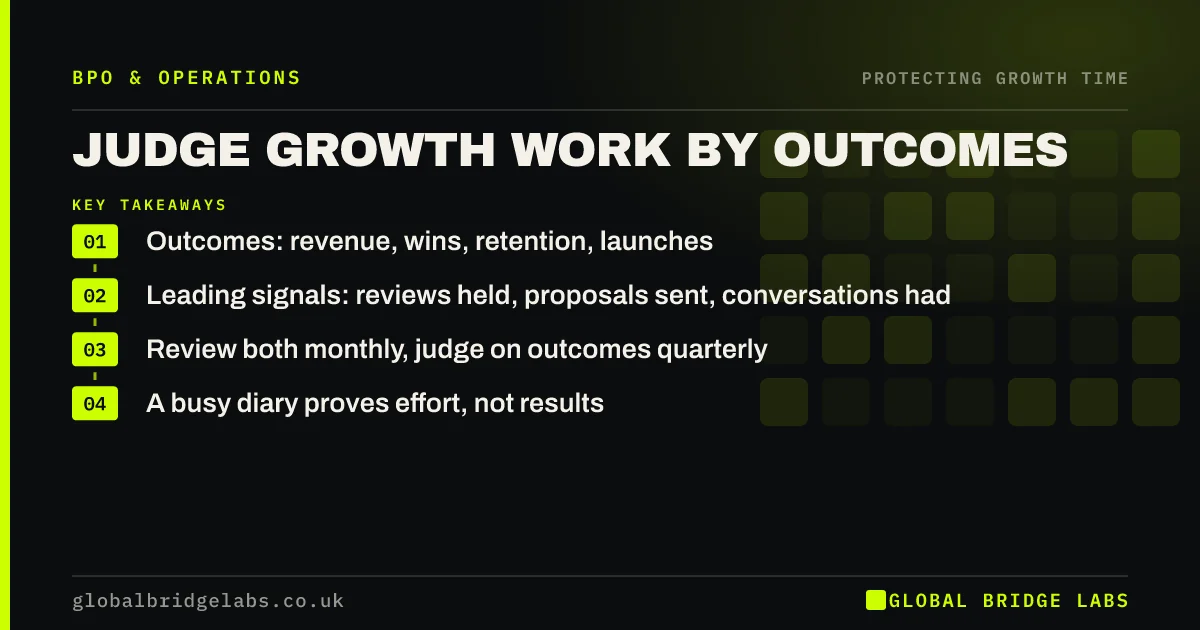
Judge growth work by what it produced, not by how busy people look. Outcomes such as revenue from expanded accounts, proposals won, retention, new services launched and partners active show whether freed time is paying off. Activity measures, like meetings held, are useful early signals but are not the goal.
- Outcomes: revenue, wins, retention, launches.
- Leading signals: reviews held, proposals sent, conversations had.
- Review both monthly, judge on outcomes quarterly.
- A busy diary proves effort, not results.
Want help choosing growth outcome measures? Message us on WhatsApp.
Chat on WhatsApp →Why judge by outcomes?
Because a busy diary looks the same whether the time produced growth or not. After outsourcing, the question is whether freed hours turned into revenue, retention or new capability. Judging by activity rewards people for appearing busy and can hide the fact that growth work is not working.
What should you measure?
Pair each with a leading signal you can see sooner, such as reviews held or conversations completed.
- Revenue from existing accounts, quarter on quarter.
- Customer retention rate.
- Proposal win rate and value won.
- New services or products launched.
- Active partners and referrals received.
How often should you review?
Look at leading signals monthly and outcomes quarterly. Many growth outcomes take a full sales cycle to show, so judging after one month is premature.
When can outcomes mislead?
When the market moves for reasons outside your control, or when a single large deal distorts a quarter. Look at trends over two or three quarters and discuss context, not just numbers.
What does this look like in practice?
A pattern we see: a team reports 40 customer calls a month after outsourcing. Revenue from those customers has not moved. Changing the measure from calls to revenue per account reviewed shifts the calls towards customers with real growth potential.
Outcome measure checklist
- Choose three or four outcome measures.
- Add a leading signal for each.
- Review signals monthly.
- Judge outcomes quarterly.
- Discuss trends, not single months.
Next step
For each growth goal, write the one outcome that would show it worked. Use that as your quarterly measure.
Message us on WhatsApp for a growth outcomes scorecard, or book a 30-minute consultation.
Chat on WhatsApp →Sources and further reading
- Employee earnings in the UK (Annual Survey of Hours and Earnings) · Office for National Statistics
- UK Customer Satisfaction Index · Institute of Customer Service
Frequently asked questions
How do you measure the success of growth work?
Measure the outcomes it is meant to produce: revenue from existing accounts, retention, proposal win rate, new services launched and partner referrals. Track a leading signal for each, such as reviews held, monthly, and judge the outcomes quarterly against the goals you set.
What is the difference between activity and outcome measures?
Activity measures count effort, such as calls made or meetings held. Outcome measures count results, such as revenue won or customers retained. Activity is a useful early signal, but only outcomes show whether freed time is producing growth. Track a few of each, and make sure every activity measure links to an outcome you care about.
How long before growth work shows results?
Leading signals such as reviews and proposals show within weeks. Revenue outcomes usually take one or two quarters, depending on your sales cycle. Judge first results at 90 days and look for trends over two or three quarters rather than single months.
Written by

Global Bridge Labs (GBL) is a UK–Sri Lanka partner for social media, websites and BPO. Everything here comes from client delivery, not theory.