On this page
Key takeaways
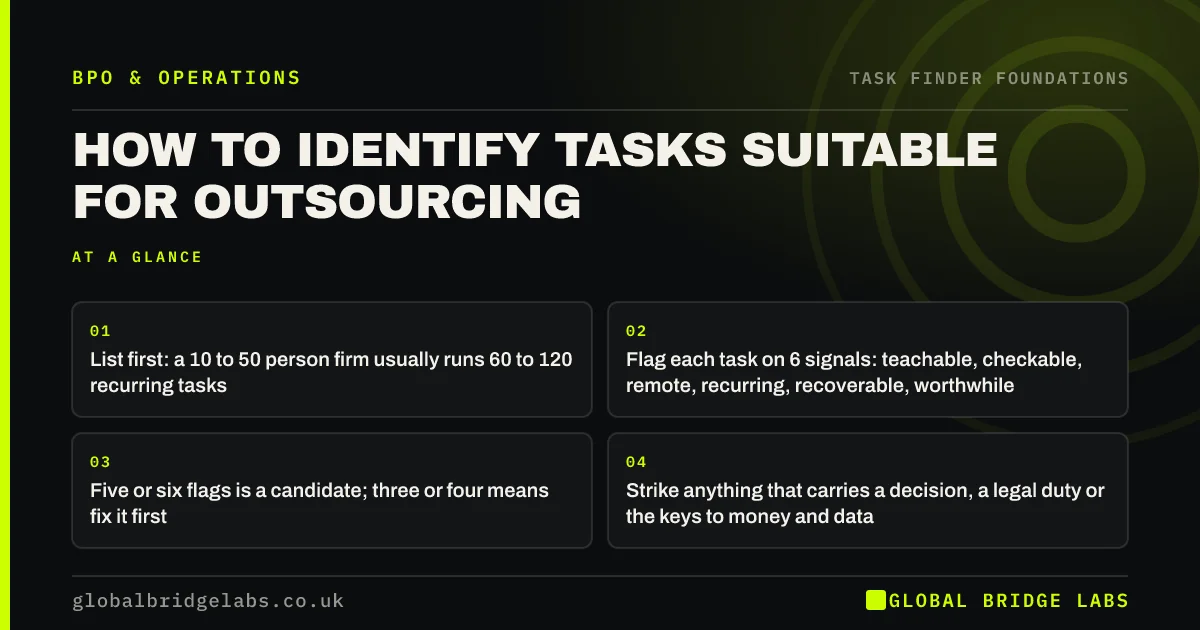
To prioritise tasks to outsource, rank the tasks that passed screening by three things: hours a week, risk and handover effort. Put high-hours, low-risk, low-effort tasks first. A task taking 6 hours a week that can be learnt in a week beats a 10-hour task that needs a month of training and carries more risk.
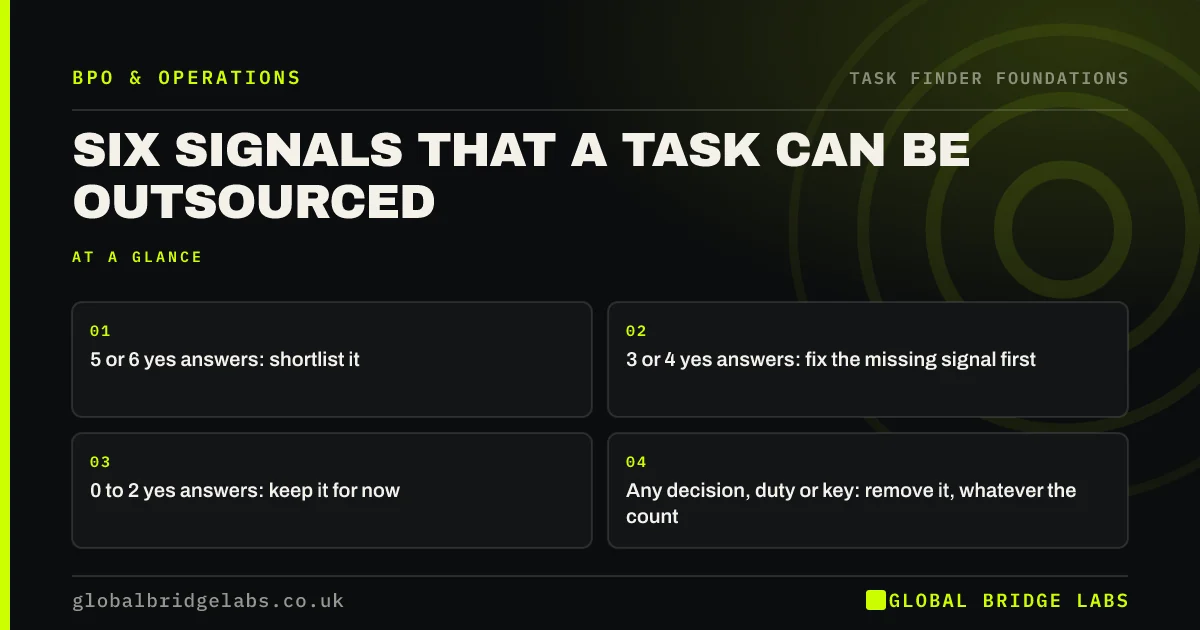
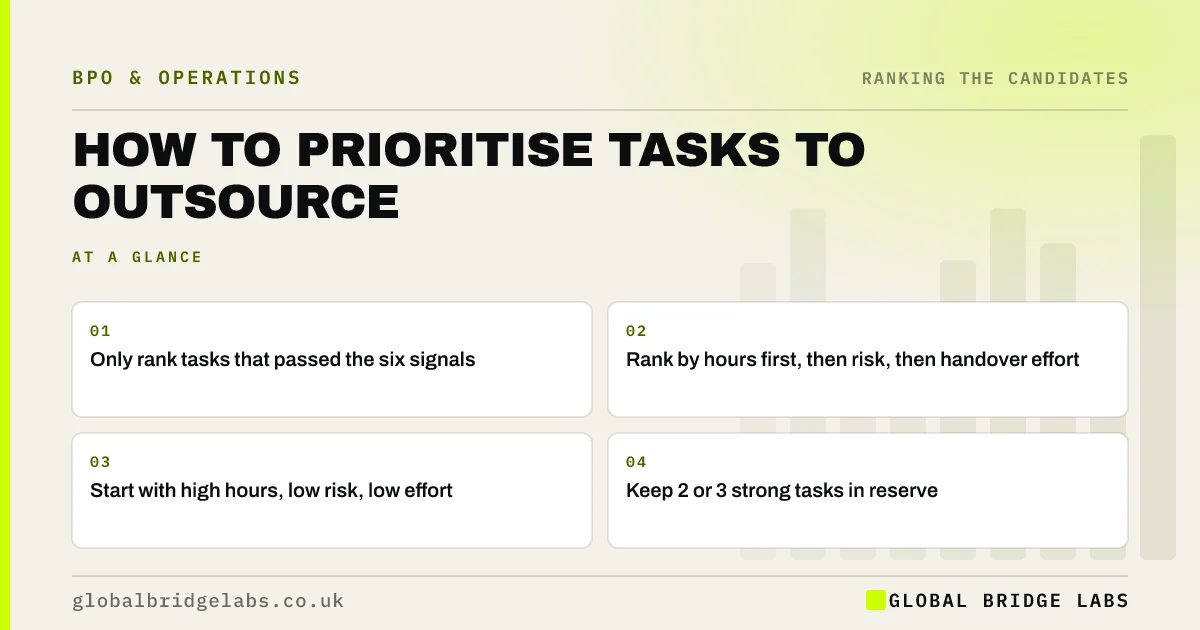
- Only rank tasks that passed the six signals.
- Rank by hours first, then risk, then handover effort.
- Start with high hours, low risk, low effort.
- Keep 2 or 3 strong tasks in reserve.
Want your candidates ranked with you? Message us on WhatsApp.
Chat on WhatsApp →Why not just start with the biggest task?
Because the biggest task is often the riskiest or hardest to hand over. A first handover should succeed quickly, so the team learns how outsourcing works and trust builds. A well-chosen medium task done well in a month is worth more than a large task that drags for a quarter.
How do you rank the candidates?
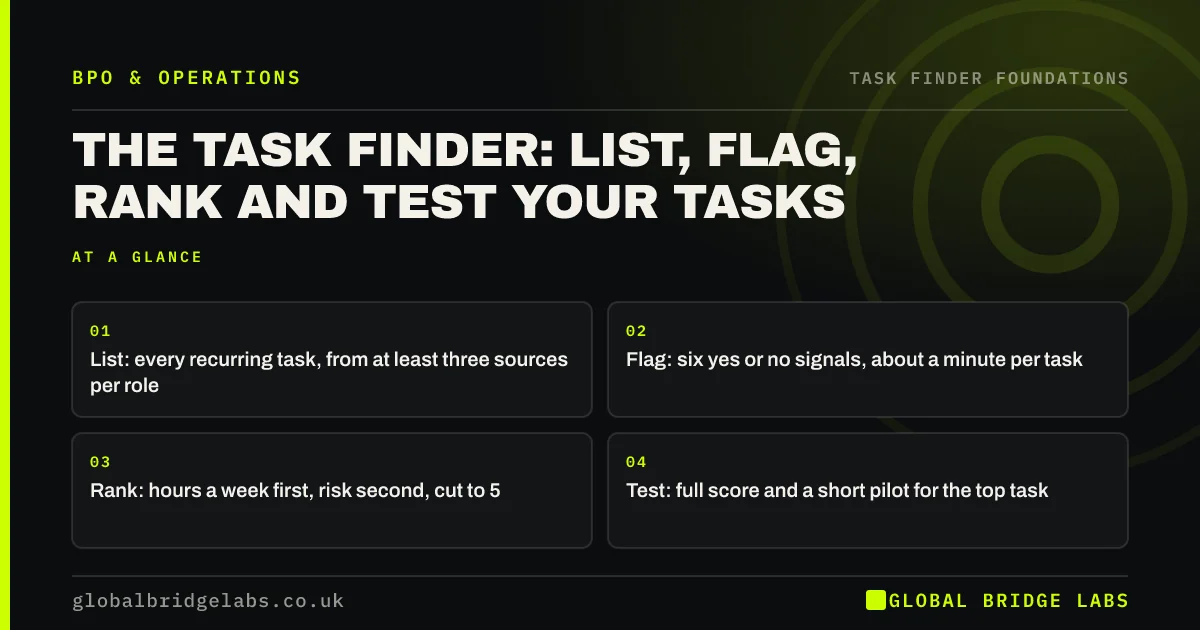
Use a simple three-column sort, not a complex score.
- 1. Hours a week, to the nearest half hour.
- 2. Risk: low, medium or high.
- 3. Handover effort: days, weeks or months.
- 4. Sort by risk (low first), then effort (low first), then hours (high first).
- 5. Take the top five as your shortlist.
When should a high-risk task come first?
Rarely, but sometimes. If a high-risk task is already failing in-house, such as payroll prep done late every month, moving it with tight controls may reduce risk overall. In that case, add checks before release and run the old and new ways side by side for a cycle before switching.
What does this look like in practice?
A pattern we see: an owner wants to start with customer service, a large block but medium risk and slow to learn. Ranking puts order and record updates first: smaller, low risk and quick to learn. It goes live quickly, and customer service follows once routines are proven.
Prioritisation checklist
- Rank only screened tasks.
- Estimate hours, risk and handover effort.
- Sort low risk and low effort to the top.
- Take five as your shortlist.
- Revisit the order after the first handover.
Next step
Add hours, risk and effort columns to your screened list and sort it. The top line is your first candidate.
Message us on WhatsApp for the ranking sheet, or book a 30-minute consultation.
Chat on WhatsApp →Sources and further reading
- The Sourcing and Consultancy Playbooks · Cabinet Office
- Human factors: managing human failures · Health and Safety Executive
Frequently asked questions
How do I decide which task to outsource first?
Rank the tasks that pass screening by risk, handover effort and hours. Start with a low-risk task that can be learnt quickly and takes a meaningful number of hours each week. Early success builds trust and teaches you how to manage outsourced work.
Should I outsource my biggest task first?
Usually not. The biggest task is often harder to learn or riskier, which makes the first handover slow. Start with a medium-sized, low-risk task, get it running well, and move larger tasks once the working relationship and routines are established.
How many tasks should I outsource at once?
One at the start, or a small bundle of closely related tasks. Add the next once the first has been stable for about a month. Moving several unrelated tasks at once splits your attention and makes problems harder to trace.
Written by

Global Bridge Labs (GBL) is a UK–Sri Lanka partner for social media, websites and BPO. Everything here comes from client delivery, not theory.