On this page
Key takeaways
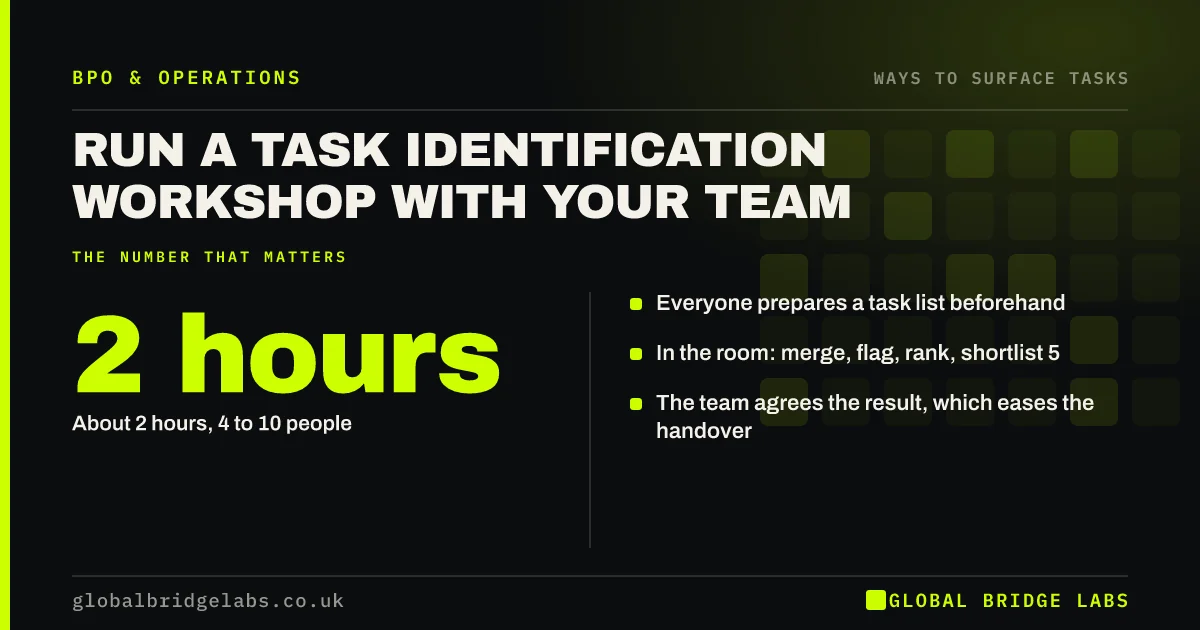
A task identification workshop brings the people who do the work together for about two hours to list, flag and rank recurring tasks. Ask everyone to prepare a list from their diary and inbox beforehand. In the room, merge the lists, flag each task against the six signals and agree a shortlist of five. The team owns the result.
- About 2 hours, 4 to 10 people.
- Everyone prepares a task list beforehand.
- In the room: merge, flag, rank, shortlist 5.
- The team agrees the result, which eases the handover.
Want the workshop agenda and templates? Message us on WhatsApp.
Chat on WhatsApp →How is this different from a process workshop?
A process selection workshop judges whole end-to-end processes. A task identification workshop works one level down: the individual recurring tasks inside roles, many of which sit across several processes. Use the task workshop when work is scattered across people, and the process workshop when one flow is the problem.
What is the agenda?
Keep each block to time.
- 10 minutes: purpose and ground rules.
- 30 minutes: merge prepared lists and remove duplicates.
- 40 minutes: flag every task against the six signals.
- 20 minutes: strike decisions, duties and keys.
- 20 minutes: rank survivors and agree a shortlist of five.
How do you keep the workshop honest?
Set ground rules: the workshop is about work, not people; nobody's role is being judged; and decisions about jobs are separate. Use records, not opinions, for frequency. Have someone neutral facilitate if you can. Teams that feel safe list far more tasks, including the ones they would quite like to lose.
What does this look like in practice?
A pattern we see: a team arrives with overlapping lists. Merging removes the duplicates, flagging and striking cut the list sharply, and ranking produces a shortlist of five. The team suggests some of the five themselves, which makes the later handover easier.
Workshop checklist
- Send the list template a week ahead.
- Set ground rules at the start.
- Merge, flag, strike and rank in that order.
- Agree a shortlist of five before you leave.
- Share the result with the whole team.
Next step
Book a two-hour slot and send the task list template to everyone a week before. The preparation does half the work.
Message us on WhatsApp for the agenda and templates, or book a 30-minute consultation.
Chat on WhatsApp →Sources and further reading
- User research · GOV.UK Service Manual
- Business transfers, takeovers and TUPE · GOV.UK
Frequently asked questions
How do you run a workshop to find tasks to outsource?
Ask participants to prepare a list of their recurring tasks from diaries and inboxes. In a two-hour session, merge the lists, flag each task against six signals, strike decisions and duties, rank the survivors by hours and risk, and agree a shortlist of five.
Who should attend a task identification workshop?
The people who do the work, not just managers, because they know the small tasks. Four to ten people is a workable group. Include at least one person who can make decisions, so the shortlist is agreed before the session ends.
Will staff worry about their jobs?
Some may. Be clear that the workshop is about work, not about people or roles, and explain what freed time will be used for. Separate any decisions about jobs from the workshop entirely, and follow employment law if roles may change.
Written by

Global Bridge Labs (GBL) is a UK–Sri Lanka partner for social media, websites and BPO. Everything here comes from client delivery, not theory.