On this page
Key takeaways
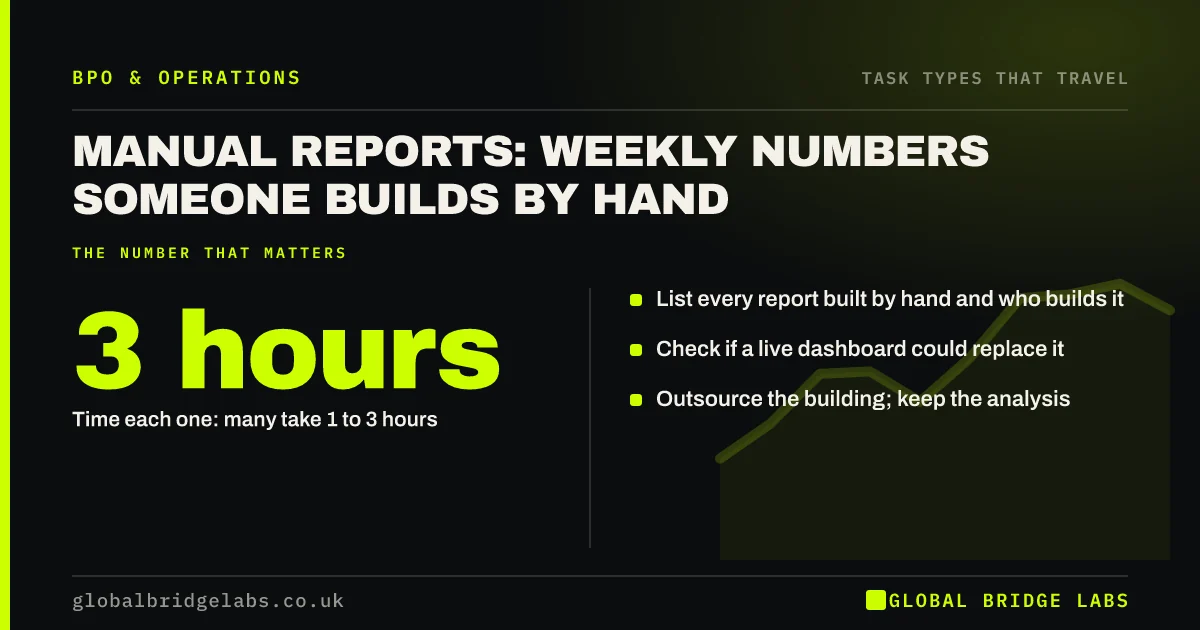
Manual reporting tasks are reports someone builds by hand each week or month: exporting from systems, pasting into spreadsheets, tidying and sending. They are strong outsourcing candidates because the steps repeat exactly and the output is easy to check. Keep the analysis and the decisions inside; move the building. Check first whether a dashboard could replace the report.
- List every report built by hand and who builds it.
- Time each one: many take 1 to 3 hours.
- Check if a live dashboard could replace it.
- Outsource the building; keep the analysis.
Want your manual reports listed and sized? Message us on WhatsApp.
Chat on WhatsApp →Why do manual reports cost more than they seem?
Each one takes an hour or two, so nobody counts them. But a business with six weekly reports and four monthly ones can easily spend a day a week building numbers. The work often falls to managers, who then have less time to act on what the reports show.
How do you find manual reports?
Ask the people who receive reports, not just those who build them.
- List every regular report anyone receives.
- Find who builds each and how long it takes.
- Note the data sources and steps.
- Ask recipients which reports they actually use.
- Stop the ones nobody uses.
Should you automate or outsource reports?
Automate when the data is clean and sources connect easily: a dashboard updated live replaces the task. Outsource when data needs cleaning, comes from several systems that do not connect, or needs a quick sense check. Many firms outsource the build first, then automate once the format settles.
What does this look like in practice?
A pattern we see: a management team receives a stack of regular reports. Some are not read and stop. The rest are built by hand from several systems and move to an outside team, who deliver them before the Monday meeting.
Manual reporting checklist
- List every regular report and its builder.
- Time each build.
- Stop reports nobody uses.
- Automate where data connects cleanly.
- Outsource the rest with a delivery deadline.
Next step
Ask your managers to list every report they build or receive. Time the builds and ask who reads each one.
Message us on WhatsApp for the report inventory template, or book a 30-minute consultation.
Chat on WhatsApp →Sources and further reading
- Labour productivity · Office for National Statistics
- Principle (d): Accuracy · Information Commissioner's Office
Frequently asked questions
Can report preparation be outsourced?
Yes. Building regular reports from system exports, cleaning the data and formatting the results follows the same steps each time, which makes it easy to hand over. Keep the interpretation and decisions inside, with the outside team delivering the finished report to an agreed deadline.
Should I automate reports instead?
Where the data is clean and the systems connect, a live dashboard is usually better because the task disappears. Where data is messy or comes from systems that do not connect, a person is still needed. Many firms outsource first and automate once the format is stable.
How do I know which reports are worth keeping?
Ask the people who receive them what decision each report supports. If nobody can name one, stop the report for a month and see if anyone asks for it. Many businesses cut a quarter of their reports this way before outsourcing the rest.
Written by

Global Bridge Labs (GBL) is a UK–Sri Lanka partner for social media, websites and BPO. Everything here comes from client delivery, not theory.