On this page
Key takeaways
Screen tasks before outsourcing with fast yes or no questions, then spend real scoring time only on the shortlist. Screening a list of 80 tasks takes about 90 minutes; scoring all 80 in depth would take days. The two steps answer different questions: screening asks 'is this worth a look?', scoring asks 'how ready is it?'
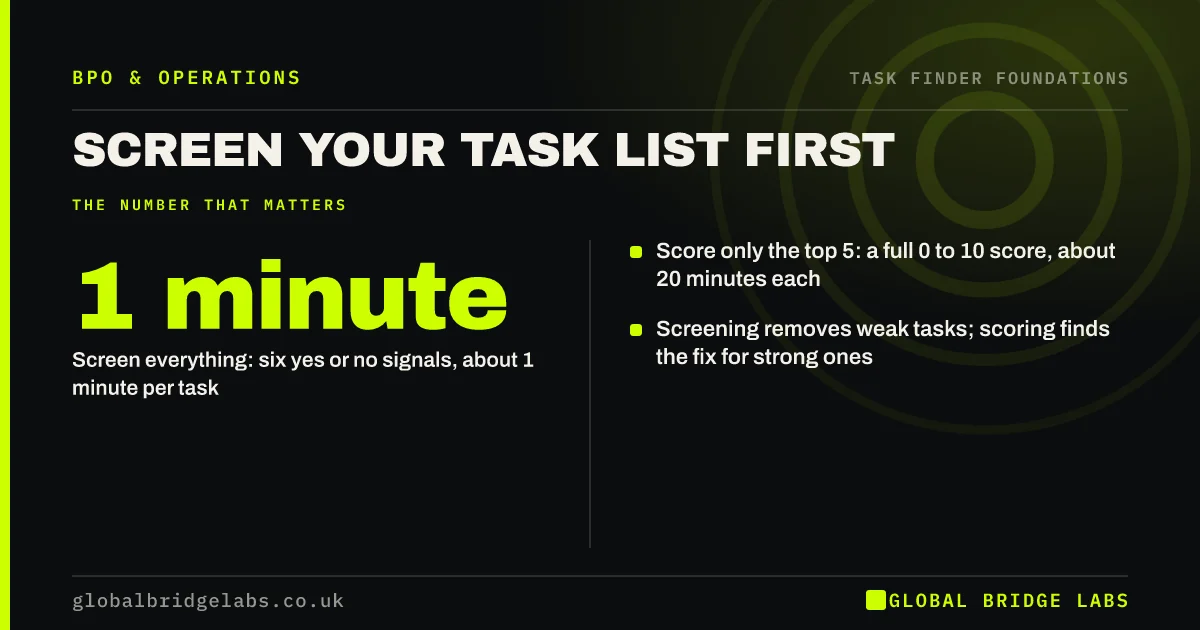
- Screen everything: six yes or no signals, about 1 minute per task.
- Score only the top 5: a full 0 to 10 score, about 20 minutes each.
- Screening removes weak tasks; scoring finds the fix for strong ones.
Want help screening a long list quickly? Message us on WhatsApp.
Chat on WhatsApp →What is the difference between screening and scoring?
Screening is a coarse filter applied to every task on a long list, using simple yes or no questions so the team can agree fast. Scoring is a detailed assessment of a few tasks, using graded criteria so you can see exactly which weakness to fix before handover. Screening is about breadth; scoring is about depth.
Why not score every task?
Because detailed scoring invites detailed debate. Two managers will argue whether a task deserves a 1 or a 2 on stability, and the meeting runs out of time halfway down the list. Yes or no questions are easier to agree on and make the weak tasks obvious, so effort goes where it counts.
- Illustrative, a list of 80 tasks: screening at 1 minute each takes about 90 minutes with discussion.
- Scoring all 80 at 20 minutes each takes more than 26 hours.
- Screening, then scoring 5 at 20 minutes each, takes under 3.5 hours.
When should you go straight to scoring?
Go straight to scoring when you already have only one or two candidates, for example when a staff member is leaving and their tasks need a home. There is no list to screen. Even then, check the never-outsource items first, so a decision or duty is not handed over by accident.
What does this look like in practice?
A pattern we see: a leadership team tries to score every task in one meeting and gets a fraction of the way down the list. Rerun as a yes or no screen, the same team gets through the whole list in one sitting and scores the shortlist the following week.
Screen then score checklist
- Screen every task with yes or no signals.
- Keep tasks with five or six yes answers.
- Rank the survivors and cut to five.
- Score the five in depth.
- Fix the weakest test on the best one.
Next step
If you have already tried scoring a long list and stalled, rerun it as a screen. Book an hour, use yes or no only, and stop when the list is done.
Message us on WhatsApp for the screening sheet, or book a 30-minute consultation.
Chat on WhatsApp →Sources and further reading
- The Sourcing and Consultancy Playbooks · Cabinet Office
- Labour productivity · Office for National Statistics
Frequently asked questions
Should I score every task before outsourcing?
No. Screen every task with quick yes or no questions first, then score only the five or so that survive. Scoring a long list in depth takes days and produces debate rather than decisions. Screening first keeps the effort proportionate.
What questions should a screen use?
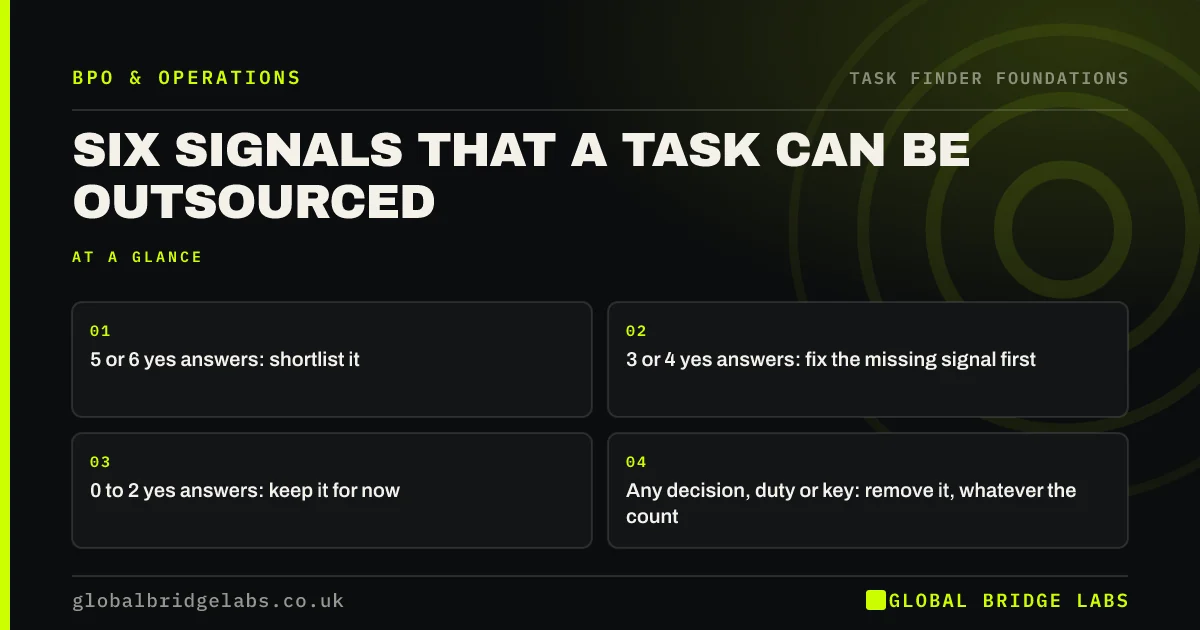
Six yes or no questions work well: can the task be written down, can the result be checked, can it be done remotely, does it recur, can mistakes be caught in time, and does it add up to about two hours a week. Remove decisions, duties and keys before you start.
How long should screening take?
About a minute per task. A list of 80 tasks takes roughly 90 minutes in one session with the managers who own the work. If a task needs more than a minute of discussion, mark it 'unsure' and move on rather than stalling the session.
Written by

Global Bridge Labs (GBL) is a UK–Sri Lanka partner for social media, websites and BPO. Everything here comes from client delivery, not theory.