On this page
Key takeaways
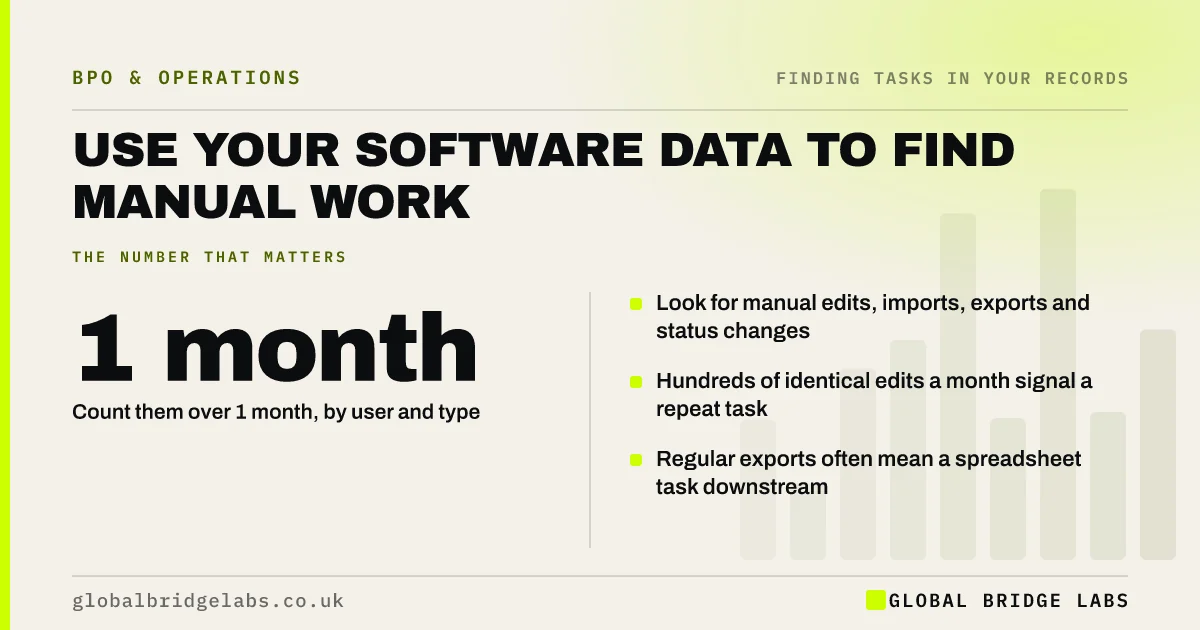
To find manual work in software data, look at what your systems record about human activity: manual edits, imports, exports, status changes and notes. Counted over a month, these show which tasks people repeat by hand, how often, and who does them. A task that appears as hundreds of manual edits a month is a strong candidate.
- Look for manual edits, imports, exports and status changes.
- Count them over 1 month, by user and type.
- Hundreds of identical edits a month signal a repeat task.
- Regular exports often mean a spreadsheet task downstream.
Want help reading your system data for tasks? Message us on WhatsApp.
Chat on WhatsApp →What does software data show that people do not?
Software data shows volume and frequency without anyone having to remember. People say they 'update orders now and then'; the order system shows 420 manual status changes last month by two users. Data also reveals tasks nobody mentions, such as a weekly export that feeds a spreadsheet only one person understands.
Where do you find the data?
Most business systems keep an audit trail or activity log, even on small plans. You rarely need a developer.
- Accounting software: manual journals, bank rule exceptions, edited invoices.
- CRM: manual record edits, imports, tasks created and closed.
- Order or shop system: manual status changes, refunds, address edits.
- Helpdesk: tickets by tag, replies using saved responses.
- File storage: who edits which shared spreadsheets, and how often.
Should you automate or outsource what you find?
Check automation first for high-volume, identical edits: a rule or integration may remove the task entirely. Where the edits vary, need a quick look at a document, or come from messy inputs, outsourcing usually works better. Many firms do both: automate the clean cases and outsource the rest.
What does this look like in practice?
A pattern we see: an accounting system's log shows bank transactions being coded by hand every month because bank rules were never set up. Fixing the rules removes most of the work; the varied items that remain become a small, well-defined weekly task that moves well.
Software data checklist
- List your main business systems.
- Find each system's activity or audit log.
- Count manual actions by type and user for one month.
- Check whether automation could remove the clean cases.
- Add the remaining manual work to the long list.
Next step
Open the activity log in your busiest system and count last month's manual edits by type. The top three types are your first data-led candidates.
Message us on WhatsApp for help reading the logs, or book a 30-minute consultation.
Chat on WhatsApp →Sources and further reading
- The probability of automation in England: 2011 and 2017 · Office for National Statistics
- Controllers and processors · Information Commissioner's Office
Frequently asked questions
How can software data show tasks to outsource?
Most systems record manual edits, imports, exports and status changes, with who did them and when. Counting those over a month shows which tasks people repeat by hand and how often, which is far more reliable than estimates from memory.
Do small business systems keep activity logs?
Most do. Accounting, CRM, e-commerce and helpdesk tools usually include an audit trail or activity report, sometimes under settings or reports. If not, exports of records changed in a period, or file version histories in shared storage, give a similar picture.
Is it better to automate manual edits than outsource them?
For identical, high-volume edits from clean data, automation is often better because it removes the task. For varied edits, messy inputs or tasks that need a quick human check, outsourcing usually works better. Test automation first, then outsource what remains.
Written by

Global Bridge Labs (GBL) is a UK–Sri Lanka partner for social media, websites and BPO. Everything here comes from client delivery, not theory.