On this page
Key takeaways
Processing online form submissions means taking each enquiry, application, booking or order form, checking it, entering it into the right system and sending the next message. It is one of the most outsourceable task types because the input has a fixed shape, the rules are clear and the result is a record you can check. Look for any form someone re-types by hand.
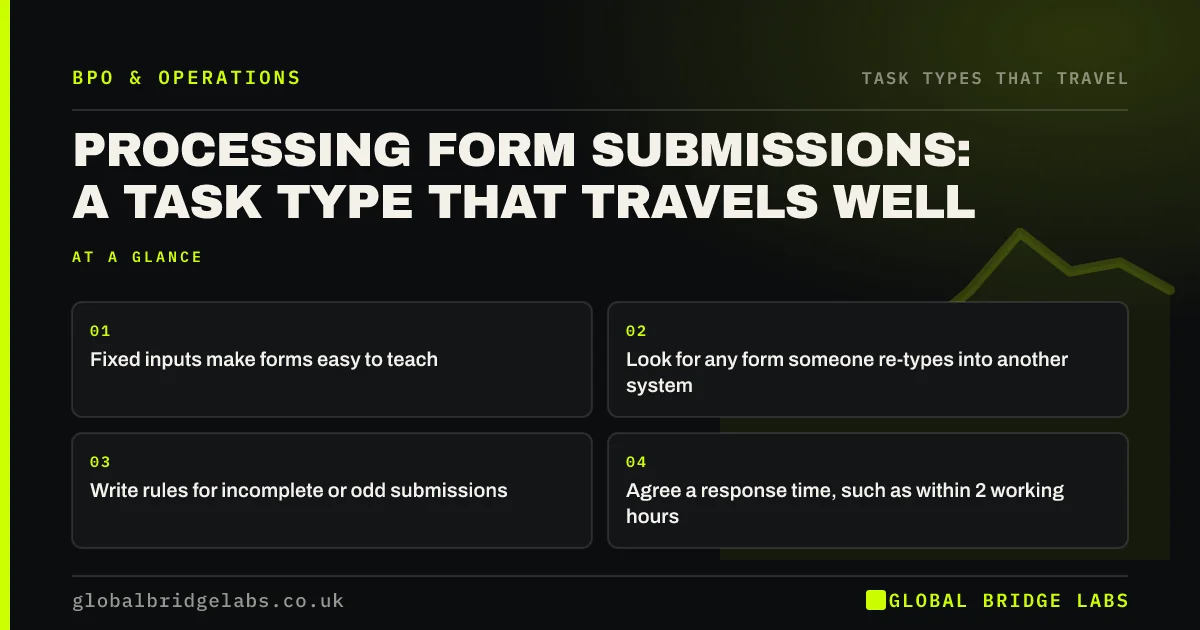
- Fixed inputs make forms easy to teach.
- Look for any form someone re-types into another system.
- Write rules for incomplete or odd submissions.
- Agree a response time, such as within 2 working hours.
Want to see which of your forms could be processed for you? Message us on WhatsApp.
Chat on WhatsApp →Why do form tasks travel well?
Because the form does half the teaching. Every submission arrives with the same fields in the same order, so the steps are the same each time. Exceptions are visible, such as a missing field or an unusual answer, and the output, a record created or an email sent, is easy to check against the submission.
Which form tasks are common candidates?
Most small firms process several of these by hand.
- Website enquiry forms entered into a CRM.
- Booking requests confirmed in a diary.
- Job or course applications logged and acknowledged.
- Customer onboarding forms checked for completeness.
- Supplier or credit applications checked and filed.
- Returns and warranty claim forms logged.
Should form processing be automated instead?
Partly. If the form only needs copying into another system, an integration is often cheaper. Human processing earns its place when submissions need checking, enriching with other information, or a judgement such as 'is this a real enquiry or spam?'. Many firms automate the copy and outsource the check and follow-up.
What does this look like in practice?
A pattern we see: a training firm's course applications arrive by web form and are re-typed into a booking system by a coordinator. An outside team checks each application, enters it and sends joining instructions the same day.
Form processing checklist
- List every form your business receives.
- Note what happens to each submission.
- Mark forms re-typed by hand.
- Write rules for incomplete submissions.
- Agree a response time for each form.
Next step
List every form on your website and the steps that follow each submission. Any form followed by re-typing is a candidate.
Message us on WhatsApp for the form processing checklist, or book a 30-minute consultation.
Chat on WhatsApp →Sources and further reading
- Right to be informed (privacy information) · Information Commissioner's Office
- Controllers and processors · Information Commissioner's Office
Frequently asked questions
Can form submissions be processed by an outsourced team?
Yes, very often. Each submission has the same fields, so the steps are easy to teach and the result is easy to check. The team checks the form, enters it into your system, flags exceptions and sends the next message within an agreed time.
What makes a form hard to process?
Free-text answers that need interpretation, attachments that must be read and judged, and submissions that lead to a decision such as a credit limit or an acceptance. These can still be processed, but the decision part should be routed to a named person inside.
How quickly should form enquiries be answered?
As quickly as practical. Enquiries go cold fast, so many firms aim to respond within an hour or two in business hours. An outsourced team can make that achievable even when your own staff are busy or out of the office.
Written by

Global Bridge Labs (GBL) is a UK–Sri Lanka partner for social media, websites and BPO. Everything here comes from client delivery, not theory.