On this page
Key takeaways
To reduce admin for field technicians, capture job data on site digitally and move the paperwork that follows to a remote team: writing up reports, issuing certificates, raising invoices, ordering parts and booking return visits. Technicians often spend 5 or more hours a week on this. Keep their technical sign-off; move the typing.
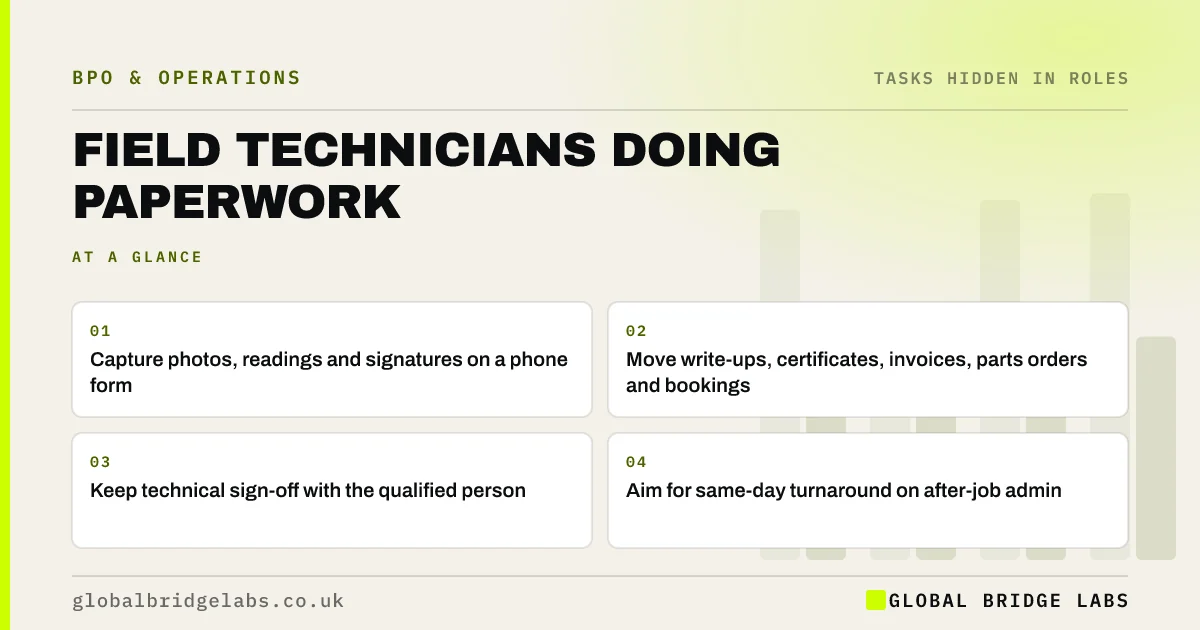
- Capture photos, readings and signatures on a phone form.
- Move write-ups, certificates, invoices, parts orders and bookings.
- Keep technical sign-off with the qualified person.
- Aim for same-day turnaround on after-job admin.
Want your engineers' paperwork sized? Message us on WhatsApp.
Chat on WhatsApp →Why does field paperwork pile up?
Because it is done after the real work, often in vans or at kitchen tables in the evening. Each job needs a report, a certificate or a job sheet, and most also need an invoice and a next booking. When technicians do all of it themselves, it is slow, late and inconsistent, and invoices go out days after the job.
Which technician admin tasks can move?
Once site data arrives digitally, these usually move well.
- Typing up job reports from notes, photos and readings.
- Preparing certificates for the technician to sign.
- Raising invoices the same day.
- Ordering parts and confirming delivery dates.
- Booking return visits and sending confirmations.
- Logging renewal dates and sending reminders.
What must stay with the technician?
Anything that depends on their competence or registration: the technical findings, safety judgements and signatures on certificates. Registered work, such as Gas Safe certificates, must be signed by the registered engineer. The remote team prepares, the technician confirms.
What does this look like in practice?
A pattern we see: engineers do paperwork in the evenings and invoices go out days after each job. With phone forms and a remote team, write-ups and invoices go out the same day and engineer paperwork shrinks to checking and signing.
Field admin checklist
- Measure each technician's weekly paperwork hours.
- Introduce a phone form for site data.
- Move write-ups, invoices, parts and bookings.
- Keep technical sign-off with the technician.
- Track time from job to invoice.
Next step
Ask two technicians to log their paperwork time for a week and note the gap between job and invoice. Those two numbers make the case.
Message us on WhatsApp for the field admin log, or book a 30-minute consultation.
Chat on WhatsApp →Sources and further reading
- Gas Safe Register · Gas Safe Register
- Competent person schemes: current schemes and how they are authorised · Ministry of Housing, Communities and Local Government
Frequently asked questions
How can I reduce paperwork for field engineers?
Capture job information on site with a phone form or job app, then have a remote team write up reports, prepare certificates, raise invoices, order parts and book return visits. Engineers check and sign technical documents, but no longer type them up in the evenings.
Can certificates be prepared by someone else?
Yes, prepared, but where a qualified or registered person must certify the work, they review and sign the certificate themselves. The remote team fills in the details from site data, and the engineer confirms the findings and signs. Check the rules of your registration scheme.
How quickly should invoices go out after a job?
Ideally the same day. Each day of delay pushes payment back and makes queries more likely. Moving invoicing from technicians to a remote team working from site data is one of the quickest ways to shorten the time from job to cash.
Written by

Global Bridge Labs (GBL) is a UK–Sri Lanka partner for social media, websites and BPO. Everything here comes from client delivery, not theory.