On this page
- 01Key takeaways
- 02Why does an owner's hourly value matter?
- 03How do you calculate what your time is worth?
- 04Which tasks fall below an owner's hourly value?
- 05What does it cost to keep doing admin yourself?
- 06Does freeing time automatically make money?
- 07When is hourly value the wrong lens?
- 08How do you start delegating by hourly value?
- 09How does hourly value change as the business grows?
- 10What does this look like in practice?
- 11Owner hourly value checklist
- 12Next step
- 13Sources and further reading
- 14Frequently asked questions
Key takeaways
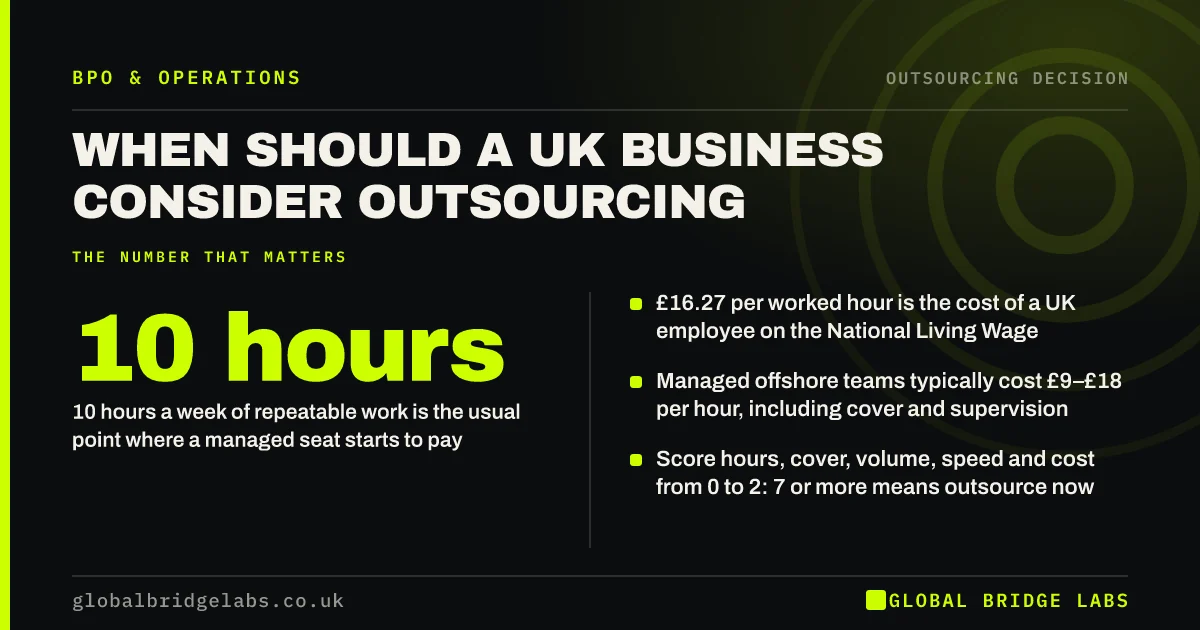
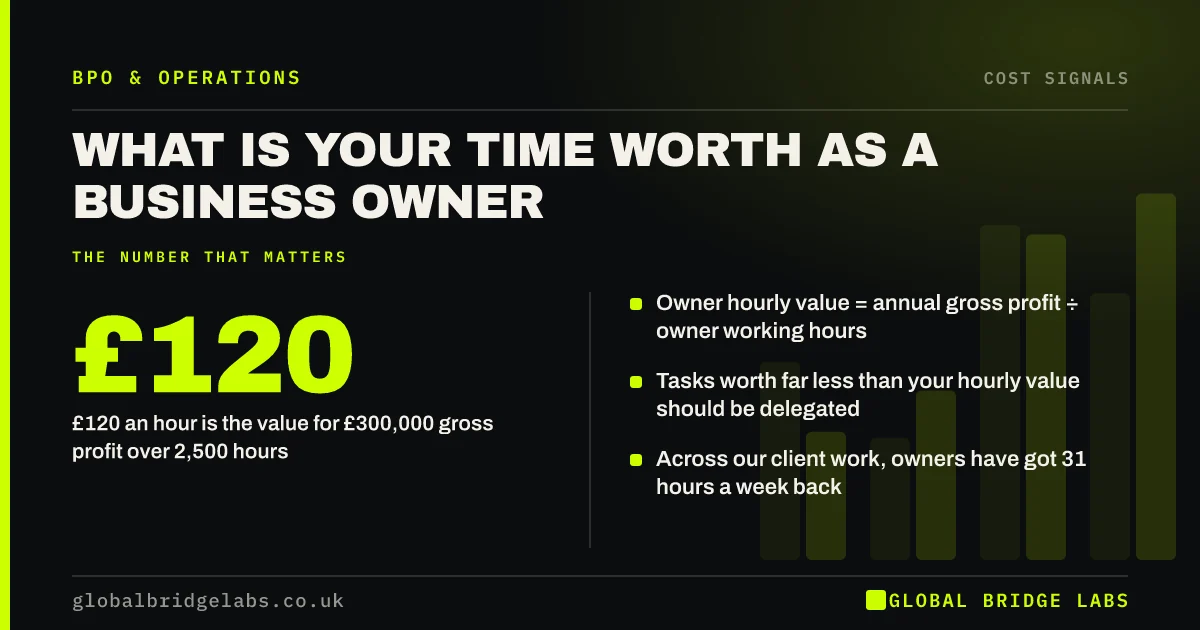
What is my time worth as a business owner? A simple answer is annual gross profit divided by the hours you work. A business making £300,000 gross profit with an owner working 2,500 hours values each owner hour at £120. Any repeatable task that could be done for less, such as admin at £9–£18 per hour, is a candidate to hand off.
- Owner hourly value = annual gross profit ÷ owner working hours.
- £120 an hour is the value for £300,000 gross profit over 2,500 hours.
- Tasks worth far less than your hourly value should be delegated.
- Across our client work, owners have got 31 hours a week back.
Want to know which of your tasks fall below your hourly value? Message us on WhatsApp.
Chat on WhatsApp →Why does an owner's hourly value matter?
It turns delegation from a feeling into a decision. Without a number, owners keep tasks because they are quick or familiar. With a number, every task can be compared with what it would cost someone else to do. Owner hourly value is the price of an owner hour spent on anything other than owner work.
How do you calculate what your time is worth?
Use one of three methods, depending on the business. Each gives a different number; pick the one that reflects what your hours actually produce.
- Gross profit method: annual gross profit ÷ your working hours.
- Target income method: what you want to earn ÷ your working hours.
- Charge-out method: your billable rate, for fee-earning owners.
Send us your numbers on WhatsApp and we will help you work out your hourly value.
Chat on WhatsApp →Which tasks fall below an owner's hourly value?
Most repeatable admin does. Inbox triage, booking, invoicing, chasing, data entry and routine calls can be done by a trained person at a fraction of an owner's hourly value. The tasks worth keeping are those only you can do: pricing, key sales, hiring, strategy and your most important relationships.
What does it cost to keep doing admin yourself?
Multiply the admin hours by your hourly value. An owner valued at £80 an hour who spends 12 hours a week on admin uses about £960 a week of owner capacity, or about £43,000 over 45 working weeks. The same hours from a managed offshore team at an indicative £12 per hour cost about £6,500.
Does freeing time automatically make money?
No. The value is only real if the freed hours go on owner work. Plan what you will do with them, such as follow-up calls to quotes, a pricing review or time with key customers, and block it in the diary. Hours returned without a plan tend to fill with new small tasks.
When is hourly value the wrong lens?
When a task has value beyond its time, such as personally answering an unhappy key client, or when doing it keeps you close to customers in a way that shapes the business. Some owners also enjoy certain tasks and choose to keep them. Hourly value is a guide, not a rule.
How do you start delegating by hourly value?
Pick the single largest block of below-value work, write it down on one page, and hand it to a person or managed team for eight weeks. Measure the hours returned and what you did with them. Then choose the next block. Owners who start with one block delegate more successfully than those who try to hand off everything at once.
How does hourly value change as the business grows?
It usually rises. As revenue and gross profit grow, each owner hour spent on strategy, sales and people is worth more, while repeatable tasks stay worth the same. That is why a task that was sensible for an owner to do at £100,000 turnover becomes an expensive habit at £1m. Recalculate your hourly value every year and review your task list against it.
- Recalculate hourly value every year from the accounts.
- Review which tasks you still do against the new figure.
- Hand off anything that has fallen far below it.
What does this look like in practice?
A pattern we see in UK mortgage brokerages: the principal broker values their time at the fee income per advice hour, then realises they spend 10 hours a week chasing documents and updating the CRM. Moving that work to a managed team returns the hours to advice appointments, which is where the income comes from.
Owner hourly value checklist
Use this to put a number on your time.
- Choose a method: gross profit, target income or charge-out.
- Calculate your hourly value.
- Log two weeks of tasks.
- Mark every task worth far less than that value.
- Hand off the largest block first.
- Plan what the freed hours will be used for.
Next step
Tell us your hourly value and what fills your week. We will help you pick the first block to hand off. 30 minutes, no pitch.
Message us on WhatsApp about your time, or book a 30-minute consultation.
Chat on WhatsApp →Sources and further reading
- National Minimum Wage and National Living Wage rates · GOV.UK
- Maximum weekly working hours · GOV.UK
- Work-related stress and how to manage it · Health and Safety Executive
Frequently asked questions
How do I calculate my hourly rate as a business owner?
Divide annual gross profit by the hours you work, or divide your target income by your working hours. Fee-earning owners can use their charge-out rate. The result is the benchmark for deciding which tasks you should keep and which to hand to someone else.
What tasks should a business owner delegate first?
Repeatable tasks worth far less than your hourly value, starting with the largest block: usually inbox triage, calls and booking, invoicing and chasing, or data entry. Keep pricing, key sales, hiring, strategy and your most important customer relationships.
Is it worth paying someone to do admin for me?
Usually, if the admin takes several hours a week and your hourly value is well above the cost. Managed offshore support costs an indicative £9–£18 per hour. The benefit is real only if you use the freed hours for work that grows the business.
Written by

Global Bridge Labs (GBL) is a UK–Sri Lanka partner for social media, websites and BPO. Everything here comes from client delivery, not theory.