On this page
Key takeaways
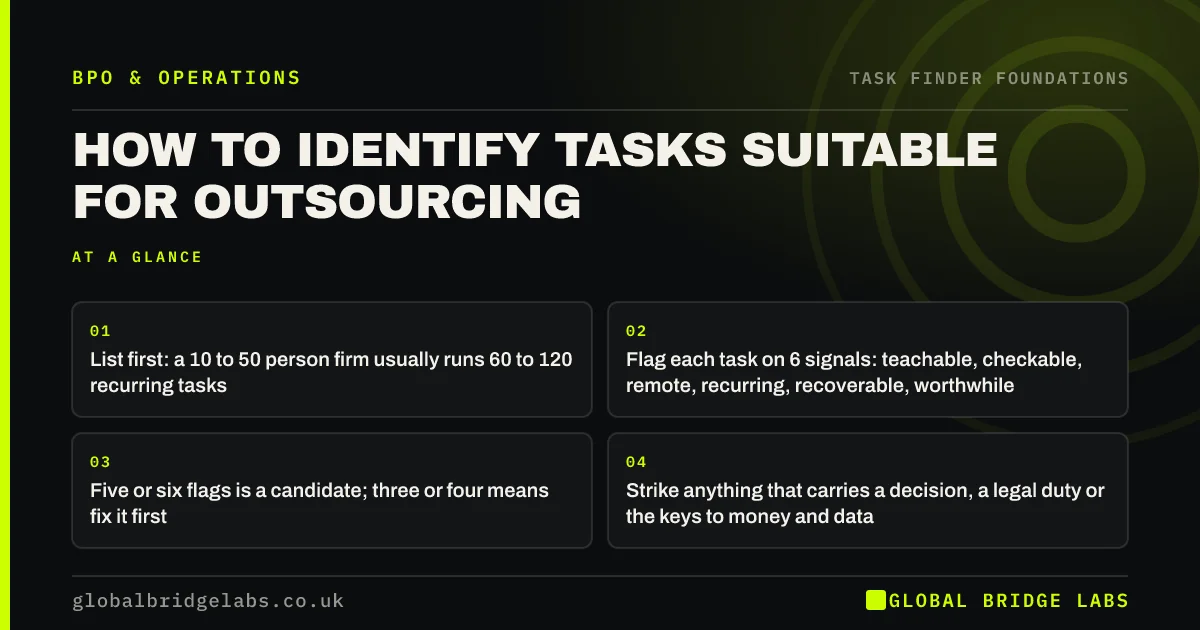
A long list of tasks to outsource is the full set of recurring work in the business, captured before anyone judges it. Record four things per task: what it is, who does it, how often, and roughly how long it takes. A firm of 10 to 50 people usually finds 60 to 120 tasks. Judge nothing until the list is complete.
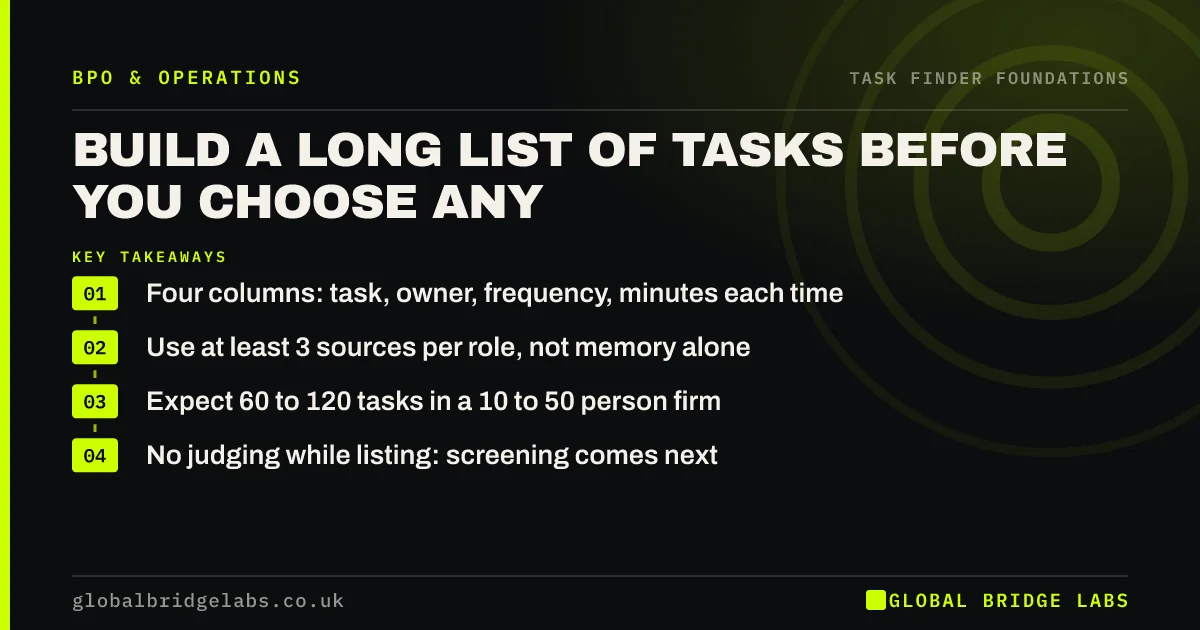
- Four columns: task, owner, frequency, minutes each time.
- Use at least 3 sources per role, not memory alone.
- Expect 60 to 120 tasks in a 10 to 50 person firm.
- No judging while listing: screening comes next.
Want a long list template your managers can fill in? Message us on WhatsApp.
Chat on WhatsApp →Why list before choosing?
Because the best candidate is rarely the first one you think of. Owners remember the tasks that annoy them, not the ones that quietly take the most hours. A complete list shows hours spread across roles and tasks that nobody owns, which is often where the strongest candidates sit.
What should the long list capture?
Keep it to a few columns so people actually fill it in. Detail can be added later for the shortlist.
- Task: a verb and an object, such as 'update order status in the shop system'.
- Owner: who does it now, and who covers when they are away.
- Frequency: daily, weekly, monthly or batch.
- Minutes each time: a rough estimate is fine.
- Source: where you found it (diary, inbox, system, leave cover).
How is a long list different from a task inventory?
A task inventory is a standing register of routine work you keep up to date. A long list is a one-off capture made for a decision, so it includes everything, even irregular and awkward tasks, and it records where each task was found. Many firms turn the long list into an inventory afterwards.
What does this look like in practice?
A pattern we see: a first attempt from memory produces a short list. A second pass, using diaries, inboxes and the shared drive, produces several times as many tasks, including quote follow-ups, supplier price checks and a weekly report three people each build separately.
Long list checklist
- Use one template for every team.
- Write tasks as a verb plus an object.
- Check at least three sources per role.
- Include irregular and awkward tasks.
- Record the source of every task.
Next step
Send your managers the four-column template with a one-week deadline. Ask them to use their diaries and inboxes, not memory.
Message us on WhatsApp for the long list template, or book a 30-minute consultation.
Chat on WhatsApp →Sources and further reading
- The probability of automation in England: 2011 and 2017 · Office for National Statistics
- User research · GOV.UK Service Manual
Frequently asked questions
How do I list all the tasks in my business?
Give each manager a simple template with four columns: task, owner, frequency and minutes each time. Ask them to fill it from diaries, inboxes, system data and leave cover notes rather than memory. Combine the lists and remove duplicates before judging any task.
How detailed should each task be?
Detailed enough that someone else would recognise it: a verb and an object, such as 'issue weekly supplier remittances'. 'Finance' or 'admin' are too broad to judge. If a task takes more than half a day each time, break it into its steps.
Should staff list their own tasks?
Yes, with their manager checking the result. Staff know the small tasks managers never see, and managers spot tasks staff do so automatically they forget them. Explain that the list is about the work, not about anyone's job, so people list honestly.
Written by

Global Bridge Labs (GBL) is a UK–Sri Lanka partner for social media, websites and BPO. Everything here comes from client delivery, not theory.