On this page
Key takeaways
An outsourcing candidate shortlist should hold five tasks: the strongest from your screened and ranked list. Five is enough to choose a good first task and keep two or three in reserve, and few enough to test each one properly. Longer shortlists turn into projects that never start; shorter ones leave no fallback if the first choice fails.
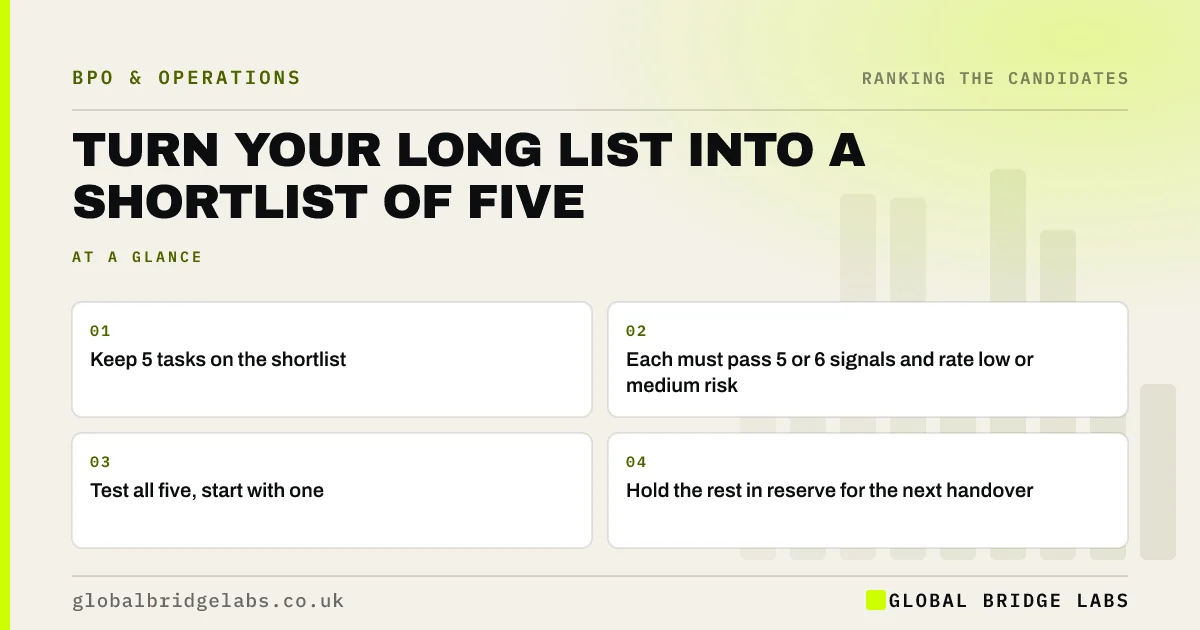
- Keep 5 tasks on the shortlist.
- Each must pass 5 or 6 signals and rate low or medium risk.
- Test all five, start with one.
- Hold the rest in reserve for the next handover.
Want help cutting your list to five? Message us on WhatsApp.
Chat on WhatsApp →Why five?
Five balances choice and focus. You need more than one candidate because testing often reveals a hidden problem with the favourite. You need fewer than ten because each candidate deserves a proper look: a full score, a check of exceptions and a handover estimate. Five gives you a first task and a pipeline.
How do you cut to five?
Apply these cuts in order.
- 1. Keep only tasks with five or six signals.
- 2. Remove anything rated high risk.
- 3. Bundle small related tasks into blocks.
- 4. Sort by effort (low first) and hours (high first).
- 5. Take the top five, with a mix of quick wins and bigger blocks.
What happens to the tasks left off?
Nothing is lost. Tasks that nearly made it stay on the candidate register for the next review. Tasks that failed screening get a note on why, so they can be fixed, automated, stopped or kept. Revisiting the register each quarter means the next five are ready when the first handovers are stable.
What does this look like in practice?
A pattern we see: removing high-risk tasks and bundling small ones into blocks shortens the screened list considerably. Sorting by effort and hours then gives a shortlist of five that includes at least one quick win.
Shortlist checklist
- Keep only tasks with five or six signals.
- Remove high-risk tasks.
- Bundle small related tasks.
- Sort by effort and hours.
- Record the reserve list on the register.
Next step
Apply the five cuts to your screened list in one sitting. Write the shortlist on one page with hours, risk and effort for each task.
Message us on WhatsApp for the shortlist template, or book a 30-minute consultation.
Chat on WhatsApp →Sources and further reading
- The Sourcing and Consultancy Playbooks · Cabinet Office
- Labour productivity · Office for National Statistics
Frequently asked questions
How many tasks should be on an outsourcing shortlist?
Five works well. It gives enough choice to find a strong first task after testing, with two or three in reserve, while staying small enough to look at each one properly. Longer shortlists tend to stall.
How do I narrow down tasks to outsource?
Keep tasks that pass five or six screening signals, remove high-risk ones, bundle small related tasks, then sort by handover effort and hours a week. Take the top five, ideally including at least one quick win you can hand over within a month.
What if none of my tasks make a good shortlist?
Check why. If most fail on one signal, such as not being written down, fixing that may make several suitable. If the work is mostly judgement or on site, outsourcing may not suit you yet, and simplifying or automating tasks could be a better first step.
Written by

Global Bridge Labs (GBL) is a UK–Sri Lanka partner for social media, websites and BPO. Everything here comes from client delivery, not theory.