On this page
Key takeaways
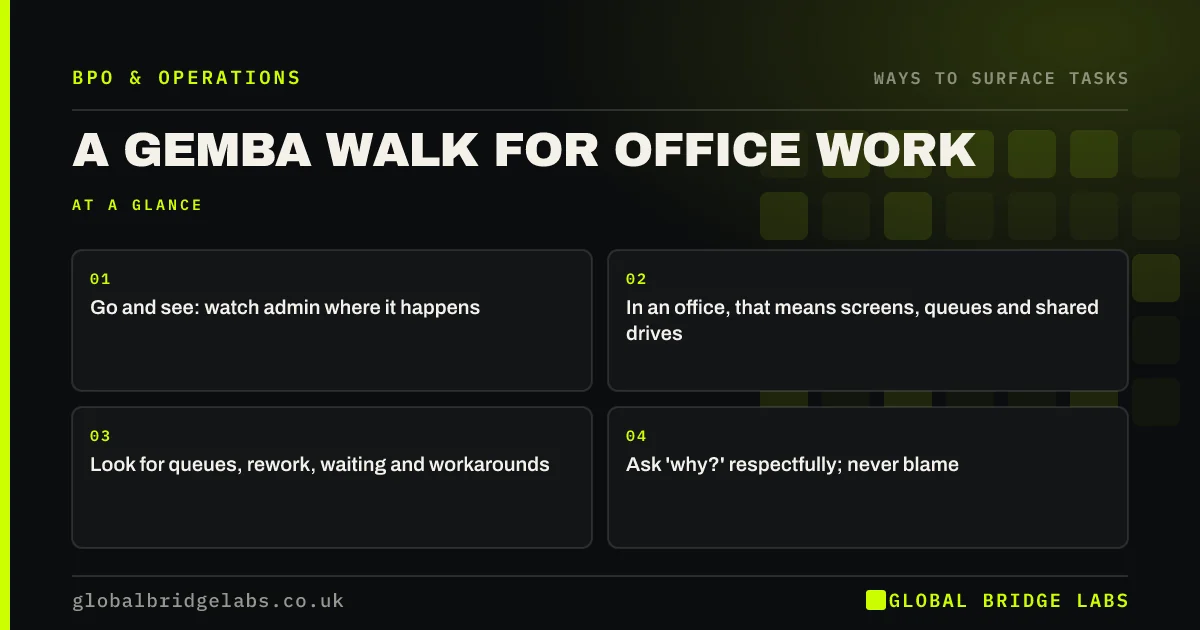
A gemba walk in the office comes from lean practice: managers go to where the work actually happens, watch it and ask respectful questions, rather than relying on reports. In admin, 'where the work happens' is the screen, the shared drive and the inbox. A short, regular walk shows queues, rework and waiting that point to tasks worth moving or fixing.
- Go and see: watch admin where it happens.
- In an office, that means screens, queues and shared drives.
- Look for queues, rework, waiting and workarounds.
- Ask 'why?' respectfully; never blame.
Want a gemba walk guide for office teams? Message us on WhatsApp.
Chat on WhatsApp →What is a gemba walk?
Gemba is a Japanese term for 'the real place', and a gemba walk is the lean habit of managers going there to see the work first-hand. It began on factory floors, but the idea transfers: in an office the real place is the order queue, the inbox and the spreadsheet, and the waste is waiting, rework and duplicate entry.
How do you run one in an office?
Keep it short and regular: 30 minutes a week works.
- 1. Pick one flow, such as orders or invoices.
- 2. Sit with the person at each step and watch.
- 3. Look at queues: what is waiting, and for how long?
- 4. Ask what gets redone, re-keyed or chased.
- 5. Note anything that could move, stop or be fixed.
What signs point to outsourceable tasks?
Queues that build when one person is busy, steps repeated the same way every time, and data copied from one screen to another all point to tasks that could move. Rework and constant chasing point to something to fix upstream first. The walk helps you tell which is which.
What does this look like in practice?
A pattern we see: a weekly walk along the invoice flow shows invoices waiting days for coding, then again for approval. Coding is rule-based and moves; approval is a control and stays, but gets a fixed daily slot. The wait between steps shrinks.
Office gemba walk checklist
- Pick one flow per walk.
- Watch each step where it happens.
- Look for queues, rework and copying.
- Ask why without blaming.
- Record candidates and fixes.
Next step
Book 30 minutes this week to walk one flow from start to finish. Watch, ask and note before you suggest any change.
Message us on WhatsApp for the gemba walk guide, or book a 30-minute consultation.
Chat on WhatsApp →Sources and further reading
- Value Stream Mapping Overview · Lean Enterprise Institute
- Labour productivity · Office for National Statistics
Frequently asked questions
What is a gemba walk in an office?
A lean practice where managers go to where the work actually happens, watch it and ask questions. In an office that means sitting with people at their screens, looking at queues, inboxes and shared files, and asking what gets redone, waited for or copied.
How often should you do a gemba walk?
Short and regular beats long and rare. Thirty minutes once a week, following one flow each time, builds a picture over a month without disrupting the team. Rotate the flows so every major process is walked each quarter.
Can a gemba walk find tasks to outsource?
Yes. Queues that build around one person, repeated identical steps and data copied between screens all point to tasks that could move. Rework and chasing usually point to an upstream fix, which should happen before anything is outsourced.
Written by

Global Bridge Labs (GBL) is a UK–Sri Lanka partner for social media, websites and BPO. Everything here comes from client delivery, not theory.