On this page
Key takeaways
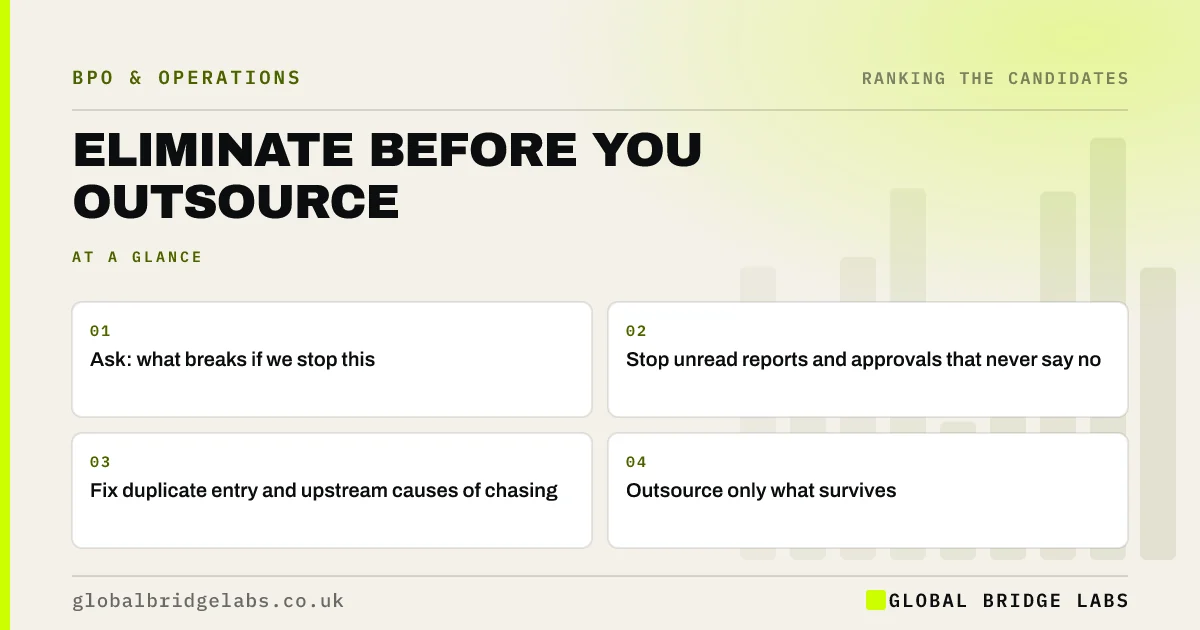
Eliminate tasks before outsourcing by asking of each candidate: would anything go wrong if we stopped? Reports nobody reads, duplicate data entry, approvals that never refuse and chasing caused by a broken upstream step should stop, not move. Outsourcing a pointless task just makes it cheaper to keep doing something you do not need.
- Ask: what breaks if we stop this?
- Stop unread reports and approvals that never say no.
- Fix duplicate entry and upstream causes of chasing.
- Outsource only what survives.
Want your candidates checked for tasks to stop? Message us on WhatsApp.
Chat on WhatsApp →Why eliminate first?
Because every task you hand over carries a cost: briefing, checking and paying for it. If a task does not need to exist, outsourcing it locks in that cost. Eliminating first also makes the remaining work cleaner and easier to hand over, which shortens every handover that follows.
Which tasks usually turn out to be unnecessary?
These are the common ones.
- Reports nobody reads or acts on.
- Entering the same data into two systems.
- Approvals that are always given.
- Chasing caused by unclear requests.
- Copies and printouts kept 'just in case'.
- Meetings that only share information already sent.
How do you test whether a task can stop?
Pause it for a month where the risk is low, and see who notices. For reports, ask each recipient which decision it supports. For approvals, count how often the approver refused in the last year. For chasing, trace why the information was late. The answers sort tasks into stop, simplify or keep.
What does this look like in practice?
A pattern we see: a shortlist includes a weekly sales report built by hand. Asked what decisions it supports, recipients name only a couple of figures, already visible in the CRM dashboard. The report stops, and the time is saved without outsourcing anything.
Eliminate first checklist
- Ask 'what breaks if we stop?' for each candidate.
- Check who uses each report.
- Count refusals for each approval.
- Trace the causes of chasing and rework.
- Outsource only the tasks that survive.
Next step
Before you brief any provider, ask the 'what breaks if we stop?' question of every task on your shortlist. Strike the ones with no good answer.
Message us on WhatsApp for the eliminate-first questions, or book a 30-minute consultation.
Chat on WhatsApp →Sources and further reading
- Labour productivity · Office for National Statistics
- Human factors: managing human failures · Health and Safety Executive
Frequently asked questions
Should I eliminate tasks before outsourcing?
Yes. Ask of each candidate what would go wrong if it stopped. Unread reports, duplicate data entry, approvals that are always given and chasing caused by unclear requests should stop or be fixed. Outsource only what genuinely needs doing.
How do I know if a task is unnecessary?
Ask who uses the output and for what decision, pause it briefly where safe and see who notices, and check whether the same information exists elsewhere. If nobody misses it and no decision depends on it, it can usually stop.
What is the difference between eliminating and outsourcing?
Eliminating removes a task entirely, so it costs nothing. Outsourcing moves a needed task to someone else at a lower cost or with better focus. Eliminating first means you only pay to outsource work that adds value.
Written by

Global Bridge Labs (GBL) is a UK–Sri Lanka partner for social media, websites and BPO. Everything here comes from client delivery, not theory.