On this page
Key takeaways
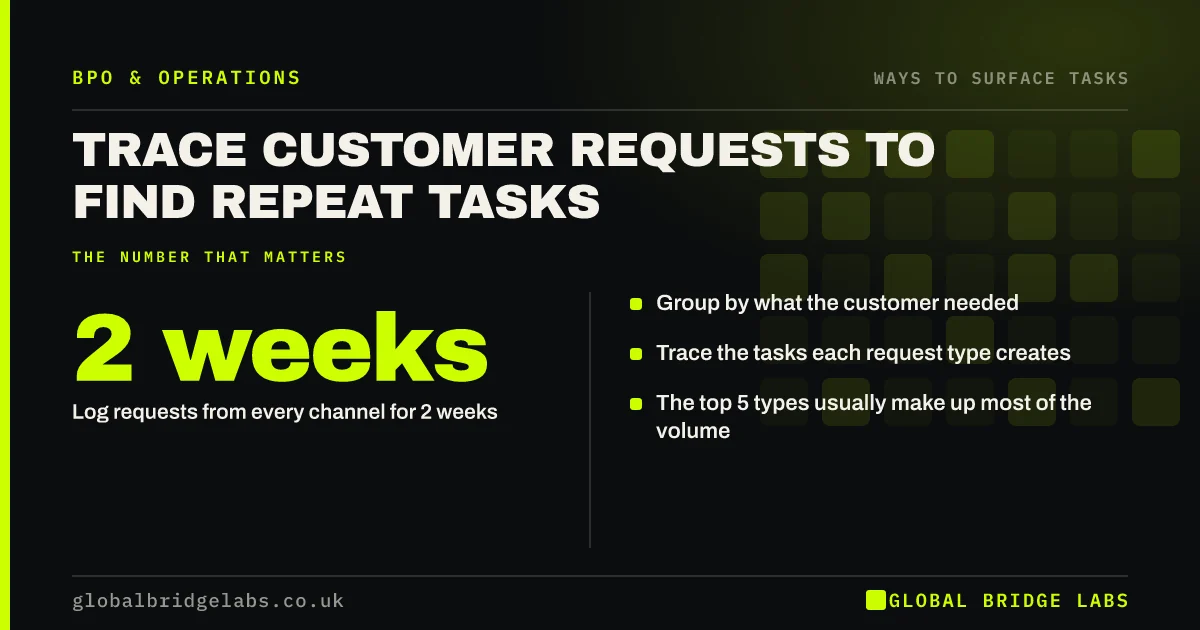
To trace customer requests, log every request for two weeks across email, phone, chat, social messages and forms, then group them by what the customer needed and trace the tasks each request created. The top five request types usually account for most of the volume, and the tasks behind them are often routine enough to hand over.
- Log requests from every channel for 2 weeks.
- Group by what the customer needed.
- Trace the tasks each request type creates.
- The top 5 types usually make up most of the volume.
Want a two-week request log template? Message us on WhatsApp.
Chat on WhatsApp →Why trace requests across channels?
Because each channel is usually handled by different people, so nobody sees the whole picture. The same 'where is my order?' question may arrive by email, phone and Instagram, answered by three people in three ways. A combined log shows the true volume of each request type and the tasks behind it.
How do you trace requests?
Use one shared log for every channel.
- 1. Create a simple log: date, channel, request type, handled by.
- 2. Log every request for two weeks.
- 3. Group by request type.
- 4. For each type, list the tasks it triggers.
- 5. Total volume and minutes per type.
What should you do with the results?
Three things. Answer the most common questions before they are asked, for example with order tracking or an FAQ page. Standardise replies for the rest. Then move the routine request types, with their follow-up tasks, to an outsourced team, keeping complaints and complex requests with your own people.
What does this look like in practice?
A pattern we see: a two-week log shows requests arriving across several channels. A handful of types, such as order status, returns, delivery changes, invoice copies and product questions, make up most of them. Those types, with their follow-up tasks, form a clear block for an outside team.
Request tracing checklist
- Set up one log for all channels.
- Log every request for two weeks.
- Group requests by need.
- Trace the tasks behind each type.
- Prevent, standardise, then move routine types.
Next step
Set up a shared request log on Monday and ask everyone who deals with customers to use it for two weeks.
Message us on WhatsApp for the request log template, or book a 30-minute consultation.
Chat on WhatsApp →Sources and further reading
- UK Customer Satisfaction Index · Institute of Customer Service
- Consumer Duty · Financial Conduct Authority
Frequently asked questions
How do I find out what customers ask for most?
Log every customer request across all channels for two weeks, including email, phone, chat, social messages and forms. Group the requests by what the customer needed. The top few types usually account for most of the volume.
What should I do with common customer requests?
First try to prevent them, for example with order tracking or clearer information online. Then standardise the replies for the rest. Routine request types and their follow-up tasks can usually be handled by an outsourced team, with complaints kept in-house.
How long should I log customer requests?
Two weeks is usually enough to see the main patterns. If your business is seasonal, repeat the log during a busy period, because request types and volumes often change at peak times.
Written by

Global Bridge Labs (GBL) is a UK–Sri Lanka partner for social media, websites and BPO. Everything here comes from client delivery, not theory.