On this page
Key takeaways
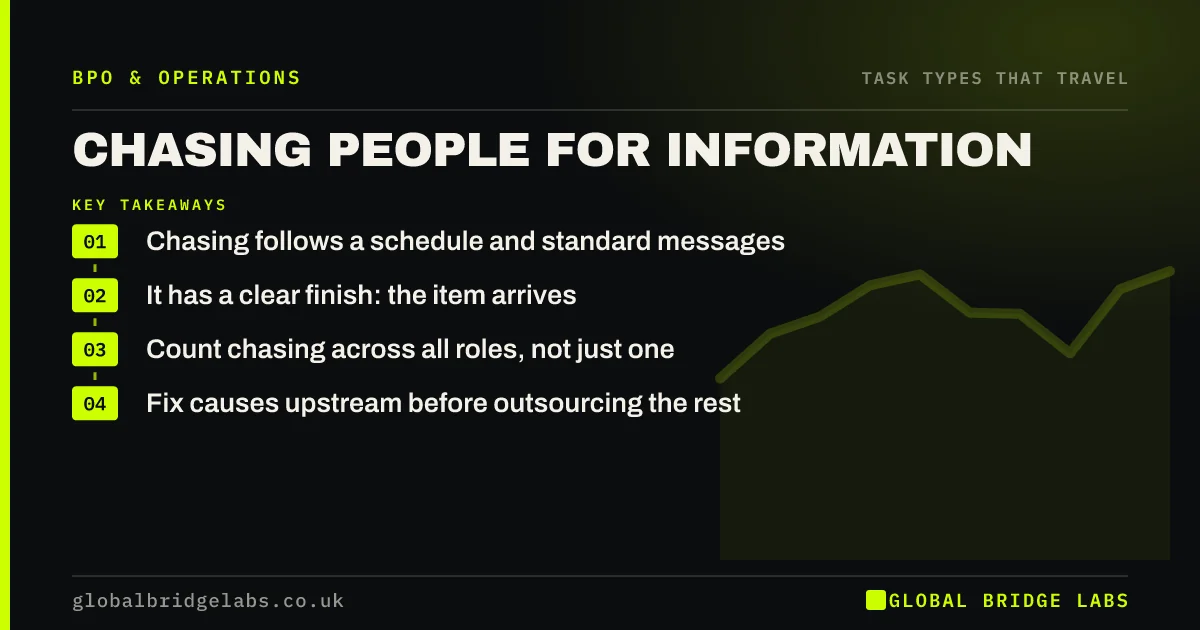
Chasing people for information at work, whether signed forms, timesheets, documents, approvals or replies, is one of the best task types to hand over. It follows a schedule, uses standard messages and has a clear finish: the information arrives. Look for chasing hidden in every role, then fix the causes of chasing you should not need at all.
- Chasing follows a schedule and standard messages.
- It has a clear finish: the item arrives.
- Count chasing across all roles, not just one.
- Fix causes upstream before outsourcing the rest.
Want your chasing tasks pulled into one list? Message us on WhatsApp.
Chat on WhatsApp →Why is chasing so suitable?
Chasing is rule-based: send a reminder on day 3, a second on day 7, escalate on day 10. The messages are standard, the progress is easy to track and success is obvious. It also drains skilled people out of proportion to its difficulty, because each chase interrupts other work and some people avoid it.
Where does chasing hide?
Most businesses chase in many places without adding it up.
- Customers: signed documents, forms, deposits and information.
- Staff: timesheets, expense receipts and training records.
- Suppliers: confirmations, delivery dates and statements.
- Partners: approvals, references and certificates.
- Internal: sign-offs and replies from colleagues.
What chasing should stay inside?
Chasing that needs the weight of a relationship or a difficult conversation, such as a key client who has gone quiet or a dispute over money, usually stays with the account owner. The routine reminders before that point can move. Overdue invoices are their own case: credit control works best with clear rules and a named escalation contact.
What does this look like in practice?
A pattern we see: a firm counts chasing across its roles and finds it scattered everywhere, mostly documents from clients and timesheets from contractors. A single outsourced chasing routine, with templates and a fixed reminder schedule, shortens the wait for missing items.
Chasing task checklist
- Count chasing in every role.
- Group chasing by who is chased for what.
- Write a reminder schedule and templates.
- Keep relationship-sensitive chases inside.
- Fix the causes of avoidable chasing.
Next step
Ask each team member how many chasing messages they sent last week, and to whom. The total usually surprises everyone.
Message us on WhatsApp for chasing templates and schedules, or book a 30-minute consultation.
Chat on WhatsApp →Sources and further reading
- Multitasking: switching costs · American Psychological Association
- Late commercial payments: charging interest and debt recovery · GOV.UK
Frequently asked questions
Can chasing be outsourced?
Yes. Routine chasing for documents, forms, timesheets, confirmations and replies follows a schedule and standard messages, which makes it easy to hand over. Keep chases that need the weight of a relationship or a difficult conversation with the person who owns the relationship.
How often should you chase for missing information?
A simple schedule works for most cases: a polite reminder around day three, a firmer one around day seven, and an escalation to a named person around day ten. Adjust for urgency, and stop as soon as the item arrives.
How do I reduce the need for chasing?
Make requests clearer and easier to answer: one link, a checklist of what is needed, a deadline and a named contact. Collect information at the start rather than later. Then outsource the chasing that remains, which is usually far less.
Written by

Global Bridge Labs (GBL) is a UK–Sri Lanka partner for social media, websites and BPO. Everything here comes from client delivery, not theory.