On this page
Key takeaways
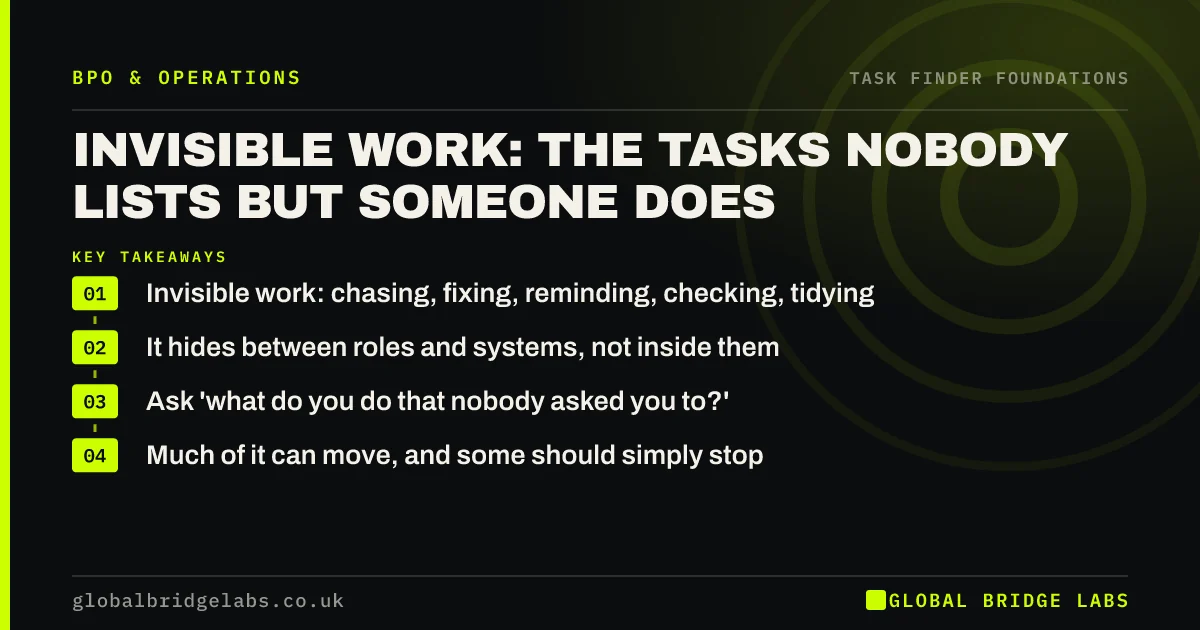
Invisible work in small business is the recurring effort that keeps things running but appears in no job description: chasing missing information, fixing other people's data, reminding, checking and tidying. Because nobody lists it, nobody sizes it, and it often adds up to several hours a week per person. It is also a common source of strong outsourcing candidates.
- Invisible work: chasing, fixing, reminding, checking, tidying.
- It hides between roles and systems, not inside them.
- Ask 'what do you do that nobody asked you to?'
- Much of it can move, and some should simply stop.
Want help bringing invisible work onto your task list? Message us on WhatsApp.
Chat on WhatsApp →What counts as invisible work?
Invisible work is any recurring task that people do to make the formal work possible, without it being assigned or recorded. It is sometimes called glue work. Typical examples are chasing colleagues for timesheets, correcting customer addresses before an order ships, and keeping an unofficial spreadsheet that the official system cannot replace.
How do you find invisible work?
Ask questions that point at the gaps, not at the job. People rarely list invisible work unprompted, because they do not think of it as a task.
- What do you do that nobody asked you to?
- What would go wrong if you stopped for a fortnight?
- Who do you chase, and for what?
- Which system do you double-check, and why?
- What do you fix before passing work on?
Should invisible work be outsourced or stopped?
Both, depending on the cause. Chasing and checking that exist because an upstream step is broken should be fixed at source; outsourcing them just pays someone to live with the problem. Invisible work that is genuinely needed, such as keeping records tidy, often passes the six signals and is a good candidate.
What does this look like in practice?
A pattern we see: a coordinator's job description lists bookings and invoicing. Asked what they do that nobody asked for, they list correcting addresses, chasing signed forms and keeping a 'real' customer list. Together that invisible work rivals the invoicing for time.
Invisible work checklist
- Ask the five gap questions in every role.
- Add each answer to the long list.
- Find the cause of each chasing or fixing task.
- Fix causes upstream where you can.
- Screen the rest like any other task.
Next step
Ask your three busiest people the question 'what do you do that nobody asked you to?' this week, and add every answer to your task list.
Message us on WhatsApp for the gap questions, or book a 30-minute consultation.
Chat on WhatsApp →Sources and further reading
- Work-related stress and how to manage it · Health and Safety Executive
- Multitasking: switching costs · American Psychological Association
Frequently asked questions
What is invisible work?
Invisible work is recurring effort that keeps a business running but is not assigned, recorded or recognised: chasing, correcting, reminding, checking and tidying. It usually sits between roles or between systems, which is why job descriptions and interviews miss it.
Why does invisible work matter for outsourcing?
Because it is often a large, unmeasured block of suitable work. Once listed and sized, invisible tasks frequently pass the outsourcing signals. Equally, some exist only because something upstream is broken, and those should be fixed rather than handed over.
How do I get staff to mention invisible work?
Ask about gaps rather than duties: what would go wrong if you stopped for a fortnight, who do you chase, what do you fix before passing work on. Make clear the aim is to remove friction, not to judge anyone's performance.
Written by

Global Bridge Labs (GBL) is a UK–Sri Lanka partner for social media, websites and BPO. Everything here comes from client delivery, not theory.