On this page
Key takeaways
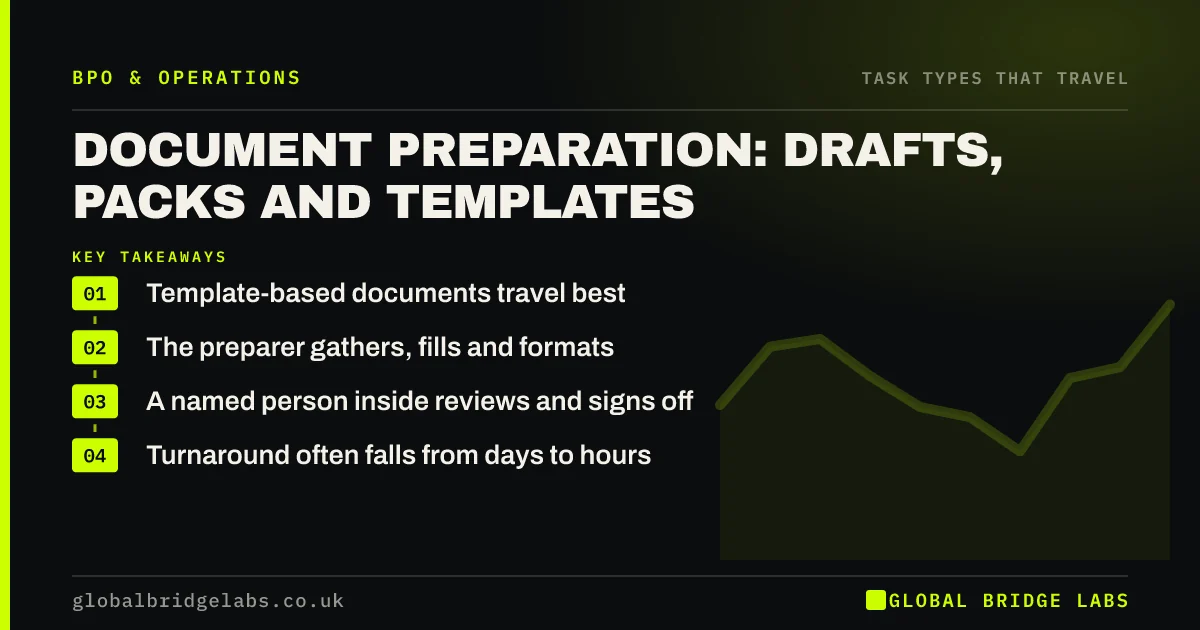
Document preparation outsourcing covers producing routine documents from templates and inputs: quotes, proposals, reports, contracts from standard terms, welcome packs and board papers. The preparer gathers information, fills the template and formats it; a named person inside reviews and signs off. The more a document follows a template, the better it travels.
- Template-based documents travel best.
- The preparer gathers, fills and formats.
- A named person inside reviews and signs off.
- Turnaround often falls from days to hours.
Want your document tasks listed and sized? Message us on WhatsApp.
Chat on WhatsApp →Why is document preparation a good candidate?
Because most of the time goes on gathering and formatting, not on the thinking. A proposal may need 20 minutes of judgement and two hours of pulling case studies, pricing tables and formatting. Separating the two lets the expert do the 20 minutes and someone else do the two hours.
Which documents are common candidates?
These are usually template-based and frequent.
- Quotes and proposals from a standard structure.
- Client reports from data and notes.
- Contracts and letters from approved templates.
- Welcome and onboarding packs.
- Board and meeting packs.
- Formatting and proofreading to a style guide.
What must stay inside?
The judgement and the signature. Pricing, scope, legal terms that depart from the template, advice and anything signed on the company's behalf stay with the right person. Expert content, such as technical or regulated advice, needs the expert's review before it goes out.
What does this look like in practice?
A pattern we see: a consultancy's senior staff build proposals themselves. With a template library and a short brief, an outside team prepares the first draft, and the senior person spends their time reviewing and pricing it instead of formatting.
Document preparation checklist
- List every document type you produce regularly.
- Build or tidy a template for each.
- Write a short brief format for requests.
- Name who reviews and signs off each type.
- Agree turnaround times by document type.
Next step
Pick the document type you produce most often and time the gathering and formatting versus the thinking. The gap is your opportunity.
Message us on WhatsApp for a document brief template, or book a 30-minute consultation.
Chat on WhatsApp →Sources and further reading
- Companies Act 2006, section 44: execution of documents · legislation.gov.uk
- Writing to GOV.UK standards: writing guidelines · GOV.UK
Frequently asked questions
What documents can be prepared by an outsourced team?
Template-based documents such as quotes, proposals, client reports, standard contracts and letters, welcome packs and board papers. The team gathers inputs, fills the template and formats it, and a named person inside reviews, adjusts judgement-based content and signs off.
How do I keep documents accurate when someone else prepares them?
Use templates with fixed sections, a short brief for each request, a library of approved content such as case studies and terms, and a review step before anything is sent. Track corrections at review and update templates when the same fix recurs.
Can contracts be prepared by an outsourced team?
Standard contracts from approved templates can be prepared, with blanks filled from agreed inputs. Any change to legal terms, unusual clauses or high-value agreements should be reviewed by someone qualified, and signing stays with people authorised to sign for the company.
Written by

Global Bridge Labs (GBL) is a UK–Sri Lanka partner for social media, websites and BPO. Everything here comes from client delivery, not theory.