On this page
Key takeaways
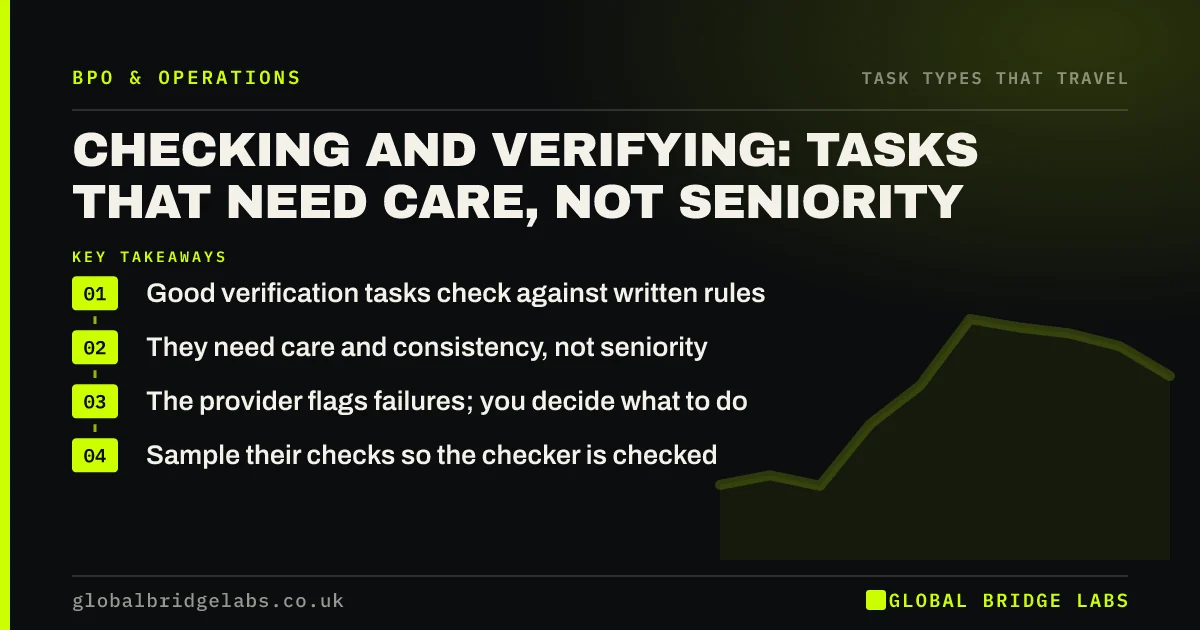
Verification tasks outsourcing works when the check is against written rules: matching invoices to orders, checking forms are complete, confirming documents are valid, or comparing records between systems. These tasks need care and consistency rather than seniority, so they are often done by expensive people for no good reason. Decisions on failures stay inside.
- Good verification tasks check against written rules.
- They need care and consistency, not seniority.
- The provider flags failures; you decide what to do.
- Sample their checks so the checker is checked.
Want your checking tasks listed and sized? Message us on WhatsApp.
Chat on WhatsApp →Why are checking tasks often in the wrong hands?
Because owners trust themselves to check. A director checking every invoice against its order, or a manager reviewing every form for missing fields, feels like control. But if the check follows rules, a trained person can do it more consistently, and the director's job becomes reviewing the exceptions, which is where judgement is actually needed.
Which verification tasks are common candidates?
These usually pass the six signals.
- Matching supplier invoices to orders and deliveries.
- Checking forms and applications for completeness.
- Checking documents are in date, such as insurance or certificates.
- Comparing records between two systems.
- Proofreading documents against a style guide.
Which checks must stay inside?
Checks that are themselves a legal duty or control usually stay, or at least their final step does. Right to work checks have specific rules about who does them and how, anti-money laundering checks sit under your firm's supervision, and the final quality check before work reaches a customer is often best kept by someone accountable.
What does this look like in practice?
A pattern we see: a director matches every purchase invoice to its order personally. An outside team does the three-way match and flags only the mismatches, and the director reviews those. Their time on the task falls to a short weekly review.
Verification task checklist
- List every check done in the business.
- Write the rules each check applies.
- Mark checks that are legal duties or controls.
- Move rule-based checks with exception flags.
- Sample the outsourced checks each month.
Next step
List the checks senior people do each week. For each, ask whether the rules could be written down. Those that can are candidates.
Message us on WhatsApp for the verification task list, or book a 30-minute consultation.
Chat on WhatsApp →Sources and further reading
- Human factors: managing human failures · Health and Safety Executive
- Check a job applicant's right to work · GOV.UK
Frequently asked questions
Can checking tasks be outsourced?
Yes, when the check follows written rules: matching documents, confirming completeness, checking dates and comparing records. The provider runs the check and flags failures, and someone inside decides what to do about each one. Sample their work to keep quality high.
Which checks should not be outsourced?
Checks that are a legal duty you hold, such as some right to work and anti-money laundering steps, and final sign-offs that carry accountability. Preparation around them can often move, but the decision and the duty should stay with a named person inside.
Who checks the checker?
You do, by sampling. Review a share of the outsourced checks each month, more at the start, and track the error rate. If the provider's checks are consistently accurate, the sample can shrink; if not, tighten the rules or the training.
Written by

Global Bridge Labs (GBL) is a UK–Sri Lanka partner for social media, websites and BPO. Everything here comes from client delivery, not theory.