On this page
Key takeaways
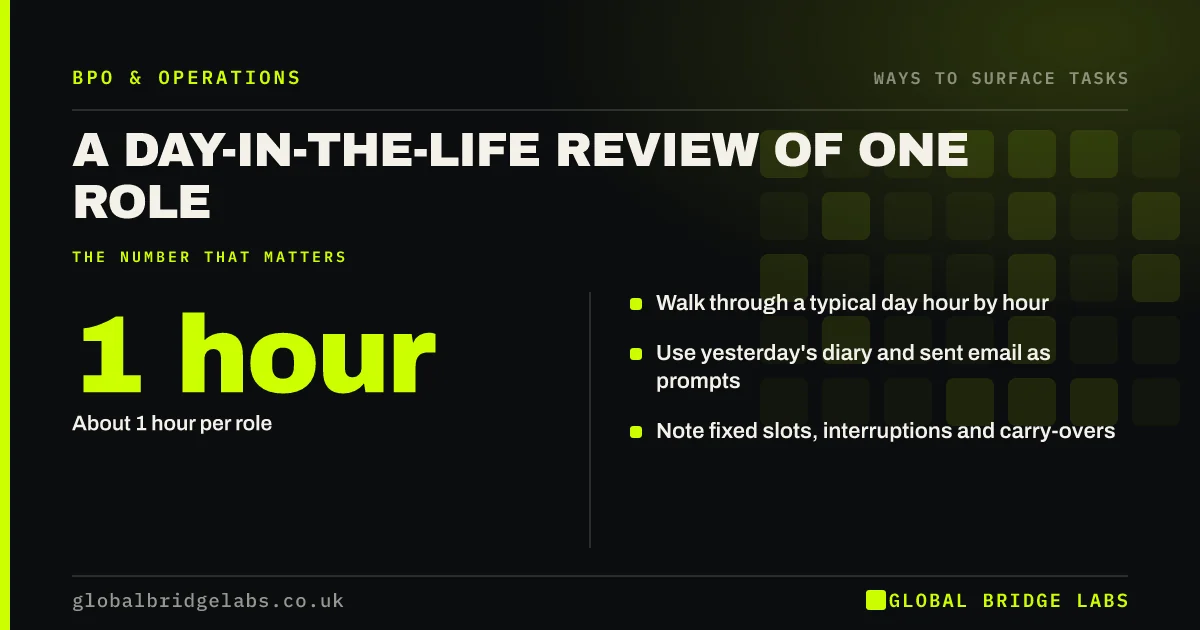
A day in the life analysis walks through one role's typical working day, hour by hour, with the person who does it: what they open first, what interrupts them, what they finish and what they carry over. It takes about an hour and shows the rhythm of the role, including the fixed slots and the interruptions that make tasks easy or hard to move.
- Walk through a typical day hour by hour.
- Use yesterday's diary and sent email as prompts.
- Note fixed slots, interruptions and carry-overs.
- About 1 hour per role.
Want a day-in-the-life template? Message us on WhatsApp.
Chat on WhatsApp →How is this different from shadowing?
Shadowing watches the work live; a day-in-the-life review reconstructs it afterwards from records and memory. It is quicker, less intrusive and covers the whole day, including early and late tasks, but it misses the small automatic steps shadowing would catch. Use the review for most roles and shadowing for the heaviest.
How do you run the review?
Sit with the person and their diary, inbox and task list from yesterday.
- 1. Start from first login: what did you open and why?
- 2. Walk hour by hour through what you did.
- 3. Note each interruption and what it was.
- 4. Note what was left unfinished and why.
- 5. List each task with its trigger and minutes.
What patterns should you look for?
Look for tasks that happen at the same time every day, such as morning order checks, which suit a provider working ahead of the UK. Look for interruptions that break deep work, such as phone queries. And look for tasks that always get carried over, which show where capacity runs out.
What does this look like in practice?
A pattern we see: a project coordinator's day starts with checking overnight emails and updating trackers, is broken by a steady run of phone queries, and ends with timesheet chasing. The first and last parts of the day are both strong candidates.
Day-in-the-life checklist
- Use yesterday's records as prompts.
- Walk through the day hour by hour.
- Note fixed slots and interruptions.
- Note what was carried over.
- Add each task to the long list.
Next step
Book an hour with one team member tomorrow and walk through today together, using their diary and inbox as prompts.
Message us on WhatsApp for the review template, or book a 30-minute consultation.
Chat on WhatsApp →Sources and further reading
- User research · GOV.UK Service Manual
- Multitasking: switching costs · American Psychological Association
Frequently asked questions
What is a day in the life analysis?
A structured walk through one role's typical working day, hour by hour, using the person's diary, inbox and task list as prompts. It shows the tasks they do, when they do them, what interrupts them and what gets carried over, which helps identify tasks that could be done elsewhere.
How long does a day in the life review take?
About an hour per role. Use the previous working day while it is fresh, and choose a typical day rather than an unusually quiet or chaotic one. Repeat for a second day if the role varies a lot.
Should I do this for every role?
For a small business, yes, for every role with significant admin. It is quick, not intrusive, and gives a consistent picture across the team. Use job shadowing in addition for the two or three roles where you suspect the most hidden work.
Written by

Global Bridge Labs (GBL) is a UK–Sri Lanka partner for social media, websites and BPO. Everything here comes from client delivery, not theory.