On this page
- 01Key takeaways
- 02Why use a method instead of a hunch?
- 03What happens at each step?
- 04How long does the task finder take?
- 05How does the task finder fit with the other scores?
- 06What does this look like in practice?
- 07Task finder steps checklist
- 08Next step
- 09Sources and further reading
- 10Frequently asked questions
Key takeaways
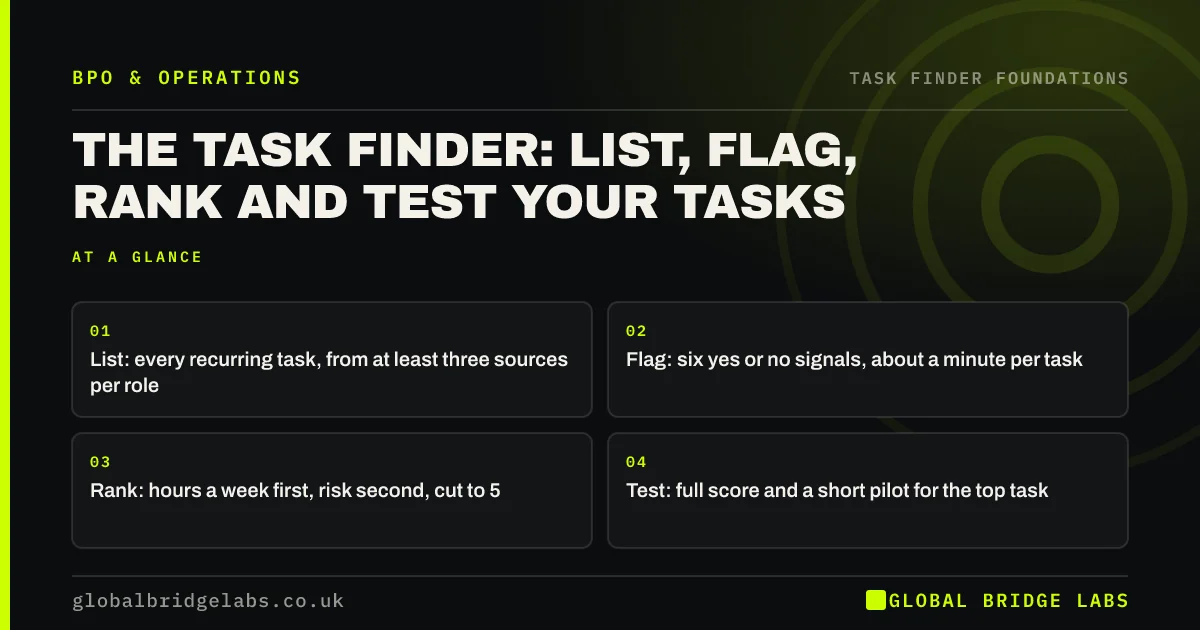
The GBL Task Finder is an outsourcing task finder method in four steps: List every recurring task, Flag each against six signals, Rank the survivors by hours and risk, and Test the top five. It takes about a week of part-time effort in a business of 10 to 50 people and replaces guesswork with a short, defensible list.
- List: every recurring task, from at least three sources per role.
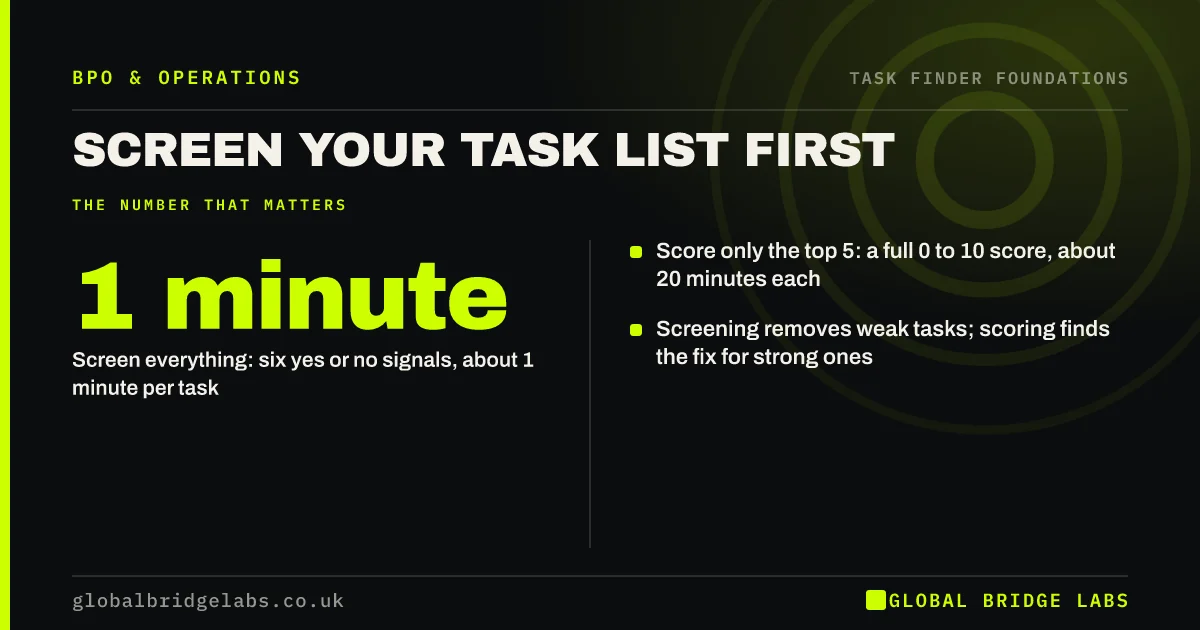
- Flag: six yes or no signals, about a minute per task.
- Rank: hours a week first, risk second, cut to 5.
- Test: full score and a short pilot for the top task.
Want to run the task finder on one team with us? Message us on WhatsApp.
Chat on WhatsApp →Why use a method instead of a hunch?
A method finds tasks a hunch misses. Owners usually pick the task that annoys them most, which is often not the most suitable or the biggest. A structured list shows the hours spread across roles, the tasks nobody owns and the ones that only look simple. It also gives you a record you can revisit each quarter.
What happens at each step?
Each step has one output, and the next step only uses that output.
- List produces a long list: task, who does it, how often, rough minutes each time.
- Flag produces a screened list: each task marked against the six signals.
- Rank produces a shortlist of five: highest hours, lowest risk, five or six flags.
- Test produces a decision: hand over, fix first or keep, with a pilot for the winner.
How long does the task finder take?
As a GBL rule of thumb, a business of 10 to 50 people needs 4 to 8 hours to build the long list, about 2 hours to flag and rank it, and 2 to 4 weeks to test the top task with a pilot. Most of the listing can be shared: each manager lists their own team's tasks using the same template.
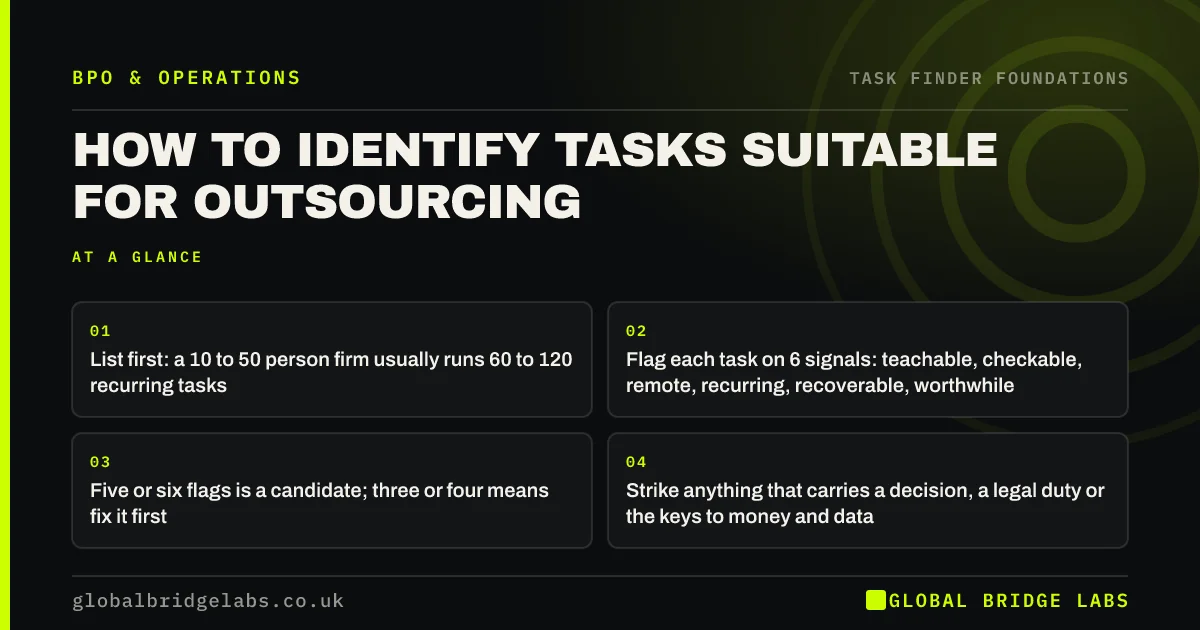
Expect a long list of 60 to 120 recurring tasks. Typically a quarter to a third pass five or six flags, which is plenty to choose from.
How does the task finder fit with the other scores?
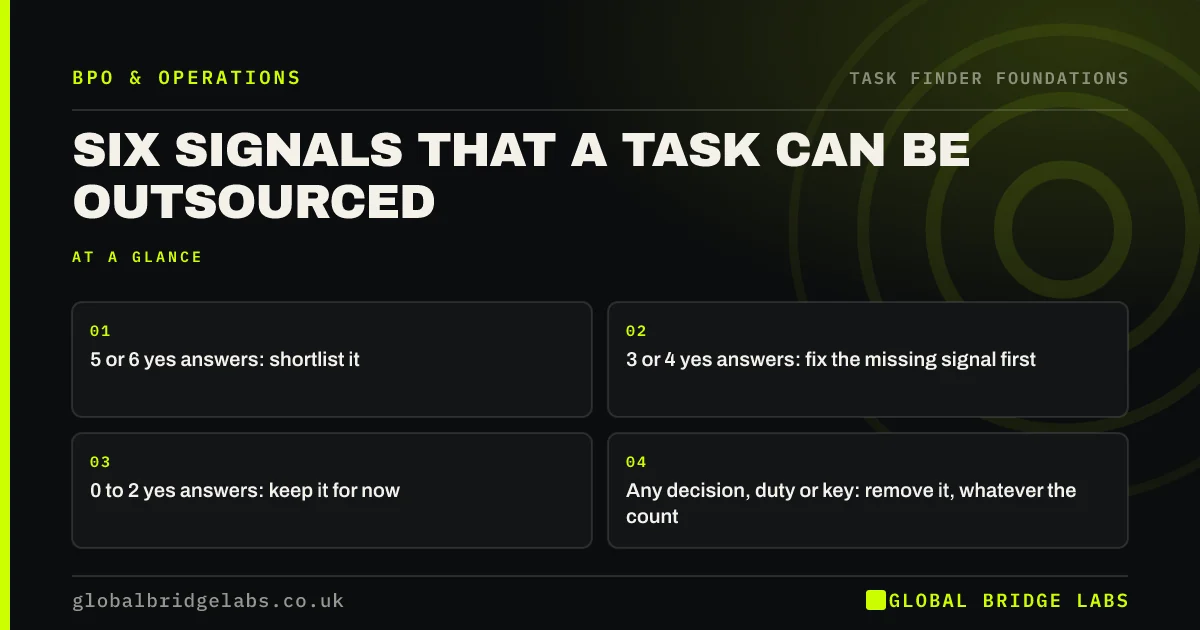
The task finder finds candidates; the other tools judge them. Once a task is on your shortlist, the repetitive task fit score rates it in depth out of 10. If the candidate turns out to be a whole process, use the process selection score instead. Before either, the never-outsource test removes any step that carries a decision or duty.
What does this look like in practice?
A pattern we see: a growing firm's managers each list their team's tasks, and the long list is far longer than anyone guessed. Flagging takes one meeting. Ranking by hours puts a bundle of order updates and delivery chasing at the top, ahead of the bookkeeping the owner had in mind.
Task finder steps checklist
- Agree one template for the long list.
- Ask each manager to list their team's tasks.
- Flag every task in one session.
- Rank by hours and risk, then cut to five.
- Test the top task and record the decision.
Next step
Start with the List step for one team this week. The rest of the method only works if the list is honest and complete.
Message us on WhatsApp for the task finder template, or book a 30-minute consultation.
Chat on WhatsApp →Sources and further reading
- The probability of automation in England: 2011 and 2017 · Office for National Statistics
- The Sourcing and Consultancy Playbooks · Cabinet Office
Frequently asked questions
What is the GBL Task Finder?
It is a four-step method for finding tasks to outsource: list every recurring task, flag each against six signals (teachable, checkable, remote, recurring, recoverable, worthwhile), rank the survivors by hours a week and risk, and test the top five before anything is handed over.
How many tasks should be on the long list?
As many as the business really runs. A firm of 10 to 50 people usually finds 60 to 120 recurring tasks once diaries, inboxes and system data are checked. A list of 15 usually means people described their jobs rather than their tasks.
Can I skip straight to scoring a task?
You can, but you risk scoring the wrong task. Scoring one favourite task tells you whether that task is suitable. Listing and screening first tells you which task is most suitable, which is the more useful answer when you only have time to hand over one or two at first.
Written by

Global Bridge Labs (GBL) is a UK–Sri Lanka partner for social media, websites and BPO. Everything here comes from client delivery, not theory.