On this page
Key takeaways
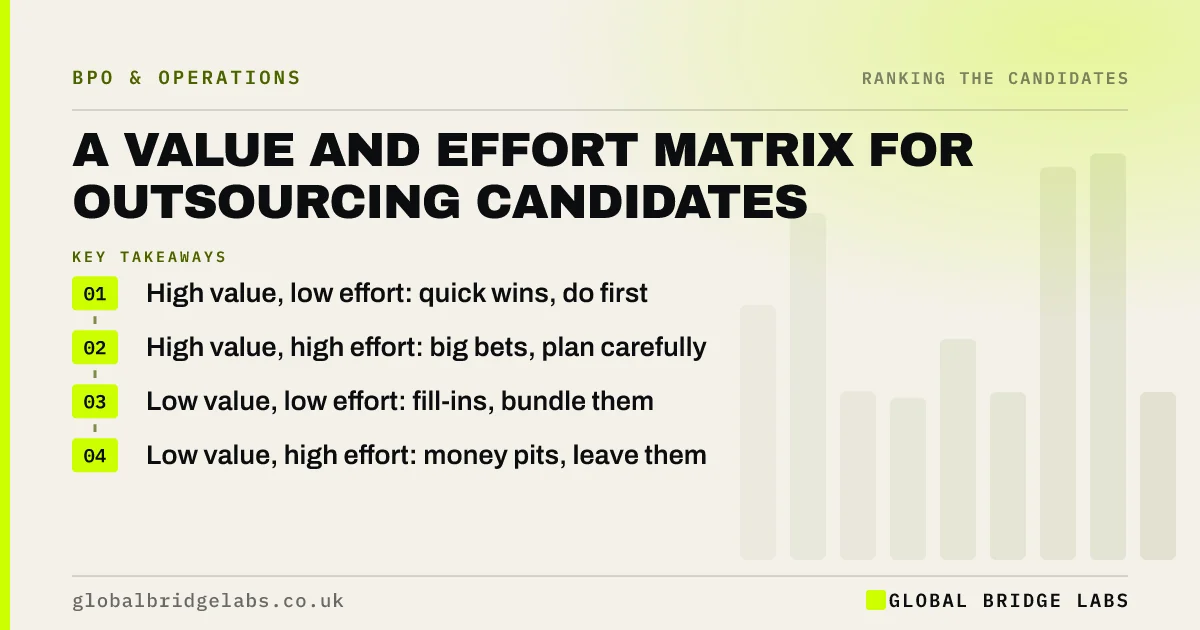
A value effort matrix plots each candidate task on two axes: value, meaning hours freed and the worth of those hours, and effort, meaning how hard the task is to hand over. The four boxes give a clear order: quick wins first, big bets second, fill-ins when there is spare capacity, and money pits left alone.
- High value, low effort: quick wins, do first.
- High value, high effort: big bets, plan carefully.
- Low value, low effort: fill-ins, bundle them.
- Low value, high effort: money pits, leave them.
Want your candidates plotted with you? Message us on WhatsApp.
Chat on WhatsApp →Why use a matrix?
Because a picture ends arguments faster than a list. Put twenty candidate tasks on a two-by-two grid and the team can see at a glance which to start with. It also shows when the list is unbalanced, for example all big bets and no quick wins, which tells you to look for easier first tasks.
How do you measure value and effort?
Keep both scales simple: low, medium, high.
- Value: hours freed a week, weighted by whose hours they are.
- An owner's hour is worth more than an administrator's.
- Effort: documentation, training, access and change needed.
- A task already written down is low effort.
- A task needing new systems or data protection work is high effort.
What should you do with each box?
Quick wins go first, one at a time. Big bets get a plan, a pilot and a parallel run, scheduled after a quick win has worked. Fill-ins are bundled together so they become worth a provider's time. Money pits are left where they are, or reconsidered if something changes, such as a new system.
What does this look like in practice?
A pattern we see: a leadership team plots its candidates and finds a few quick wins, several big bets, a scatter of fill-ins that bundle into one weekly block, and some money pits. The matrix turns a long debate into a six-month order in one meeting.
Value and effort checklist
- Rate each candidate's value low, medium or high.
- Rate each candidate's effort low, medium or high.
- Plot them on a two-by-two grid.
- Start with quick wins, then plan big bets.
- Bundle fill-ins and leave money pits.
Next step
Draw the grid on a whiteboard and place your screened tasks on it with your managers. It takes about 30 minutes.
Message us on WhatsApp for the matrix template, or book a 30-minute consultation.
Chat on WhatsApp →Sources and further reading
- The Sourcing and Consultancy Playbooks · Cabinet Office
- The Green Book: appraisal and evaluation in central government · HM Treasury
Frequently asked questions
What is a value effort matrix?
A two-by-two grid that plots options by the value they deliver and the effort they take. For outsourcing, value is the hours freed and their worth, and effort is how hard the task is to hand over. It sorts candidates into quick wins, big bets, fill-ins and money pits.
How do I measure the value of outsourcing a task?
Start with hours freed per week, then weight them by whose time is freed and what they will do instead. An hour of an owner's time moved to sales is worth far more than an hour of administrator time. Simple low, medium and high ratings are enough.
What are money pit tasks?
Tasks that free little time but take a lot of effort to hand over, such as a rare, complicated task needing special access. They are best left where they are, unless something changes, such as a new system that makes the task simpler.
Written by

Global Bridge Labs (GBL) is a UK–Sri Lanka partner for social media, websites and BPO. Everything here comes from client delivery, not theory.