On this page
Key takeaways
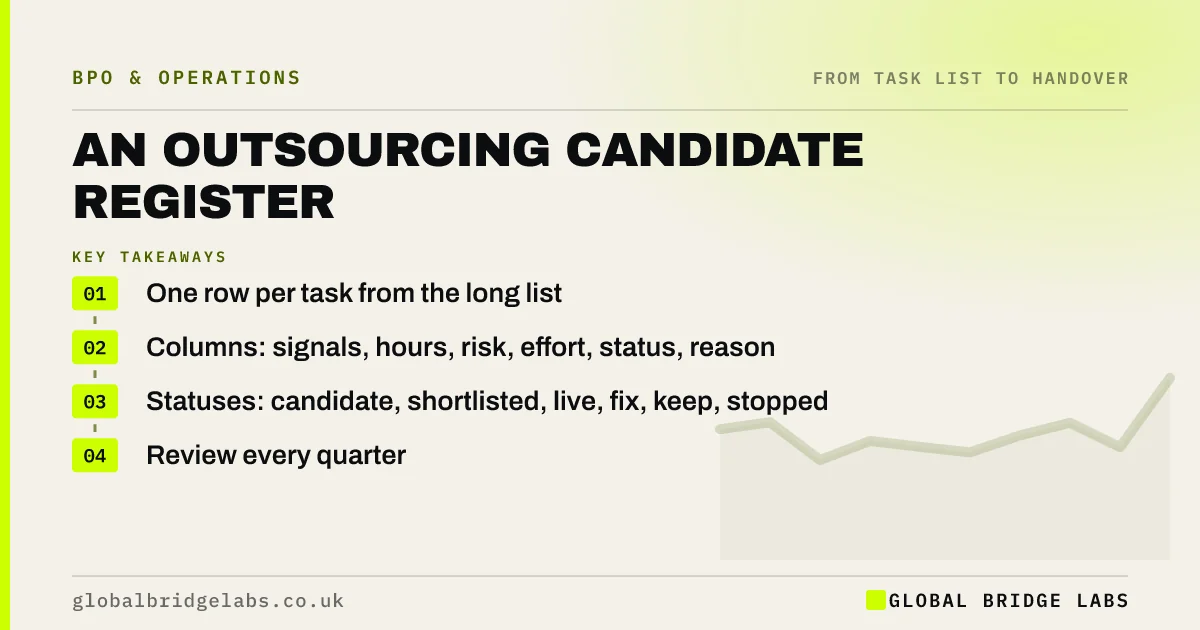
An outsourcing candidate register is one spreadsheet with a row per task from your long list, recording the six signals, hours a week, risk, handover effort and status. It turns a one-off exercise into a pipeline: when one handover is stable, the next candidate is already screened and ranked. Review it each quarter.
- One row per task from the long list.
- Columns: signals, hours, risk, effort, status, reason.
- Statuses: candidate, shortlisted, live, fix, keep, stopped.
- Review every quarter.
Want the candidate register template? Message us on WhatsApp.
Chat on WhatsApp →Why keep a register?
Because the first task-finding exercise is the hardest, and you should only do it once. A register keeps the work: which tasks passed, which failed and why, and which are waiting. When a role changes, a system is replaced or someone leaves, you update rows instead of starting again.
What columns should it have?
Keep it lean enough that people update it.
- Task, owner and source where it was found.
- Frequency and estimated hours a week.
- Six signals: yes or no each.
- Risk: low, medium or high.
- Handover effort: days, weeks or months.
- Status and reason, such as 'keep: approval step'.
How is it different from a risk register?
The candidate register is about choosing what to move. An outsourcing risk register tracks the risks of what has already moved, with owners and controls. Tasks pass from one to the other: when a candidate goes live, its risks move to the risk register and its row changes to 'live'.
What does this look like in practice?
A pattern we see: a register built at the start keeps its value long after. Over the following months, rows move from candidate to live, some are fixed and re-screened, many are kept with reasons, and a few stop. Each quarterly review is short and picks the next tasks.
Candidate register checklist
- Create one row per task.
- Record signals, hours, risk and effort.
- Give every row a status and reason.
- Update rows when roles or systems change.
- Review the register quarterly.
Next step
Turn your long list into a register by adding the status and reason columns. It takes an hour and saves the next exercise.
Message us on WhatsApp for the register template, or book a 30-minute consultation.
Chat on WhatsApp →Sources and further reading
- The Sourcing and Consultancy Playbooks · Cabinet Office
- Labour productivity · Office for National Statistics
Frequently asked questions
What is an outsourcing candidate register?
A single list, usually a spreadsheet, with one row for every task identified, recording its outsourcing signals, hours, risk, handover effort, status and the reason for that status. It keeps the results of task-finding so the next candidate is always ready to pick.
How often should the register be reviewed?
Every quarter, and whenever something significant changes, such as a new system, a restructure or someone leaving. Quarterly reviews usually take under an hour once the register exists, and pick the next one or two tasks to hand over.
Should kept tasks stay on the register?
Yes, with the reason they were kept. Reasons change: a task kept because it was not written down may become a candidate once documented. Keeping the row avoids rediscovering and re-judging the same task later.
Written by

Global Bridge Labs (GBL) is a UK–Sri Lanka partner for social media, websites and BPO. Everything here comes from client delivery, not theory.