On this page
Key takeaways
Tasks with fixed deadlines, such as VAT preparation, payroll inputs, renewals and monthly reports, are often good outsourcing candidates because the deadline makes the standard clear. The risk is a missed date. Build the clock in: an input cut-off, a delivery time ahead of the real deadline, reminders, and a named person inside who checks it arrived.
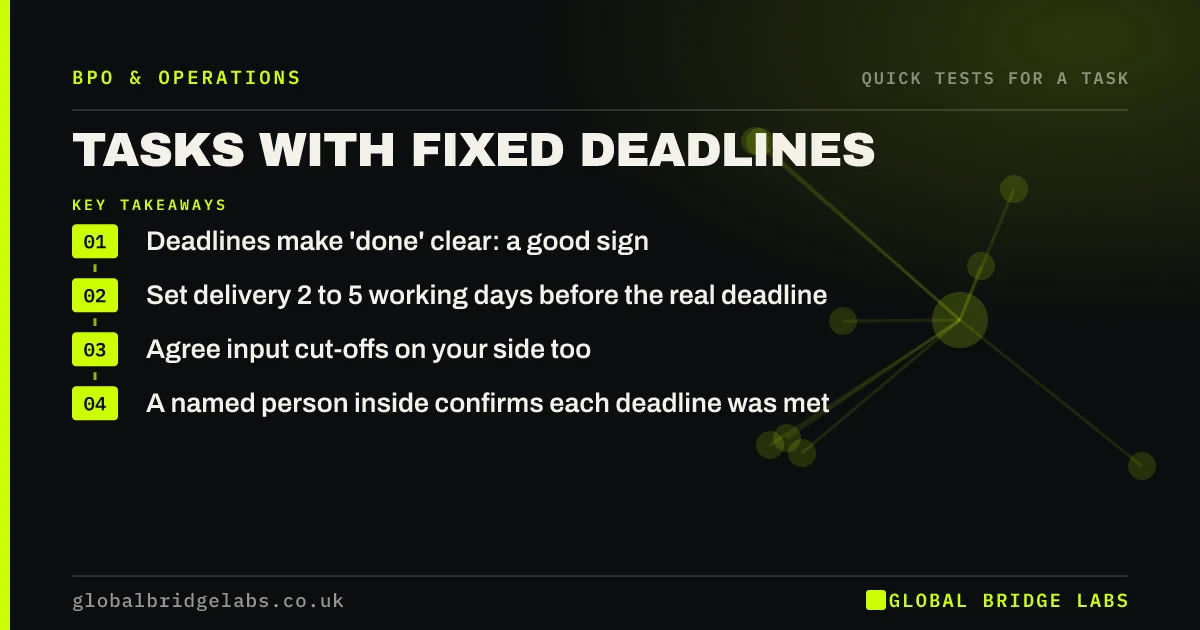
- Deadlines make 'done' clear: a good sign.
- Set delivery 2 to 5 working days before the real deadline.
- Agree input cut-offs on your side too.
- A named person inside confirms each deadline was met.
Want a deadline calendar built for your candidate tasks? Message us on WhatsApp.
Chat on WhatsApp →Why are deadline tasks good candidates?
A fixed deadline gives the task a clear finished state and a clear measure: on time or not. Deadline tasks also tend to recur on a known cycle, weekly, monthly or quarterly, which makes them easy to plan. The danger is not the task but the gap between who does it and who is accountable for the date.
How do you build the clock in?
Treat the deadline as a chain of smaller dates.
- Input cut-off: the date your team must supply information.
- Provider delivery: 2 to 5 working days before the real deadline.
- Review: a named person checks the output.
- Submission: done or approved by the person accountable.
- Reminders: at 7 days and 2 days before each date.
Which deadline tasks should stay inside?
The submission and the accountability usually stay inside. Directors remain responsible for company filings and tax returns their accountant submits, and employers stay responsible for payroll and pensions even when a bureau runs them. Outsource the preparation; keep the approval and the duty.
What does this look like in practice?
A pattern we see: a firm's quarterly VAT preparation always runs to the last two days because receipts arrive late. Outsourcing the preparation with an input cut-off two weeks before the deadline and delivery five working days before it ends the last-minute scramble.
Deadline task checklist
- List every deadline task and its real due date.
- Set input cut-offs and provider delivery dates.
- Add reminders at 7 and 2 days.
- Name the person who checks and submits.
- Keep accountability for the deadline inside.
Next step
Write down every fixed deadline your business works to in a year. Mark which ones are prepared by someone who could be doing higher-value work.
Message us on WhatsApp for a deadline calendar template, or book a 30-minute consultation.
Chat on WhatsApp →Sources and further reading
- Sending a VAT Return · HM Revenue & Customs
- Accounts and tax returns for private limited companies: penalties for late filing · GOV.UK
Frequently asked questions
Can you outsource tasks with legal deadlines?
You can outsource the preparation, but the legal responsibility stays with you. Directors remain responsible for filings, and employers for payroll and pension duties. Build in a delivery date well before the real deadline and keep the final check and submission with a named person inside.
How early should an outsourced task be delivered?
As a rule of thumb, two to five working days before the real deadline, depending on how long your review takes and how serious a late submission would be. That buffer covers questions, corrections and the occasional late input from your own side.
What causes missed deadlines in outsourced work?
Usually late inputs from the client side rather than slow work by the provider. Agree input cut-offs, send reminders to your own team, and make the provider flag missing inputs early. A shared deadline calendar keeps both sides working to the same dates.
Written by

Global Bridge Labs (GBL) is a UK–Sri Lanka partner for social media, websites and BPO. Everything here comes from client delivery, not theory.