On this page
Key takeaways
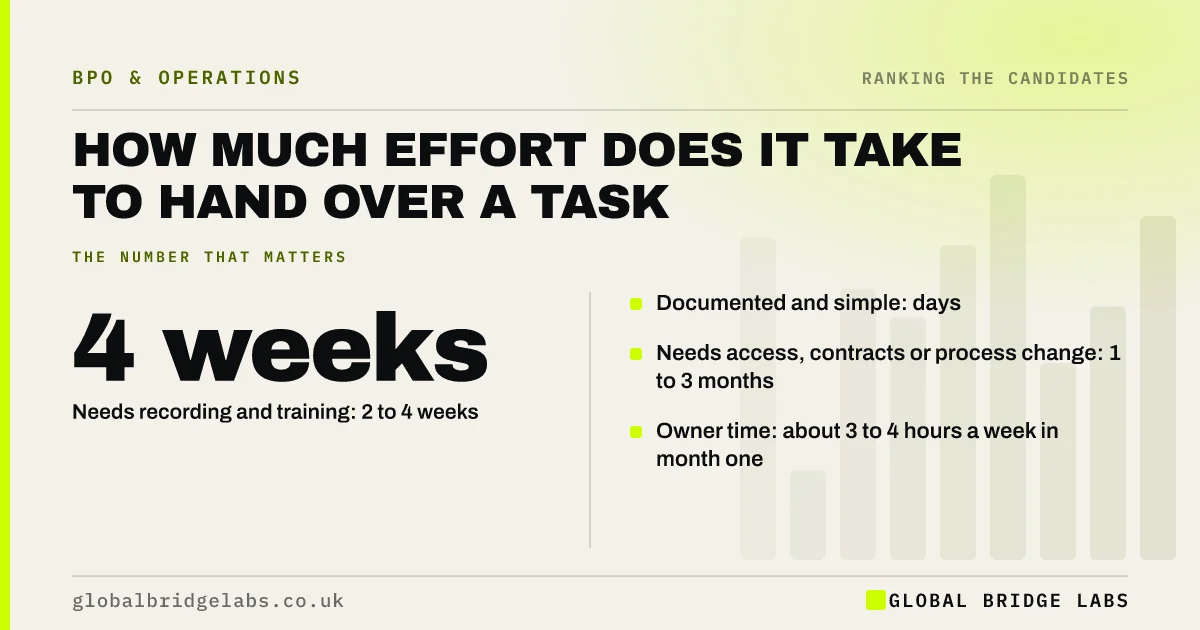
How long it takes to hand over a task depends on four things: whether it is written down, how much training it needs, what access must be set up, and what has to change on your side. A documented, screen-based task can move in days. A task needing new systems, data protection work or a process change can take months. Estimate effort before you rank.
- Documented and simple: days.
- Needs recording and training: 2 to 4 weeks.
- Needs access, contracts or process change: 1 to 3 months.
- Owner time: about 3 to 4 hours a week in month one.
Want handover effort estimated for your shortlist? Message us on WhatsApp.
Chat on WhatsApp →Why estimate handover effort?
Because it decides how soon you see the benefit. Two tasks that each free 6 hours a week are not equal if one is live in a week and the other in three months. Effort also tells you how much of your own time the handover needs, which is often the real constraint in a small business.
What drives handover effort?
Check each factor for every shortlisted task.
- Documentation: is there a page and a recording?
- Training: how many cases before someone is reliable?
- Access: which systems, which permissions, who sets them up?
- Contracts: is a processor agreement or transfer safeguard needed?
- Change: must anything change on your side, such as forms or routes?
How much of your time will it take?
As a GBL rule of thumb, expect 3 to 4 hours a week of owner or manager time in the first month of a new task, falling to 1 to 2 hours by the third month. Most of it goes on answering questions and checking work. Good documentation cuts it more than anything else.
What does this look like in practice?
A pattern we see: two candidates free similar hours. One, invoice coding, is documented and needs one login: live in eight days. The other, customer onboarding, needs new forms, a processor contract and CRM permissions: live in ten weeks. Ranking by effort puts invoice coding first.
Handover effort checklist
- Check documentation for each candidate.
- Estimate training cases needed.
- List the access and permissions required.
- Check whether contracts or safeguards are needed.
- Rate effort as days, weeks or months.
Next step
Rate handover effort for each task on your shortlist as days, weeks or months. Re-sort your list with that column added.
Message us on WhatsApp for the handover effort sheet, or book a 30-minute consultation.
Chat on WhatsApp →Sources and further reading
- International transfers of personal data · Information Commissioner's Office
- The Sourcing and Consultancy Playbooks · Cabinet Office
Frequently asked questions
How long does it take to hand over a task to an outsourced team?
A documented, screen-based task can be live within days and stable within a few weeks. Tasks that need recording, training and new access usually take two to four weeks. Tasks needing contracts, data protection work or process changes can take one to three months.
How much management time does a handover need?
As a rule of thumb, three to four hours a week of owner or manager time in the first month, falling to one or two hours by the third month. Most of it is answering questions and checking work. Clear written instructions reduce it significantly.
What slows a handover down most?
Missing documentation and slow access set-up are the usual culprits, followed by unclear rules for exceptions. Writing the task down, preparing logins in advance and listing the common exceptions before the start date removes most delays.
Written by

Global Bridge Labs (GBL) is a UK–Sri Lanka partner for social media, websites and BPO. Everything here comes from client delivery, not theory.