On this page
Key takeaways
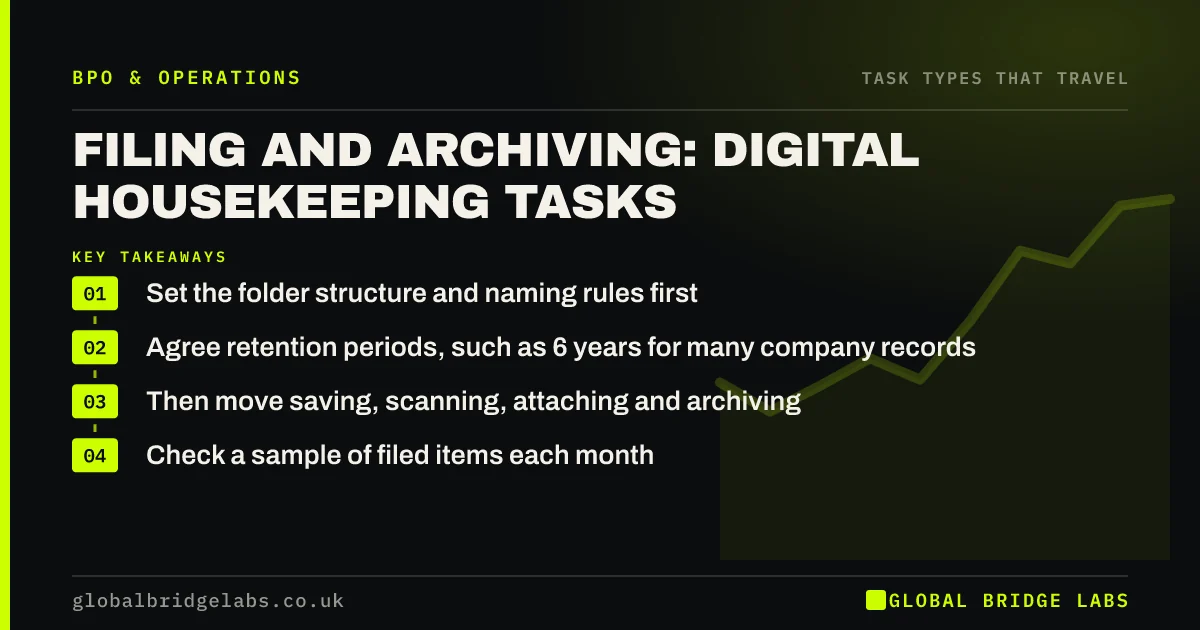
Filing and archiving outsourcing covers the digital housekeeping most firms neglect: saving documents to the right folder with the right name, scanning paper, attaching files to records, and archiving or deleting files when their retention period ends. It is rule-based and checkable, but it needs a filing structure and retention rules first, or the provider just files the mess faster.
- Set the folder structure and naming rules first.
- Agree retention periods, such as 6 years for many company records.
- Then move saving, scanning, attaching and archiving.
- Check a sample of filed items each month.
Want your filing tasks listed and sized? Message us on WhatsApp.
Chat on WhatsApp →Why does filing matter for outsourcing?
Because poor filing slows every other task. Staff waste time searching, documents are saved twice under different names, and nobody knows which version is current. Good filing is also a precondition for outsourcing other work: a provider who cannot find the right file cannot do the task.
Which filing tasks are common candidates?
These are usually frequent, rule-based and screen-based.
- Saving incoming documents to the right folder with the right name.
- Scanning and indexing paper post and forms.
- Attaching documents to customer, job or supplier records.
- Moving closed files to an archive.
- Flagging files due for deletion under retention rules.
What must be decided inside?
The structure and the retention rules. How folders are organised, how files are named, and how long each type is kept are decisions for the business, guided by law: many company and tax records must be kept for at least six years, and personal data should not be kept longer than needed. Deletion of anything important should be approved inside.
What does this look like in practice?
A pattern we see: a shared drive with years of files and no naming rules. After a structure and retention schedule are agreed, an outside team files incoming documents daily and works through the backlog in planned batches, archiving closed files and flagging old ones for approval to delete.
Filing and archiving checklist
- Agree a folder structure and naming rule.
- Write a retention schedule by document type.
- Move daily filing to an outside team.
- Clear the backlog in planned batches.
- Approve deletions inside the business.
Next step
Write a one-page folder structure and naming rule this week. Once it exists, filing becomes a task anyone can follow.
Message us on WhatsApp for a filing structure template, or book a 30-minute consultation.
Chat on WhatsApp →Sources and further reading
- Running a limited company: company and accounting records · GOV.UK
- Advice for small organisations · Information Commissioner's Office
Frequently asked questions
Can filing and archiving be outsourced?
Yes. Saving documents correctly, scanning paper, attaching files to records and archiving closed files are rule-based tasks that travel well. The business should set the folder structure, naming rules and retention periods first, and approve deletion of anything important.
How long should a UK business keep records?
It depends on the record. Many company and tax records must be kept for at least six years, while personal data should only be kept as long as needed for its purpose. Write a retention schedule by document type and check it against current guidance.
Should we scan all our paper files?
Scan what you use or must keep accessible, and set a rule for new paper going forward. Old files rarely needed may be cheaper to store or securely destroy once their retention period ends. Scanning everything at once is rarely the best use of budget.
Written by

Global Bridge Labs (GBL) is a UK–Sri Lanka partner for social media, websites and BPO. Everything here comes from client delivery, not theory.