On this page
Key takeaways
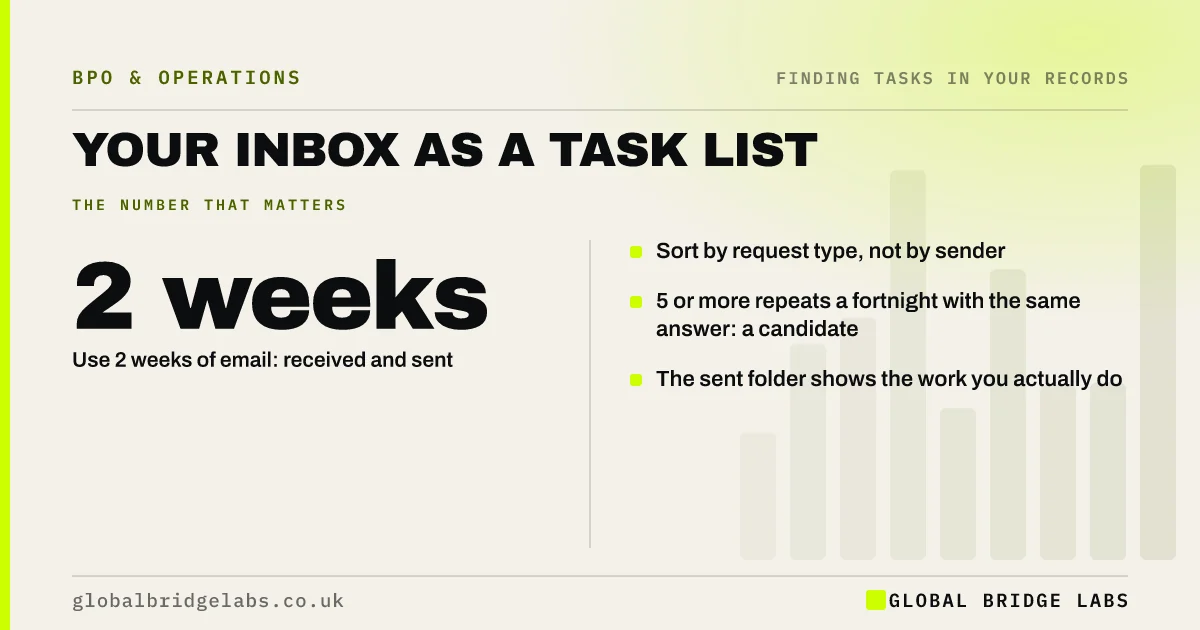
An inbox task analysis takes two weeks of received and sent email, sorts it by the request behind each thread, and counts how often each type appears. Any request that arrives five or more times a fortnight and is answered the same way is a candidate task. The sent folder matters more than the inbox.
- Use 2 weeks of email: received and sent.
- Sort by request type, not by sender.
- 5 or more repeats a fortnight with the same answer: a candidate.
- The sent folder shows the work you actually do.
Want a hand sorting a fortnight of email into tasks? Message us on WhatsApp.
Chat on WhatsApp →Why is the inbox such a good source?
In most small firms, email is where requests arrive and where work is done. An inbox shows the same delivery query, quote request or document chase arriving week after week, which interviews rarely capture. The sent folder shows how each was answered, and whether the answer was the same each time.
How do you sort an inbox into tasks?
Work from your own inbox, or ask each person to sort theirs. Do not read colleagues' mailboxes without telling them; this is about work patterns, not monitoring.
- 1. Pick two typical weeks.
- 2. List each thread's underlying request in a few words.
- 3. Group similar requests together.
- 4. Count each group and note who answered.
- 5. Mark groups answered with a standard reply or lookup.
Which email tasks usually move?
Requests that need a lookup and a standard reply move well: order status, document copies, appointment changes, invoice queries and supplier confirmations. Requests that need a negotiation, a complaint decision or an opinion stay, though the provider can triage them and draft replies for approval.
What does this look like in practice?
A pattern we see: a coordinator's fortnight of email looks like a blur of different requests. Sorted by need, most threads fall into a handful of groups, such as order status questions, invoice copies and delivery bookings, each answered with a lookup and a standard reply. Those groups are the candidate task.
Inbox analysis checklist
- Choose two typical weeks.
- Sort threads by request type.
- Count repeats and note standard answers.
- Ask people to sort their own mailboxes.
- Add repeat groups to the long list.
Next step
Sort your own last fortnight of sent email this week. Count the three most common request types and estimate the minutes each takes.
Message us on WhatsApp for the inbox sort sheet, or book a 30-minute consultation.
Chat on WhatsApp →Sources and further reading
- Employment information · Information Commissioner's Office
- User research · GOV.UK Service Manual
Frequently asked questions
How do I find repeat tasks in my email?
Take two weeks of email, write down the underlying request behind each thread, group similar requests and count them. Any group that appears five or more times a fortnight and gets the same kind of answer is a repeat task worth considering for outsourcing.
Can I review my staff's inboxes?
Be careful. Staff have reasonable expectations of privacy and the ICO expects monitoring to be necessary, proportionate and transparent. The simpler route is to ask each person to sort their own inbox using a shared template, which also gives better results because they know the context.
Should shared inboxes be analysed too?
Yes, they are often the richest source. A shared sales, accounts or orders mailbox shows every repeat request in one place. Sort a fortnight by request type, note who answered and how long replies took, and you will see which groups could be handled by an outsourced team.
Written by

Global Bridge Labs (GBL) is a UK–Sri Lanka partner for social media, websites and BPO. Everything here comes from client delivery, not theory.