On this page
Key takeaways
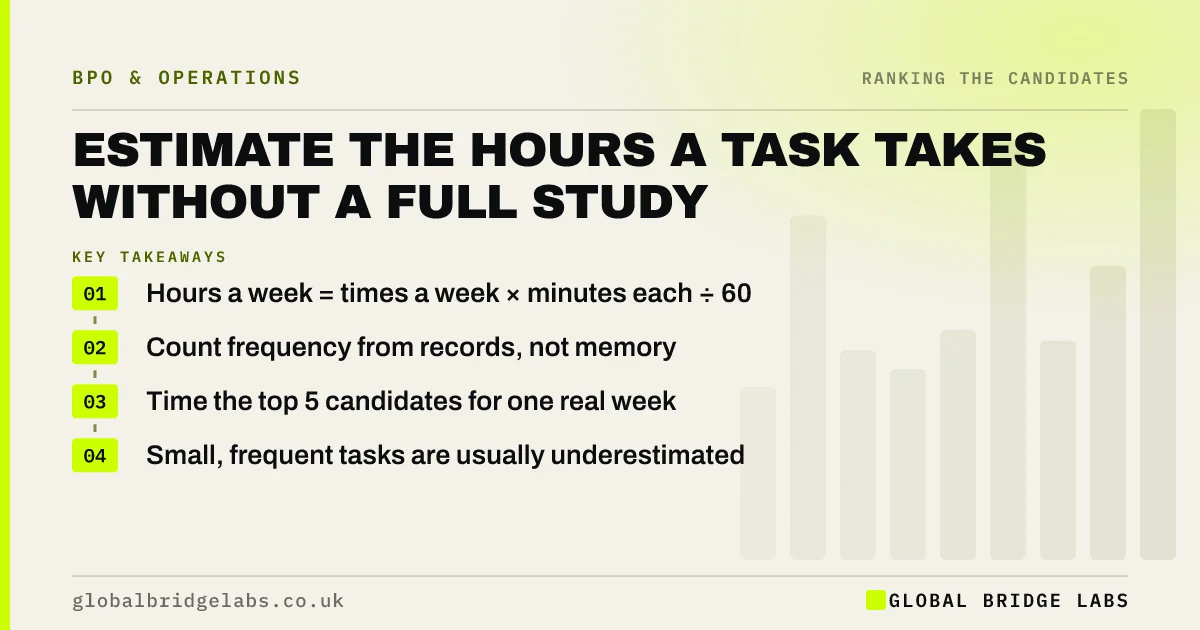
To estimate hours per task without a full time study, multiply how many times the task happens each week by the minutes it takes each time, then check that figure against one week of real timing for the top candidates. Round to the nearest half hour. People usually underestimate small, frequent tasks and overestimate large, rare ones.
- Hours a week = times a week × minutes each ÷ 60.
- Count frequency from records, not memory.
- Time the top 5 candidates for one real week.
- Small, frequent tasks are usually underestimated.
Want help estimating your candidate tasks? Message us on WhatsApp.
Chat on WhatsApp →Why estimate rather than measure everything?
Because ranking only needs rough numbers. Whether a task takes 4 or 4.5 hours a week rarely changes which comes first. A full time study for 80 tasks would take weeks. Estimating all of them and measuring only the shortlist gives you enough accuracy at a fraction of the effort.
How do you make a quick estimate?
Use records for frequency and the person doing the task for duration.
- 1. Count how often it happens: emails sent, invoices raised, bookings made.
- 2. Ask the person how long one takes, including switching in and out.
- 3. Multiply and convert to hours a week.
- 4. Add time for exceptions, often 10% to 20%.
- 5. Round to the nearest half hour.
Where do estimates go wrong?
Frequent small tasks are underestimated because each feels trivial: twenty 3-minute updates a day is 5 hours a week. Interruptions are missed, because switching between tasks has a real cost. Rare, unpleasant tasks are overestimated because they feel long. One week of timing on the shortlist corrects most of this.
What does this look like in practice?
A pattern we see: a coordinator estimates order updates at 'a few minutes here and there'. The system shows dozens of updates every day, which adds up to a large share of the week once exceptions are included. The estimate moves the task from the bottom of the list to the top.
Task hours checklist
- Count frequency from records.
- Ask for minutes each time, including switching.
- Add an allowance for exceptions.
- Round to the nearest half hour.
- Time the shortlist for one real week.
Next step
Estimate hours for every task on your long list in one sitting, then time your top five for a week. Compare the two and adjust.
Message us on WhatsApp for the estimate sheet, or book a 30-minute consultation.
Chat on WhatsApp →Sources and further reading
- Multitasking: switching costs · American Psychological Association
- Labour productivity · Office for National Statistics
Frequently asked questions
How do I estimate how long a task takes?
Count how often it happens each week from your records, ask the person doing it how long one takes including switching in and out, multiply, and add 10% to 20% for exceptions. For your top candidates, check the estimate against one week of real timing.
Why are task time estimates usually wrong?
People underestimate small, frequent tasks because each one feels quick, and forget the time lost switching between tasks. They overestimate rare, unpleasant tasks. Using records for frequency and timing a real week for the most important tasks corrects most of the error.
Do I need a time tracking tool?
Not for estimating. Records such as emails, system logs and diaries give frequency, and a simple log for one week gives duration. Time tracking tools help if you want ongoing data, but a quick estimate is enough to rank outsourcing candidates.
Written by

Global Bridge Labs (GBL) is a UK–Sri Lanka partner for social media, websites and BPO. Everything here comes from client delivery, not theory.