On this page
Key takeaways
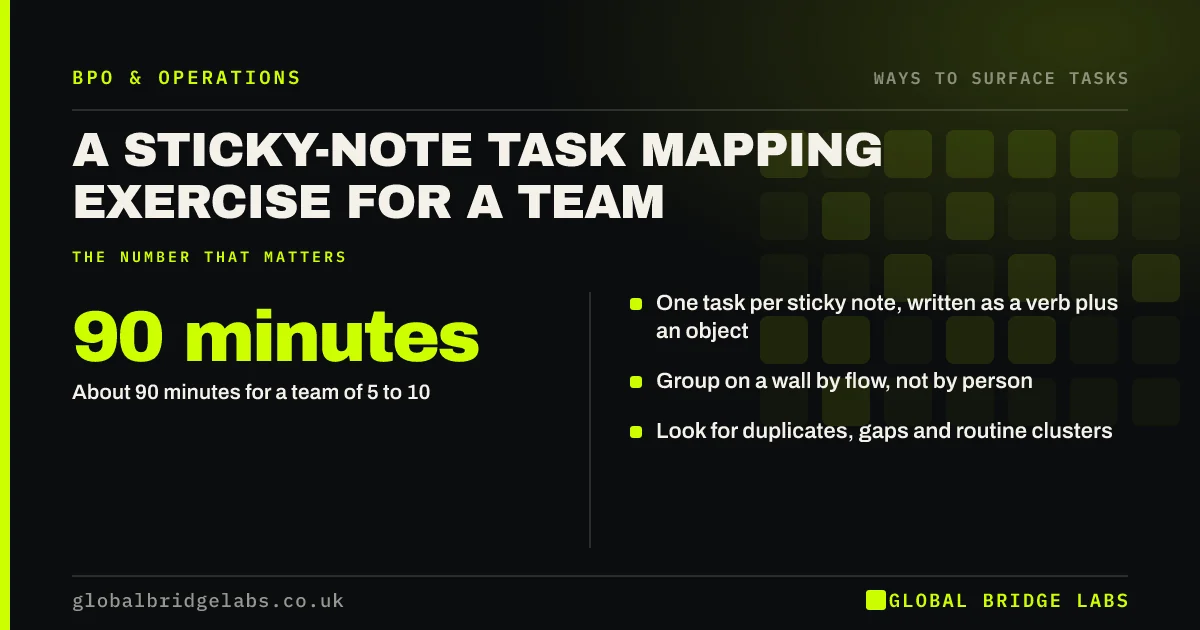
A task mapping exercise for a team gets everyone to write their recurring tasks on sticky notes, one per note, then group them on a wall by flow, such as order to cash. In 90 minutes the team sees duplicates (two people doing the same task), gaps (tasks nobody owns) and clusters of routine work that could move together.
- One task per sticky note, written as a verb plus an object.
- Group on a wall by flow, not by person.
- Look for duplicates, gaps and routine clusters.
- About 90 minutes for a team of 5 to 10.
Want a facilitation guide for the session? Message us on WhatsApp.
Chat on WhatsApp →Why map tasks as a team?
Because individual lists hide overlaps. When each person lists alone, nobody sees that three of them build the same weekly figures or that nobody updates supplier details. On a wall, grouped by flow, duplicates and gaps are obvious, and the team agrees the picture together, which helps later when work moves.
How do you run the session?
Prepare the flows in advance and keep the pace brisk.
- 1. Put four to six flow headings on the wall.
- 2. Give everyone 20 minutes to write tasks, one per note.
- 3. Each person places notes under the right flow.
- 4. Group identical tasks and mark duplicates.
- 5. Mark routine clusters and gaps with different colours.
What should you do with the wall?
Photograph it, type it into your long list and add frequency and minutes for each task. Fix duplicates first, because two people doing the same work is pure waste. Assign gaps an owner. Then screen the routine clusters against the six signals; they often form ready-made blocks to hand over.
What does this look like in practice?
A pattern we see: a team's wall of notes shows duplicated tasks, including two people reconciling the same supplier account, a few tasks nobody owns, and a cluster of routine order tasks that could move together as one block.
Task mapping checklist
- Prepare flow headings before the session.
- One task per note, verb plus object.
- Group by flow and mark duplicates.
- Mark gaps and routine clusters.
- Type the wall into the long list the same day.
Next step
Book 90 minutes with your team, buy a pack of sticky notes and pick four flows. The wall will do most of the analysis for you.
Message us on WhatsApp for the session guide, or book a 30-minute consultation.
Chat on WhatsApp →Sources and further reading
- Value Stream Mapping Overview · Lean Enterprise Institute
- User research · GOV.UK Service Manual
Frequently asked questions
How do you run a task mapping exercise?
Put flow headings such as order to cash on a wall, give everyone 20 minutes to write recurring tasks on sticky notes, one per note, then place and group them. Mark duplicates, gaps and routine clusters, photograph the wall and type it into a task list.
Can task mapping be done remotely?
Yes, with an online whiteboard. Prepare the flow headings, give everyone a colour of digital note and follow the same steps. Keep the session shorter, around an hour, and ask people to write their notes beforehand to save time.
What do you do about duplicated tasks?
Fix them first. Agree who owns the task, stop the duplicate, and update the process so it does not creep back. Two people doing the same work is waste whether or not you outsource, and removing it makes the remaining work cleaner to hand over.
Written by

Global Bridge Labs (GBL) is a UK–Sri Lanka partner for social media, websites and BPO. Everything here comes from client delivery, not theory.